Mathematical fidelity: These page images preserve the exact notation and visual layout of the supplied PDF. The optional text extract below is for searching/copying only and may contain transcription errors.
Original pages — equations and symbols preserved
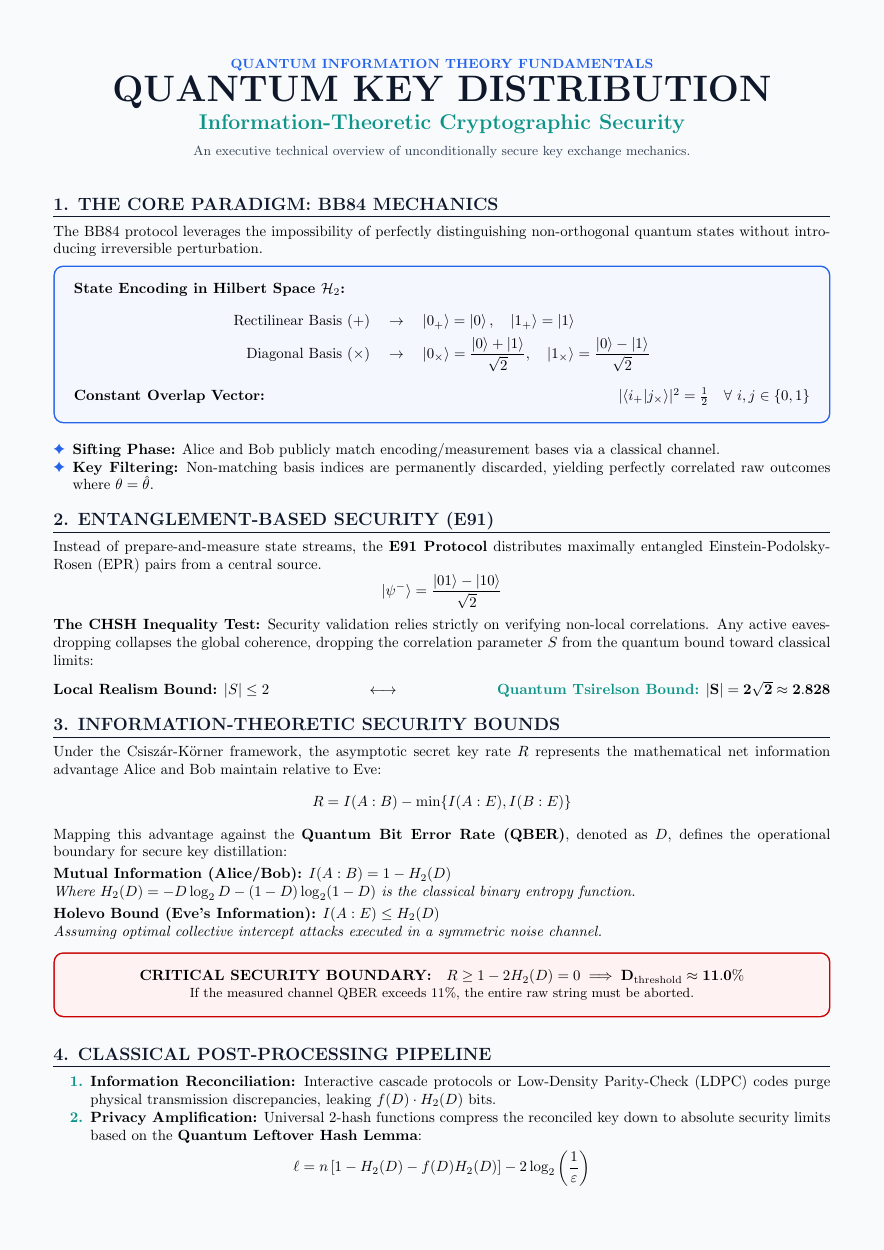
Show extracted text (searchable; equations may be imperfect)
Extract · PDF page 1
QUANTUM INFORMATION THEORY FUNDAMENTALS
QUANTUM KEY DISTRIBUTION
Information-Theoretic Cryptographic Security
An executive technical overview of unconditionally secure key exchange mechanics.
Extract · PDF page 1
1. THE CORE PARADIGM: BB84 MECHANICS
The BB84 protocol leverages the impossibility of perfectly distinguishing non-orthogonal quantum states without intro-
ducing irreversible perturbation.
State Encoding in Hilbert Space H2:
Rectilinear Basis (+) → |0+⟩= |0⟩, |1+⟩= |1⟩
|0⟩+ |1⟩ |0⟩−|1⟩
Diagonal Basis (×) → |0×⟩= √ , |1×⟩= √
2 2
Constant Overlap Vector: |⟨i+|j×⟩|2 = 21 ∀i, j ∈{0, 1}
✦Sifting Phase: Alice and Bob publicly match encoding/measurement bases via a classical channel.
✦Key Filtering: Non-matching basis indices are permanently discarded, yielding perfectly correlated raw outcomes
where θ = ˆθ.
Extract · PDF page 1
2. ENTANGLEMENT-BASED SECURITY (E91)
Instead of prepare-and-measure state streams, the E91 Protocol distributes maximally entangled Einstein-Podolsky-
Rosen (EPR) pairs from a central source.
|01⟩−|10⟩
|ψ−⟩= √
2
The CHSH Inequality Test: Security validation relies strictly on verifying non-local correlations. Any active eaves-
dropping collapses the global coherence, dropping the correlation parameter S from the quantum bound toward classical
limits:
√
Local Realism Bound: |S| ≤2 ←→ Quantum Tsirelson Bound: |S| = 2 2 ≈2.828
Extract · PDF page 1
3. INFORMATION-THEORETIC SECURITY BOUNDS
Under the Csisz´ar-K¨orner framework, the asymptotic secret key rate R represents the mathematical net information
advantage Alice and Bob maintain relative to Eve:
R = I(A : B) −min{I(A : E), I(B : E)}
Mapping this advantage against the Quantum Bit Error Rate (QBER), denoted as D, defines the operational
boundary for secure key distillation:
Mutual Information (Alice/Bob): I(A : B) = 1 −H2(D)
Where H2(D) = −D log2 D −(1 −D) log2(1 −D) is the classical binary entropy function.
Holevo Bound (Eve’s Information): I(A : E) ≤H2(D)
Assuming optimal collective intercept attacks executed in a symmetric noise channel.
CRITICAL SECURITY BOUNDARY: R ≥1 −2H2(D) = 0 =⇒Dthreshold ≈11.0%
If the measured channel QBER exceeds 11%, the entire raw string must be aborted.
Extract · PDF page 1
4. CLASSICAL POST-PROCESSING PIPELINE
1. Information Reconciliation: Interactive cascade protocols or Low-Density Parity-Check (LDPC) codes purge
physical transmission discrepancies, leaking f(D) · H2(D) bits.
2. Privacy Amplification: Universal 2-hash functions compress the reconciled key down to absolute security limits
based on the Quantum Leftover Hash Lemma:
1
ℓ= n [1 −H2(D) −f(D)H2(D)] −2 log2
ε