Mathematical fidelity: These page images preserve the exact notation and visual layout of the supplied PDF. The optional text extract below is for searching/copying only and may contain transcription errors.
Original pages — equations and symbols preserved
Show extracted text (searchable; equations may be imperfect)
Extract · PDF page 1
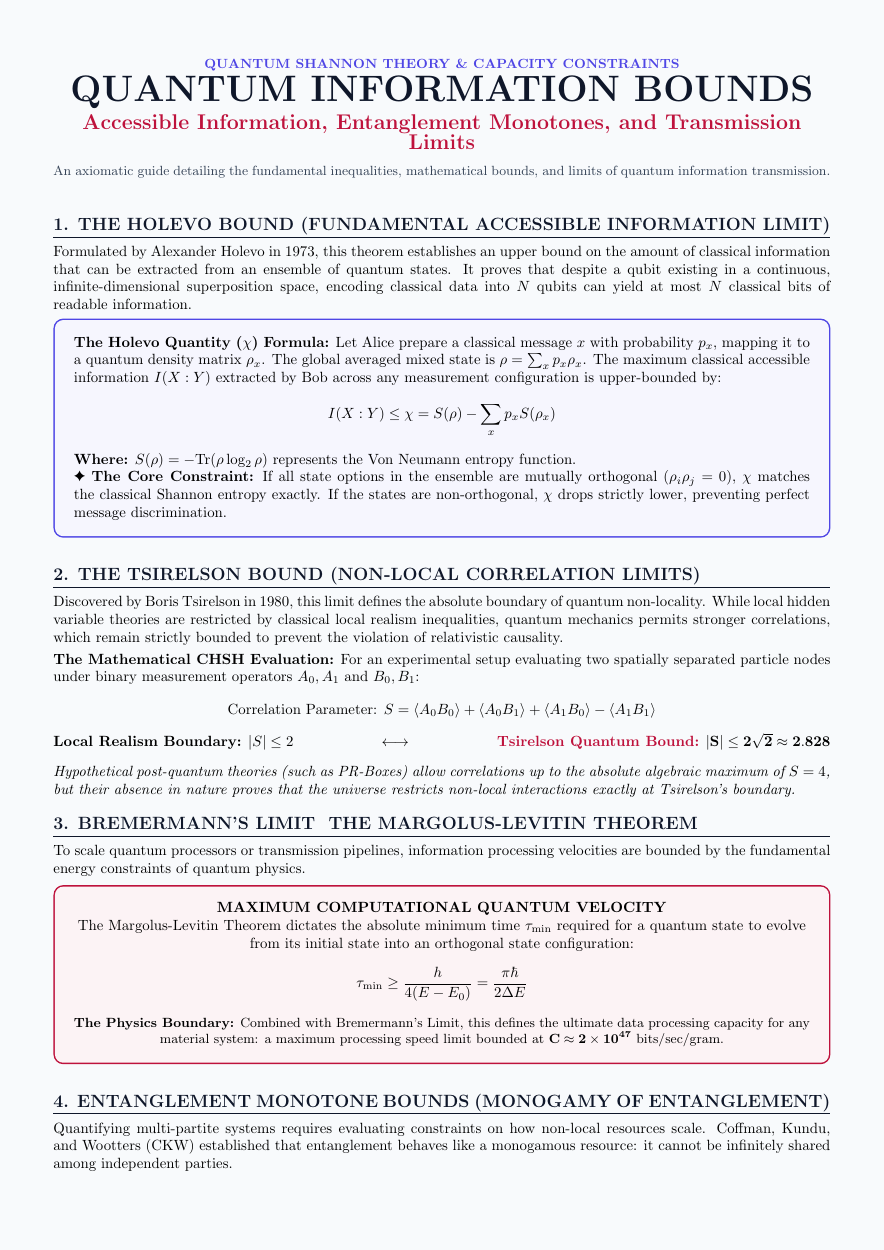
QUANTUM SHANNON THEORY & CAPACITY CONSTRAINTS
QUANTUM INFORMATION BOUNDS
Accessible Information, Entanglement Monotones, and Transmission
Limits
An axiomatic guide detailing the fundamental inequalities, mathematical bounds, and limits of quantum information transmission.
Extract · PDF page 1
1. THE HOLEVO BOUND (FUNDAMENTAL ACCESSIBLE INFORMATION LIMIT)
Formulated by Alexander Holevo in 1973, this theorem establishes an upper bound on the amount of classical information
that can be extracted from an ensemble of quantum states. It proves that despite a qubit existing in a continuous,
infinite-dimensional superposition space, encoding classical data into N qubits can yield at most N classical bits of
readable information.
The Holevo Quantity (χ) Formula: Let Alice prepare a classical message x with probability px, mapping it to
a quantum density matrix ρx. The global averaged mixed state is ρ = Px pxρx. The maximum classical accessible
information I(X : Y ) extracted by Bob across any measurement configuration is upper-bounded by:
I(X : Y ) ≤χ = S(ρ) − X pxS(ρx)
x
Where: S(ρ) = −Tr(ρ log2 ρ) represents the Von Neumann entropy function.
✦The Core Constraint: If all state options in the ensemble are mutually orthogonal (ρiρj = 0), χ matches
the classical Shannon entropy exactly. If the states are non-orthogonal, χ drops strictly lower, preventing perfect
message discrimination.
Extract · PDF page 1
2. THE TSIRELSON BOUND (NON-LOCAL CORRELATION LIMITS)
Discovered by Boris Tsirelson in 1980, this limit defines the absolute boundary of quantum non-locality. While local hidden
variable theories are restricted by classical local realism inequalities, quantum mechanics permits stronger correlations,
which remain strictly bounded to prevent the violation of relativistic causality.
The Mathematical CHSH Evaluation: For an experimental setup evaluating two spatially separated particle nodes
under binary measurement operators A0, A1 and B0, B1:
Correlation Parameter: S = ⟨A0B0⟩+ ⟨A0B1⟩+ ⟨A1B0⟩−⟨A1B1⟩
√
Local Realism Boundary: |S| ≤2 ←→ Tsirelson Quantum Bound: |S| ≤2 2 ≈2.828
Hypothetical post-quantum theories (such as PR-Boxes) allow correlations up to the absolute algebraic maximum of S = 4,
but their absence in nature proves that the universe restricts non-local interactions exactly at Tsirelson’s boundary.
Extract · PDF page 1
3. BREMERMANN’S LIMIT THE MARGOLUS-LEVITIN THEOREM
To scale quantum processors or transmission pipelines, information processing velocities are bounded by the fundamental
energy constraints of quantum physics.
MAXIMUM COMPUTATIONAL QUANTUM VELOCITY
The Margolus-Levitin Theorem dictates the absolute minimum time τmin required for a quantum state to evolve
from its initial state into an orthogonal state configuration:
h πℏ
τmin ≥ =
4(E −E0) 2∆E
The Physics Boundary: Combined with Bremermann’s Limit, this defines the ultimate data processing capacity for any
material system: a maximum processing speed limit bounded at C ≈2 × 1047 bits/sec/gram.
Extract · PDF page 1
4. ENTANGLEMENT MONOTONE BOUNDS (MONOGAMY OF ENTANGLEMENT)
Quantifying multi-partite systems requires evaluating constraints on how non-local resources scale. Coffman, Kundu,
and Wootters (CKW) established that entanglement behaves like a monogamous resource: it cannot be infinitely shared
among independent parties.
Extract · PDF page 2
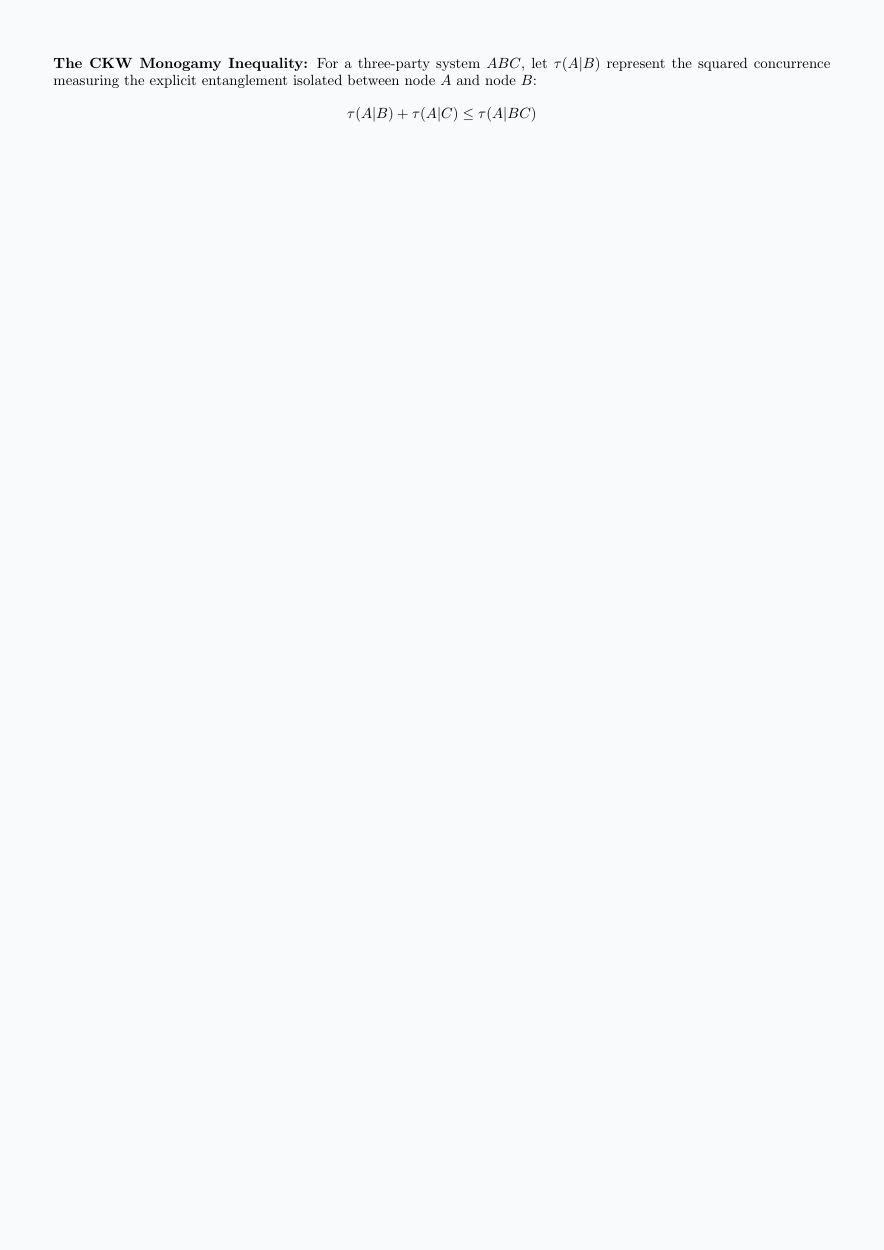
The CKW Monogamy Inequality: For a three-party system ABC, let τ(A|B) represent the squared concurrence
measuring the explicit entanglement isolated between node A and node B:
τ(A|B) + τ(A|C) ≤τ(A|BC)