Mathematical fidelity: These page images preserve the exact notation and visual layout of the supplied PDF. The optional text extract below is for searching/copying only and may contain transcription errors.
Original pages — equations and symbols preserved
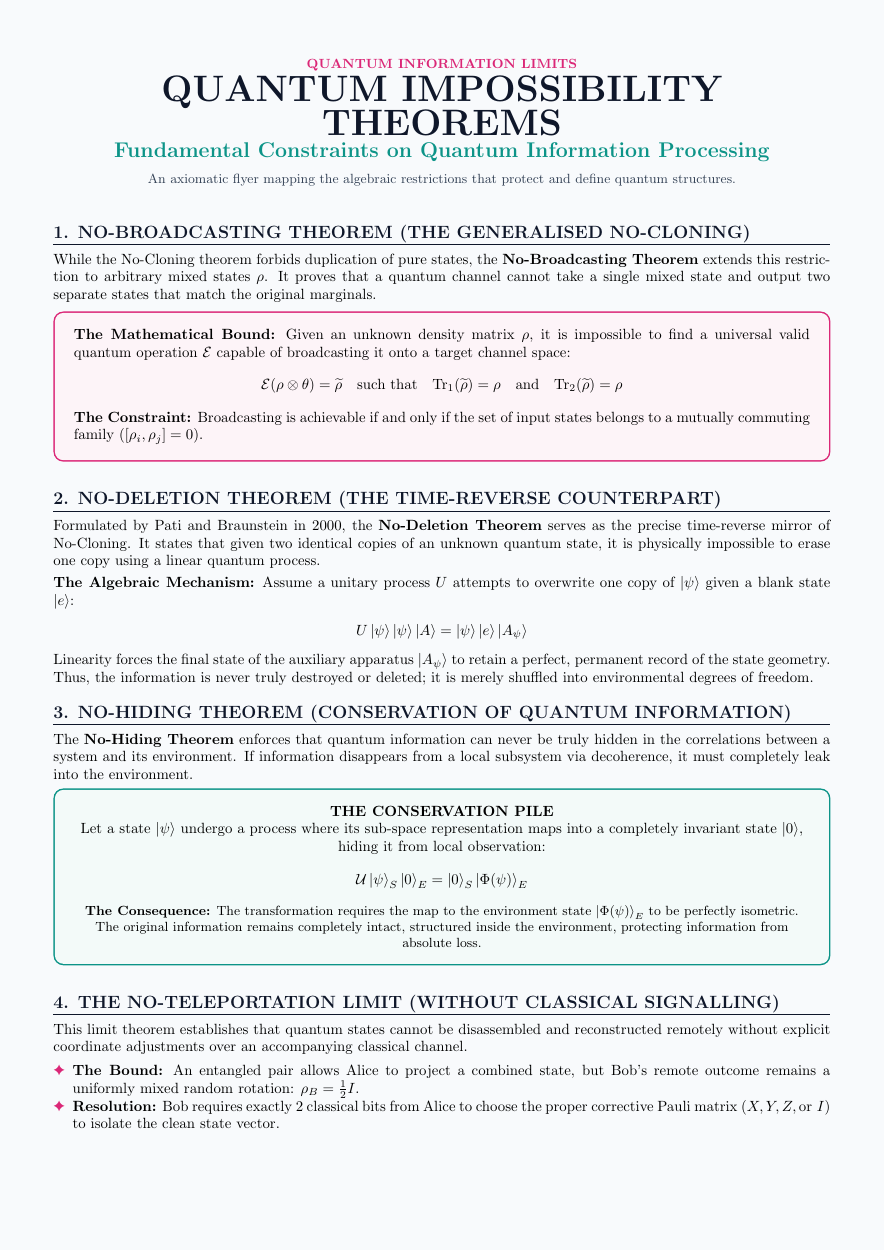
Show extracted text (searchable; equations may be imperfect)
Extract · PDF page 1
QUANTUM INFORMATION LIMITS
QUANTUM IMPOSSIBILITY
THEOREMS
Fundamental Constraints on Quantum Information Processing
An axiomatic flyer mapping the algebraic restrictions that protect and define quantum structures.
Extract · PDF page 1
1. NO-BROADCASTING THEOREM (THE GENERALISED NO-CLONING)
While the No-Cloning theorem forbids duplication of pure states, the No-Broadcasting Theorem extends this restric-
tion to arbitrary mixed states ρ. It proves that a quantum channel cannot take a single mixed state and output two
separate states that match the original marginals.
The Mathematical Bound: Given an unknown density matrix ρ, it is impossible to find a universal valid
quantum operation E capable of broadcasting it onto a target channel space:
E(ρ ⊗θ) = eρ such that Tr1(eρ) = ρ and Tr2(eρ) = ρ
The Constraint: Broadcasting is achievable if and only if the set of input states belongs to a mutually commuting
family ([ρi, ρj] = 0).
Extract · PDF page 1
2. NO-DELETION THEOREM (THE TIME-REVERSE COUNTERPART)
Formulated by Pati and Braunstein in 2000, the No-Deletion Theorem serves as the precise time-reverse mirror of
No-Cloning. It states that given two identical copies of an unknown quantum state, it is physically impossible to erase
one copy using a linear quantum process.
The Algebraic Mechanism: Assume a unitary process U attempts to overwrite one copy of |ψ⟩given a blank state
|e⟩:
U |ψ⟩|ψ⟩|A⟩= |ψ⟩|e⟩|Aψ⟩
Linearity forces the final state of the auxiliary apparatus |Aψ⟩to retain a perfect, permanent record of the state geometry.
Thus, the information is never truly destroyed or deleted; it is merely shuffled into environmental degrees of freedom.
Extract · PDF page 1
3. NO-HIDING THEOREM (CONSERVATION OF QUANTUM INFORMATION)
The No-Hiding Theorem enforces that quantum information can never be truly hidden in the correlations between a
system and its environment. If information disappears from a local subsystem via decoherence, it must completely leak
into the environment.
THE CONSERVATION PILE
Let a state |ψ⟩undergo a process where its sub-space representation maps into a completely invariant state |0⟩,
hiding it from local observation:
U |ψ⟩S |0⟩E = |0⟩S |Φ(ψ)⟩E
The Consequence: The transformation requires the map to the environment state |Φ(ψ)⟩E to be perfectly isometric.
The original information remains completely intact, structured inside the environment, protecting information from
absolute loss.
Extract · PDF page 1
4. THE NO-TELEPORTATION LIMIT (WITHOUT CLASSICAL SIGNALLING)
This limit theorem establishes that quantum states cannot be disassembled and reconstructed remotely without explicit
coordinate adjustments over an accompanying classical channel.
✦The Bound: An entangled pair allows Alice to project a combined state, but Bob’s remote outcome remains a
uniformly mixed random rotation: ρB = 12I.
✦Resolution: Bob requires exactly 2 classical bits from Alice to choose the proper corrective Pauli matrix (X, Y, Z, or I)
to isolate the clean state vector.