Mathematical fidelity: These page images preserve the exact notation and visual layout of the supplied PDF. The optional text extract below is for searching/copying only and may contain transcription errors.
Original pages — equations and symbols preserved
Show extracted text (searchable; equations may be imperfect)
Extract · PDF page 1
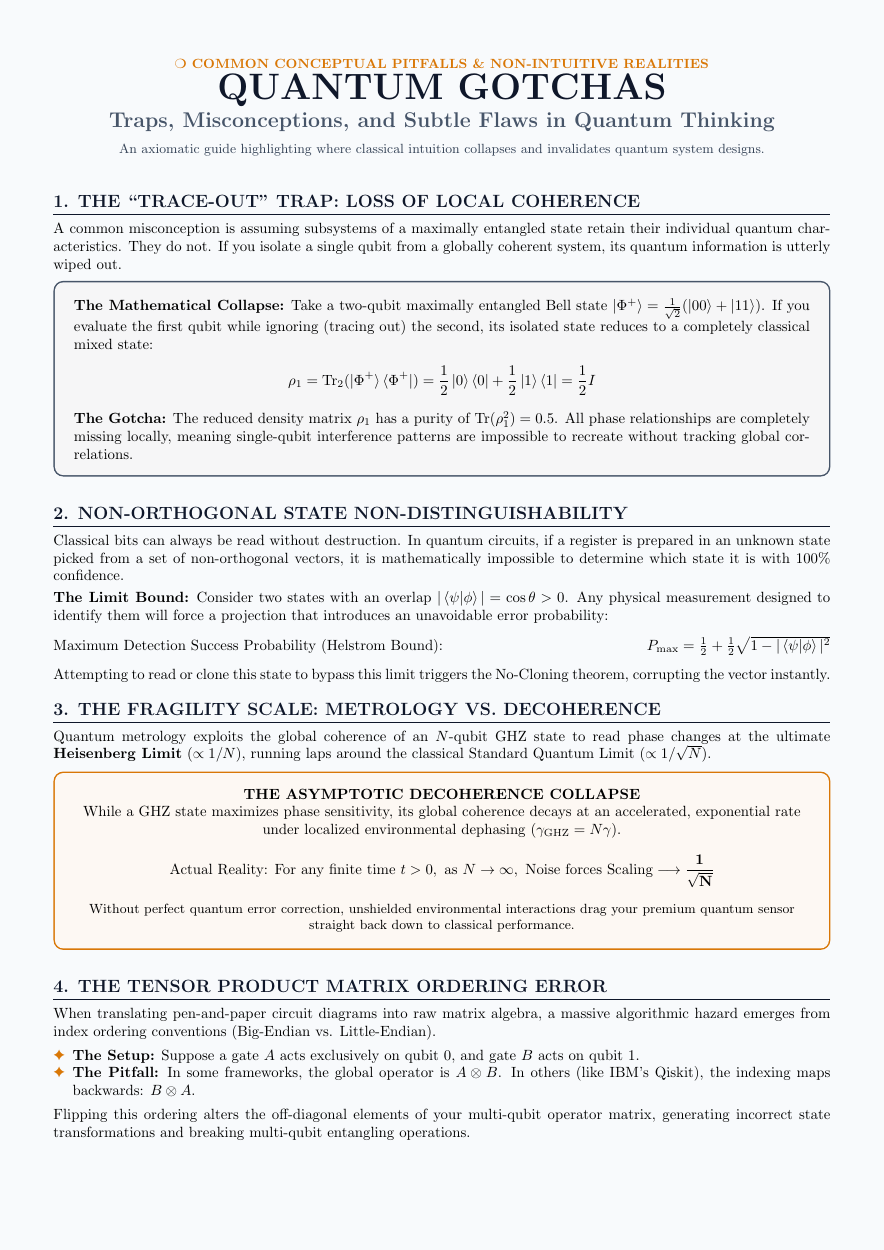
❍COMMON CONCEPTUAL PITFALLS & NON-INTUITIVE REALITIES
QUANTUM GOTCHAS
Traps, Misconceptions, and Subtle Flaws in Quantum Thinking
An axiomatic guide highlighting where classical intuition collapses and invalidates quantum system designs.
Extract · PDF page 1
1. THE “TRACE-OUT” TRAP: LOSS OF LOCAL COHERENCE
A common misconception is assuming subsystems of a maximally entangled state retain their individual quantum char-
acteristics. They do not. If you isolate a single qubit from a globally coherent system, its quantum information is utterly
wiped out.
The Mathematical Collapse: Take a two-qubit maximally entangled Bell state |Φ+⟩= √12(|00⟩+ |11⟩). If you
evaluate the first qubit while ignoring (tracing out) the second, its isolated state reduces to a completely classical
mixed state:
1 1 1
ρ1 = Tr2(|Φ+⟩⟨Φ+|) = |0⟩⟨0| + |1⟩⟨1| = 2 2 2I
The Gotcha: The reduced density matrix ρ1 has a purity of Tr(ρ21) = 0.5. All phase relationships are completely
missing locally, meaning single-qubit interference patterns are impossible to recreate without tracking global cor-
relations.
Extract · PDF page 1
2. NON-ORTHOGONAL STATE NON-DISTINGUISHABILITY
Classical bits can always be read without destruction. In quantum circuits, if a register is prepared in an unknown state
picked from a set of non-orthogonal vectors, it is mathematically impossible to determine which state it is with 100%
confidence.
The Limit Bound: Consider two states with an overlap | ⟨ψ|ϕ⟩| = cos θ > 0. Any physical measurement designed to
identify them will force a projection that introduces an unavoidable error probability:
Maximum Detection Success Probability (Helstrom Bound): Pmax = 12 + 12 p 1 −| ⟨ψ|ϕ⟩|2
Attempting to read or clone this state to bypass this limit triggers the No-Cloning theorem, corrupting the vector instantly.
Extract · PDF page 1
3. THE FRAGILITY SCALE: METROLOGY VS. DECOHERENCE
Quantum metrology exploits the global coherence of an N-qubit GHZ state to read phase changes at the ultimate √
Heisenberg Limit (∝1/N), running laps around the classical Standard Quantum Limit (∝1/ N).
THE ASYMPTOTIC DECOHERENCE COLLAPSE
While a GHZ state maximizes phase sensitivity, its global coherence decays at an accelerated, exponential rate
under localized environmental dephasing (γGHZ = Nγ).
1
Actual Reality: For any finite time t > 0, as N →∞, Noise forces Scaling −→ √
N
Without perfect quantum error correction, unshielded environmental interactions drag your premium quantum sensor
straight back down to classical performance.
Extract · PDF page 1
4. THE TENSOR PRODUCT MATRIX ORDERING ERROR
When translating pen-and-paper circuit diagrams into raw matrix algebra, a massive algorithmic hazard emerges from
index ordering conventions (Big-Endian vs. Little-Endian).
✦The Setup: Suppose a gate A acts exclusively on qubit 0, and gate B acts on qubit 1.
✦The Pitfall: In some frameworks, the global operator is A ⊗B. In others (like IBM’s Qiskit), the indexing maps
backwards: B ⊗A.
Flipping this ordering alters the off-diagonal elements of your multi-qubit operator matrix, generating incorrect state
transformations and breaking multi-qubit entangling operations.