Mathematical fidelity: These page images preserve the exact notation and visual layout of the supplied PDF. The optional text extract below is for searching/copying only and may contain transcription errors.
Original pages — equations and symbols preserved
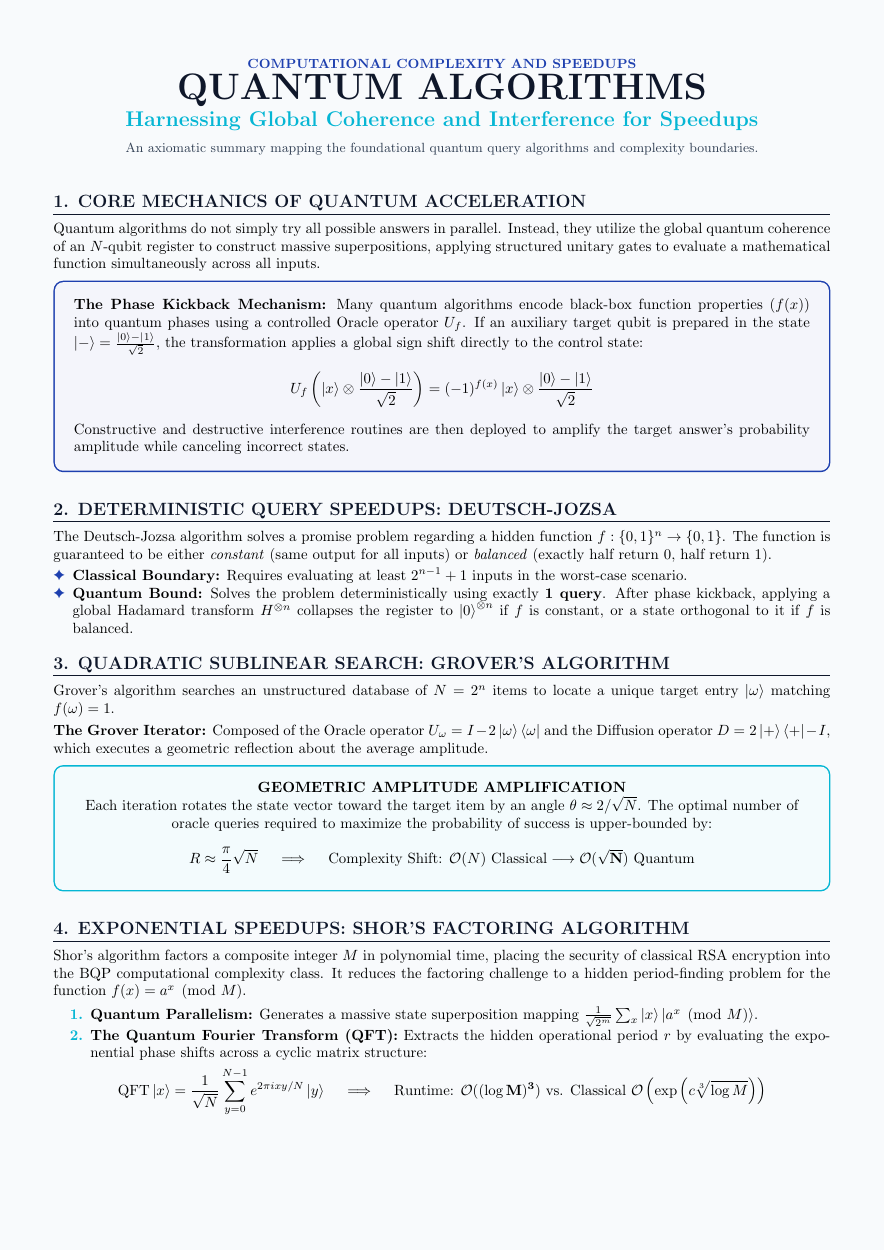
Show extracted text (searchable; equations may be imperfect)
Extract · PDF page 1
COMPUTATIONAL COMPLEXITY AND SPEEDUPS
QUANTUM ALGORITHMS
Harnessing Global Coherence and Interference for Speedups
An axiomatic summary mapping the foundational quantum query algorithms and complexity boundaries.
Extract · PDF page 1
1. CORE MECHANICS OF QUANTUM ACCELERATION
Quantum algorithms do not simply try all possible answers in parallel. Instead, they utilize the global quantum coherence
of an N-qubit register to construct massive superpositions, applying structured unitary gates to evaluate a mathematical
function simultaneously across all inputs.
The Phase Kickback Mechanism: Many quantum algorithms encode black-box function properties (f(x))
into quantum phases using a controlled Oracle operator Uf. If an auxiliary target qubit is prepared in the state
|−⟩= |0⟩−|1⟩√ , the transformation applies a global sign shift directly to the control state:
2
Uf |x⟩⊗|0⟩−|1⟩√ = (−1)f(x) |x⟩⊗|0⟩−|1⟩√
2 2
Constructive and destructive interference routines are then deployed to amplify the target answer’s probability
amplitude while canceling incorrect states.
Extract · PDF page 1
2. DETERMINISTIC QUERY SPEEDUPS: DEUTSCH-JOZSA
The Deutsch-Jozsa algorithm solves a promise problem regarding a hidden function f : {0, 1}n →{0, 1}. The function is
guaranteed to be either constant (same output for all inputs) or balanced (exactly half return 0, half return 1).
✦Classical Boundary: Requires evaluating at least 2n−1 + 1 inputs in the worst-case scenario.
✦Quantum Bound: Solves the problem deterministically using exactly 1 query. After phase kickback, applying a
global Hadamard transform H⊗n collapses the register to |0⟩⊗n if f is constant, or a state orthogonal to it if f is
balanced.
Extract · PDF page 1
3. QUADRATIC SUBLINEAR SEARCH: GROVER’S ALGORITHM
Grover’s algorithm searches an unstructured database of N = 2n items to locate a unique target entry |ω⟩matching
f(ω) = 1.
The Grover Iterator: Composed of the Oracle operator Uω = I −2 |ω⟩⟨ω| and the Diffusion operator D = 2 |+⟩⟨+|−I,
which executes a geometric reflection about the average amplitude.
GEOMETRIC AMPLITUDE AMPLIFICATION √
Each iteration rotates the state vector toward the target item by an angle θ ≈2/ N. The optimal number of
oracle queries required to maximize the probability of success is upper-bounded by:
R ≈π √ N =⇒ Complexity Shift: O(N) Classical −→O(√ N) Quantum
4
Extract · PDF page 1
4. EXPONENTIAL SPEEDUPS: SHOR’S FACTORING ALGORITHM
Shor’s algorithm factors a composite integer M in polynomial time, placing the security of classical RSA encryption into
the BQP computational complexity class. It reduces the factoring challenge to a hidden period-finding problem for the
function f(x) = ax (mod M).
Extract · PDF page 1
1. Quantum Parallelism: Generates a massive state superposition mapping √ 1 Px |x⟩|ax (mod M)⟩. 2m
Extract · PDF page 1
2. The Quantum Fourier Transform (QFT): Extracts the hidden operational period r by evaluating the expo-
nential phase shifts across a cyclic matrix structure:
N−1
1
QFT |x⟩= √ X e2πixy/N |y⟩ =⇒ Runtime: O((log M)3) vs. Classical O exp c 3p log M
N y=0