Mathematical fidelity: These page images preserve the exact notation and visual layout of the supplied PDF. The optional text extract below is for searching/copying only and may contain transcription errors.
Original pages — equations and symbols preserved

Show extracted text (searchable; equations may be imperfect)
Extract · PDF page 1
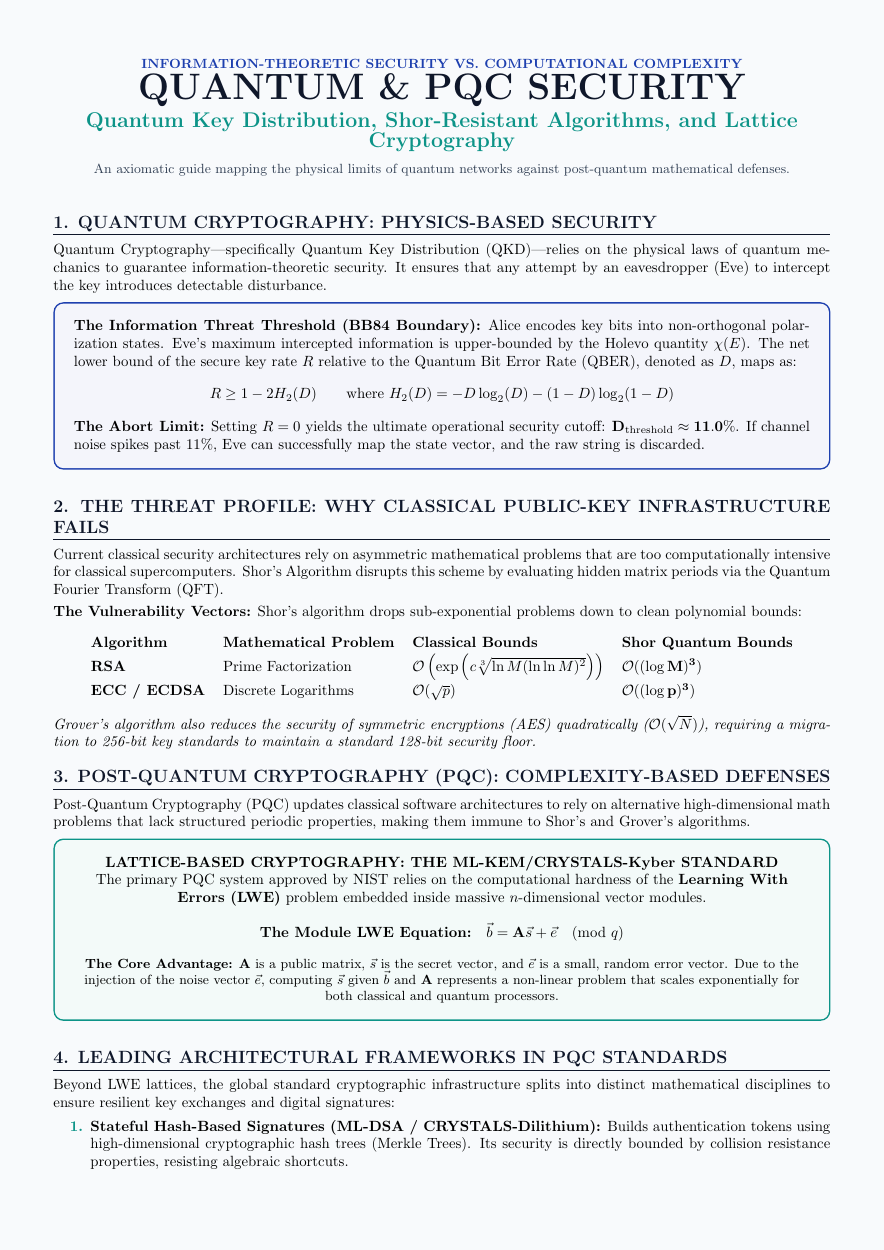
INFORMATION-THEORETIC SECURITY VS. COMPUTATIONAL COMPLEXITY
QUANTUM & PQC SECURITY
Quantum Key Distribution, Shor-Resistant Algorithms, and Lattice
Cryptography
An axiomatic guide mapping the physical limits of quantum networks against post-quantum mathematical defenses.
Extract · PDF page 1
1. QUANTUM CRYPTOGRAPHY: PHYSICS-BASED SECURITY
Quantum Cryptography—specifically Quantum Key Distribution (QKD)—relies on the physical laws of quantum me-
chanics to guarantee information-theoretic security. It ensures that any attempt by an eavesdropper (Eve) to intercept
the key introduces detectable disturbance.
The Information Threat Threshold (BB84 Boundary): Alice encodes key bits into non-orthogonal polar-
ization states. Eve’s maximum intercepted information is upper-bounded by the Holevo quantity χ(E). The net
lower bound of the secure key rate R relative to the Quantum Bit Error Rate (QBER), denoted as D, maps as:
R ≥1 −2H2(D) where H2(D) = −D log2(D) −(1 −D) log2(1 −D)
The Abort Limit: Setting R = 0 yields the ultimate operational security cutoff: Dthreshold ≈11.0%. If channel
noise spikes past 11%, Eve can successfully map the state vector, and the raw string is discarded.
Extract · PDF page 1
2. THE THREAT PROFILE: WHY CLASSICAL PUBLIC-KEY INFRASTRUCTURE
FAILS
Current classical security architectures rely on asymmetric mathematical problems that are too computationally intensive
for classical supercomputers. Shor’s Algorithm disrupts this scheme by evaluating hidden matrix periods via the Quantum
Fourier Transform (QFT).
The Vulnerability Vectors: Shor’s algorithm drops sub-exponential problems down to clean polynomial bounds:
Algorithm Mathematical Problem Classical Bounds Shor Quantum Bounds
RSA Prime Factorization O exp c 3pln M(ln ln M)2 O((log M)3)
ECC / ECDSA Discrete Logarithms O(√p) O((log p)3)
√
Grover’s algorithm also reduces the security of symmetric encryptions (AES) quadratically (O( N)), requiring a migra-
tion to 256-bit key standards to maintain a standard 128-bit security floor.
Extract · PDF page 1
3. POST-QUANTUM CRYPTOGRAPHY (PQC): COMPLEXITY-BASED DEFENSES
Post-Quantum Cryptography (PQC) updates classical software architectures to rely on alternative high-dimensional math
problems that lack structured periodic properties, making them immune to Shor’s and Grover’s algorithms.
LATTICE-BASED CRYPTOGRAPHY: THE ML-KEM/CRYSTALS-Kyber STANDARD
The primary PQC system approved by NIST relies on the computational hardness of the Learning With
Errors (LWE) problem embedded inside massive n-dimensional vector modules.
The Module LWE Equation: ⃗b = A⃗s + ⃗e (mod q)
The Core Advantage: A is a public matrix, ⃗s is the secret vector, and ⃗e is a small, random error vector. Due to the
injection of the noise vector ⃗e, computing ⃗s given ⃗b and A represents a non-linear problem that scales exponentially for
both classical and quantum processors.
Extract · PDF page 1
4. LEADING ARCHITECTURAL FRAMEWORKS IN PQC STANDARDS
Beyond LWE lattices, the global standard cryptographic infrastructure splits into distinct mathematical disciplines to
ensure resilient key exchanges and digital signatures:
Extract · PDF page 1
1. Stateful Hash-Based Signatures (ML-DSA / CRYSTALS-Dilithium): Builds authentication tokens using
high-dimensional cryptographic hash trees (Merkle Trees). Its security is directly bounded by collision resistance
properties, resisting algebraic shortcuts.
Extract · PDF page 2
2. Code-Based Cryptography (Classic McEliece): Encrypts text strings by masking information inside the
generator matrices of error-correcting codes (Goppa Codes), introducing random bit flips. Decoding the arbitrary
code remains an NP-hard permutation search challenge.
3. Multi-Variate Quadratic Equations: Protects validation protocols by mapping security keys to large systems
of non-linear multi-variate quadratic polynomials over finite fields, blocking linear matrix factorization routines.