Mathematical fidelity: These page images preserve the exact notation and visual layout of the supplied PDF. The optional text extract below is for searching/copying only and may contain transcription errors.
Original pages — equations and symbols preserved
Show extracted text (searchable; equations may be imperfect)
Extract · PDF page 1
DEGREES OF FREEDOM & MULTI-DIMENSIONAL PHOTONIC ENGINEERING
PHOTON ENTANGLEMENT TYPES
Polarization, Time-Energy, Orbital Angular Momentum, and
Hyperentanglement
An axiomatic mathematical guide mapping the explicit physical degrees of freedom used to distribute non-local quantum
resources.
Extract · PDF page 1
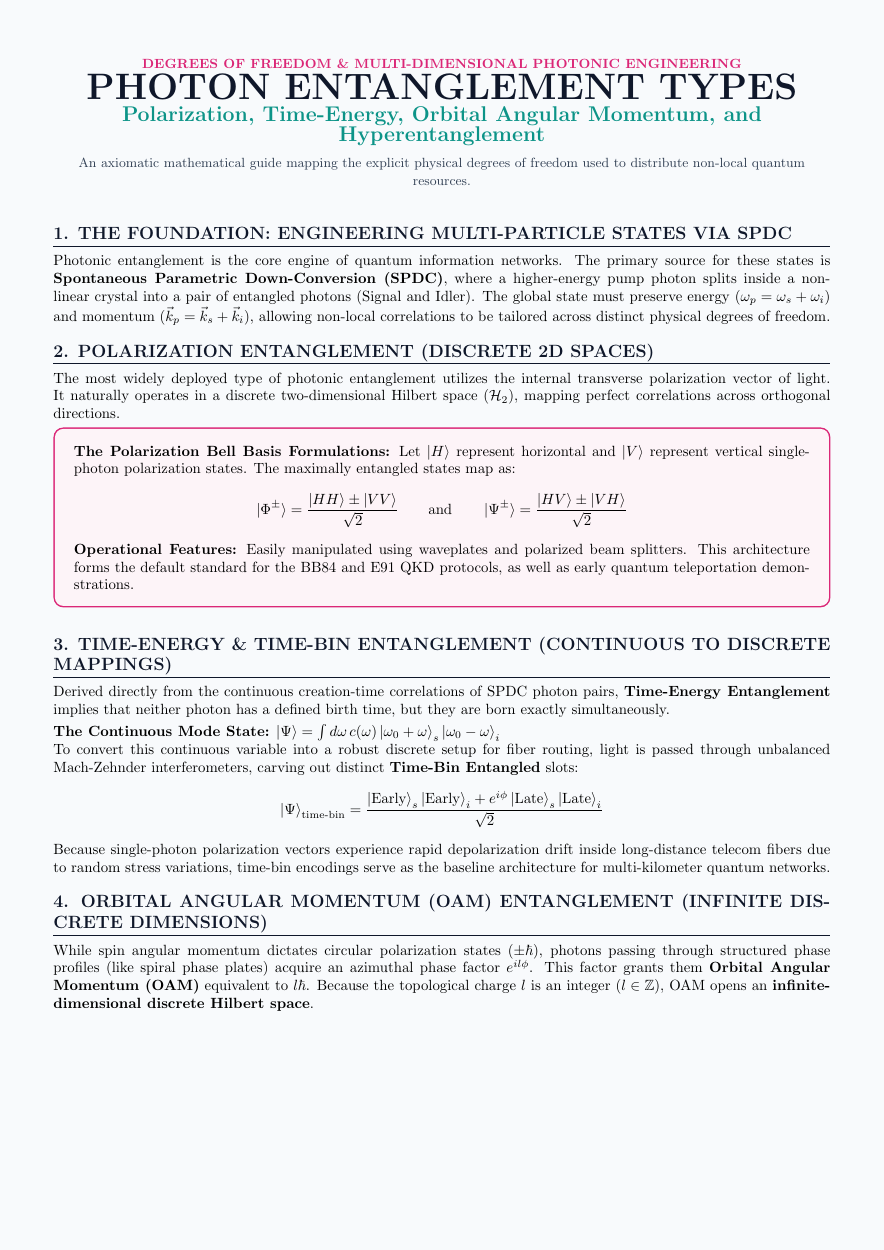
1. THE FOUNDATION: ENGINEERING MULTI-PARTICLE STATES VIA SPDC
Photonic entanglement is the core engine of quantum information networks. The primary source for these states is
Spontaneous Parametric Down-Conversion (SPDC), where a higher-energy pump photon splits inside a non-
linear crystal into a pair of entangled photons (Signal and Idler). The global state must preserve energy (ωp = ωs + ωi)
and momentum (⃗kp = ⃗ks + ⃗ki), allowing non-local correlations to be tailored across distinct physical degrees of freedom.
Extract · PDF page 1
2. POLARIZATION ENTANGLEMENT (DISCRETE 2D SPACES)
The most widely deployed type of photonic entanglement utilizes the internal transverse polarization vector of light.
It naturally operates in a discrete two-dimensional Hilbert space (H2), mapping perfect correlations across orthogonal
directions.
The Polarization Bell Basis Formulations: Let |H⟩represent horizontal and |V ⟩represent vertical single-
photon polarization states. The maximally entangled states map as:
|HH⟩± |V V ⟩ |HV ⟩± |V H⟩
|Φ±⟩= √ and |Ψ±⟩= √
2 2
Operational Features: Easily manipulated using waveplates and polarized beam splitters. This architecture
forms the default standard for the BB84 and E91 QKD protocols, as well as early quantum teleportation demon-
strations.
Extract · PDF page 1
3. TIME-ENERGY & TIME-BIN ENTANGLEMENT (CONTINUOUS TO DISCRETE
MAPPINGS)
Derived directly from the continuous creation-time correlations of SPDC photon pairs, Time-Energy Entanglement
implies that neither photon has a defined birth time, but they are born exactly simultaneously.
The Continuous Mode State: |Ψ⟩= R dω c(ω) |ω0 + ω⟩s |ω0 −ω⟩i
To convert this continuous variable into a robust discrete setup for fiber routing, light is passed through unbalanced
Mach-Zehnder interferometers, carving out distinct Time-Bin Entangled slots:
|Early⟩s |Early⟩i + eiϕ |Late⟩s |Late⟩i
|Ψ⟩time-bin = √
2
Because single-photon polarization vectors experience rapid depolarization drift inside long-distance telecom fibers due
to random stress variations, time-bin encodings serve as the baseline architecture for multi-kilometer quantum networks.
Extract · PDF page 1
4. ORBITAL ANGULAR MOMENTUM (OAM) ENTANGLEMENT (INFINITE DIS-
CRETE DIMENSIONS)
While spin angular momentum dictates circular polarization states (±ℏ), photons passing through structured phase
profiles (like spiral phase plates) acquire an azimuthal phase factor eilϕ. This factor grants them Orbital Angular
Momentum (OAM) equivalent to lℏ. Because the topological charge l is an integer (l ∈Z), OAM opens an infinite-
dimensional discrete Hilbert space.
Extract · PDF page 2
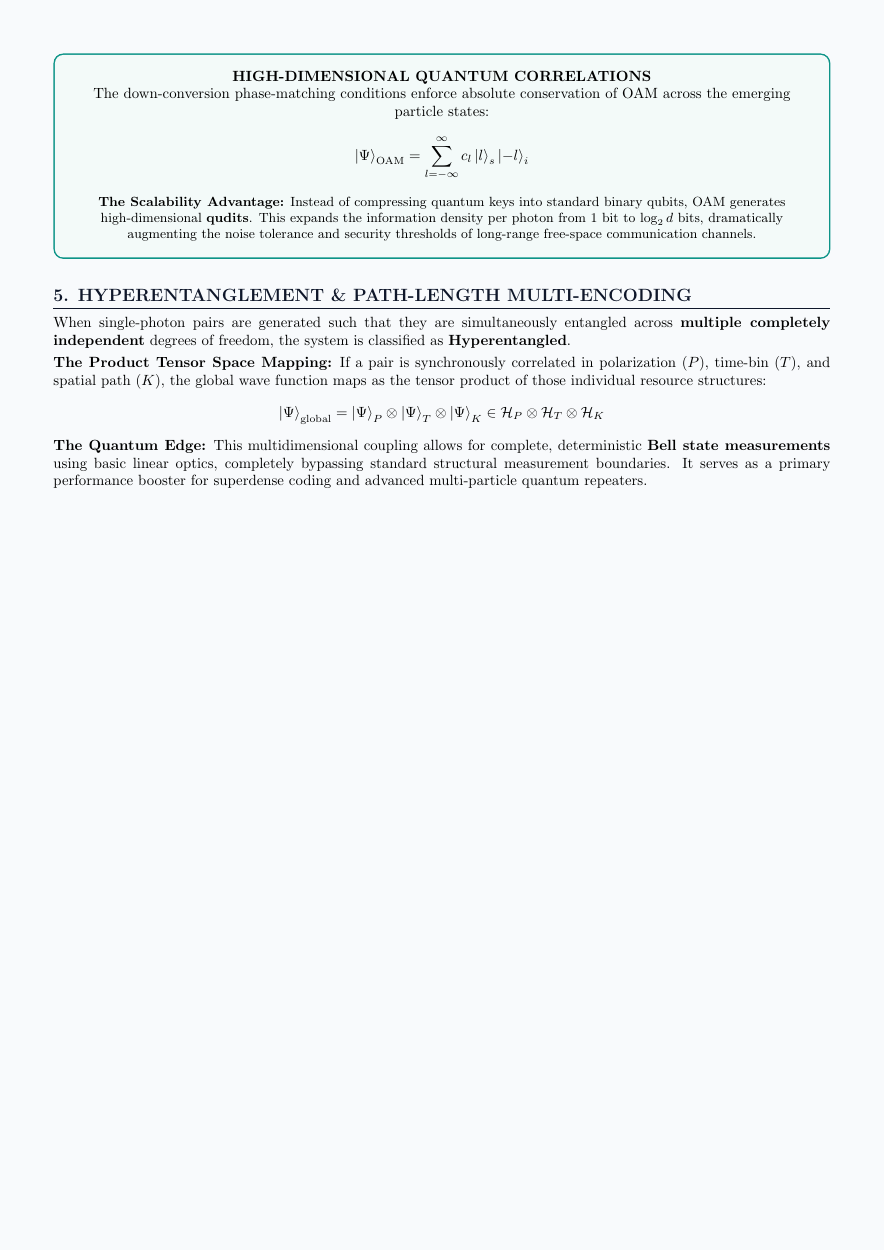
HIGH-DIMENSIONAL QUANTUM CORRELATIONS
The down-conversion phase-matching conditions enforce absolute conservation of OAM across the emerging
particle states:
∞
|Ψ⟩OAM = X cl |l⟩s |−l⟩i
l=−∞
The Scalability Advantage: Instead of compressing quantum keys into standard binary qubits, OAM generates
high-dimensional qudits. This expands the information density per photon from 1 bit to log2 d bits, dramatically
augmenting the noise tolerance and security thresholds of long-range free-space communication channels.
Extract · PDF page 2
5. HYPERENTANGLEMENT & PATH-LENGTH MULTI-ENCODING
When single-photon pairs are generated such that they are simultaneously entangled across multiple completely
independent degrees of freedom, the system is classified as Hyperentangled.
The Product Tensor Space Mapping: If a pair is synchronously correlated in polarization (P), time-bin (T), and
spatial path (K), the global wave function maps as the tensor product of those individual resource structures:
|Ψ⟩global = |Ψ⟩P ⊗|Ψ⟩T ⊗|Ψ⟩K ∈HP ⊗HT ⊗HK
The Quantum Edge: This multidimensional coupling allows for complete, deterministic Bell state measurements
using basic linear optics, completely bypassing standard structural measurement boundaries. It serves as a primary
performance booster for superdense coding and advanced multi-particle quantum repeaters.