Mathematical fidelity: These page images preserve the exact notation and visual layout of the supplied PDF. The optional text extract below is for searching/copying only and may contain transcription errors.
Original pages — equations and symbols preserved

Show extracted text (searchable; equations may be imperfect)
Extract · PDF page 1
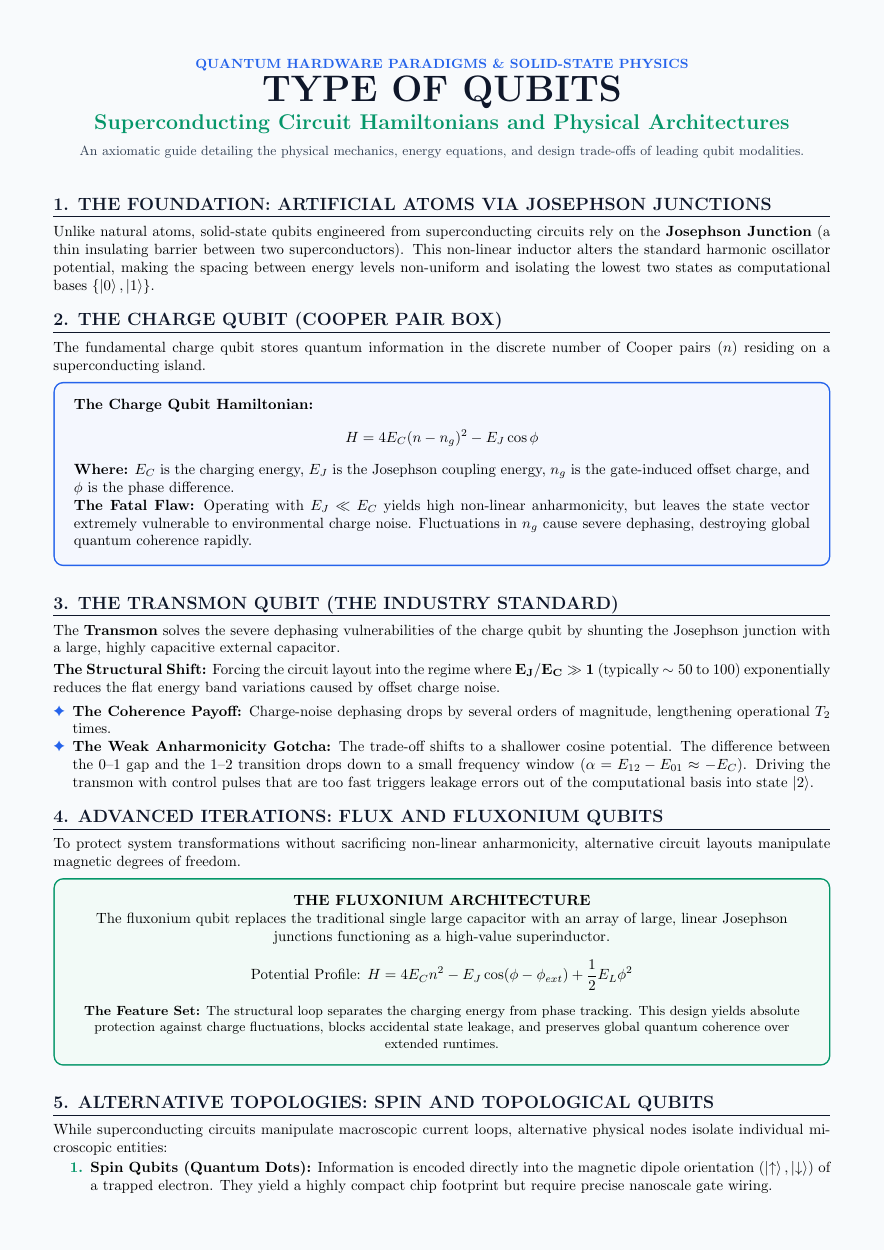
QUANTUM HARDWARE PARADIGMS & SOLID-STATE PHYSICS
TYPE OF QUBITS
Superconducting Circuit Hamiltonians and Physical Architectures
An axiomatic guide detailing the physical mechanics, energy equations, and design trade-offs of leading qubit modalities.
Extract · PDF page 1
1. THE FOUNDATION: ARTIFICIAL ATOMS VIA JOSEPHSON JUNCTIONS
Unlike natural atoms, solid-state qubits engineered from superconducting circuits rely on the Josephson Junction (a
thin insulating barrier between two superconductors). This non-linear inductor alters the standard harmonic oscillator
potential, making the spacing between energy levels non-uniform and isolating the lowest two states as computational
bases {|0⟩, |1⟩}.
Extract · PDF page 1
2. THE CHARGE QUBIT (COOPER PAIR BOX)
The fundamental charge qubit stores quantum information in the discrete number of Cooper pairs (n) residing on a
superconducting island.
The Charge Qubit Hamiltonian:
H = 4EC(n −ng)2 −EJ cos ϕ
Where: EC is the charging energy, EJ is the Josephson coupling energy, ng is the gate-induced offset charge, and
ϕ is the phase difference.
The Fatal Flaw: Operating with EJ ≪EC yields high non-linear anharmonicity, but leaves the state vector
extremely vulnerable to environmental charge noise. Fluctuations in ng cause severe dephasing, destroying global
quantum coherence rapidly.
Extract · PDF page 1
3. THE TRANSMON QUBIT (THE INDUSTRY STANDARD)
The Transmon solves the severe dephasing vulnerabilities of the charge qubit by shunting the Josephson junction with
a large, highly capacitive external capacitor.
The Structural Shift: Forcing the circuit layout into the regime where EJ/EC ≫1 (typically ∼50 to 100) exponentially
reduces the flat energy band variations caused by offset charge noise.
✦The Coherence Payoff: Charge-noise dephasing drops by several orders of magnitude, lengthening operational T2
times.
✦The Weak Anharmonicity Gotcha: The trade-off shifts to a shallower cosine potential. The difference between
the 0–1 gap and the 1–2 transition drops down to a small frequency window (α = E12 −E01 ≈−EC). Driving the
transmon with control pulses that are too fast triggers leakage errors out of the computational basis into state |2⟩.
Extract · PDF page 1
4. ADVANCED ITERATIONS: FLUX AND FLUXONIUM QUBITS
To protect system transformations without sacrificing non-linear anharmonicity, alternative circuit layouts manipulate
magnetic degrees of freedom.
THE FLUXONIUM ARCHITECTURE
The fluxonium qubit replaces the traditional single large capacitor with an array of large, linear Josephson
junctions functioning as a high-value superinductor.
1
Potential Profile: H = 4ECn2 −EJ cos(ϕ −ϕext) + 2ELϕ2
The Feature Set: The structural loop separates the charging energy from phase tracking. This design yields absolute
protection against charge fluctuations, blocks accidental state leakage, and preserves global quantum coherence over
extended runtimes.
Extract · PDF page 1
5. ALTERNATIVE TOPOLOGIES: SPIN AND TOPOLOGICAL QUBITS
While superconducting circuits manipulate macroscopic current loops, alternative physical nodes isolate individual mi-
croscopic entities:
1. Spin Qubits (Quantum Dots): Information is encoded directly into the magnetic dipole orientation (|↑⟩, |↓⟩) of
a trapped electron. They yield a highly compact chip footprint but require precise nanoscale gate wiring.
Extract · PDF page 2
2. Topological Qubits (Majorana Fermions): Information is stored non-locally by braiding un-paired exotic
particles. This structural protection makes them immune to local environmental noise, though they remain difficult
to isolate and scale cleanly.