Mathematical fidelity: These page images preserve the exact notation and visual layout of the supplied PDF. The optional text extract below is for searching/copying only and may contain transcription errors.
Original pages — equations and symbols preserved
Show extracted text (searchable; equations may be imperfect)
Extract · PDF page 1
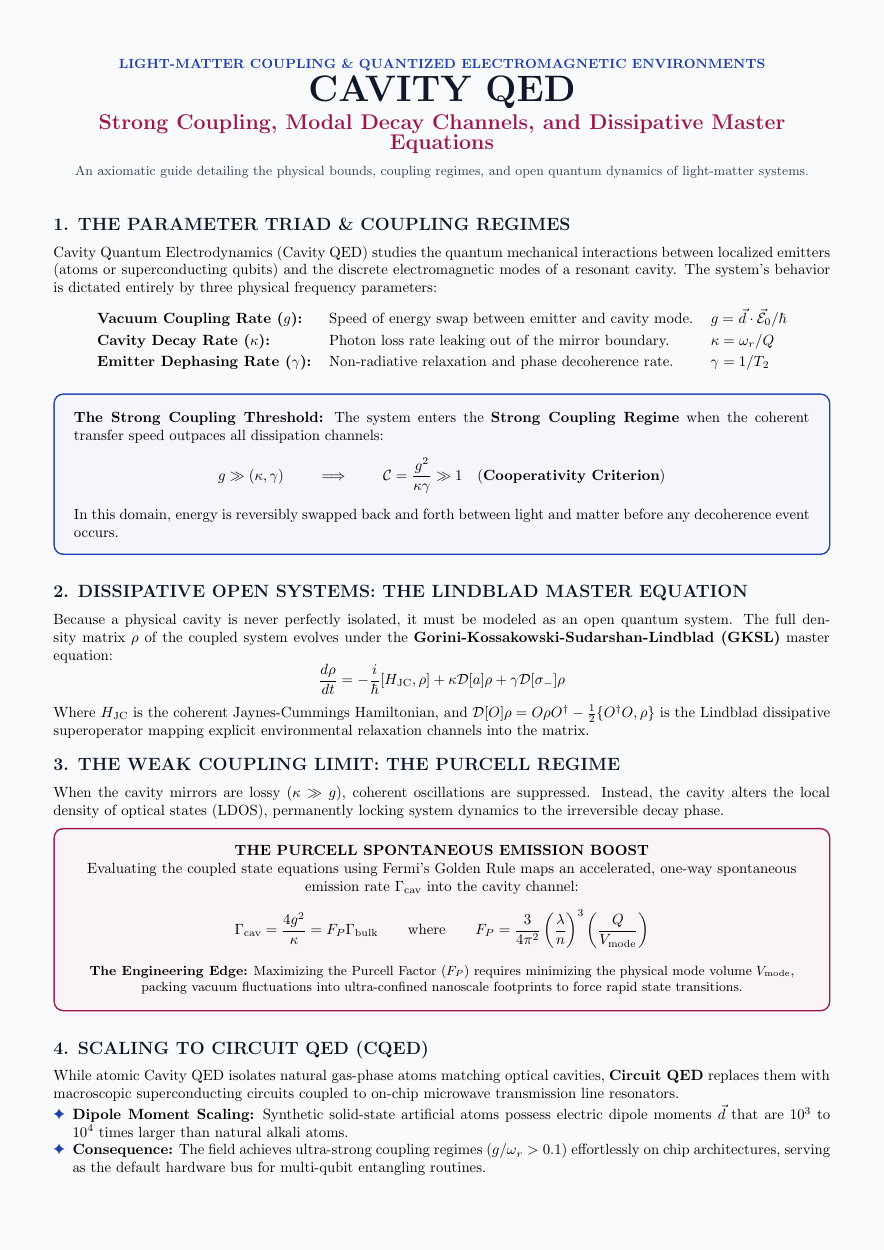
LIGHT-MATTER COUPLING & QUANTIZED ELECTROMAGNETIC ENVIRONMENTS
CAVITY QED
Strong Coupling, Modal Decay Channels, and Dissipative Master
Equations
An axiomatic guide detailing the physical bounds, coupling regimes, and open quantum dynamics of light-matter systems.
Extract · PDF page 1
1. THE PARAMETER TRIAD & COUPLING REGIMES
Cavity Quantum Electrodynamics (Cavity QED) studies the quantum mechanical interactions between localized emitters
(atoms or superconducting qubits) and the discrete electromagnetic modes of a resonant cavity. The system’s behavior
is dictated entirely by three physical frequency parameters:
Vacuum Coupling Rate (g): Speed of energy swap between emitter and cavity mode. g = ⃗d · ⃗E0/ℏ
Cavity Decay Rate (κ): Photon loss rate leaking out of the mirror boundary. κ = ωr/Q
Emitter Dephasing Rate (γ): Non-radiative relaxation and phase decoherence rate. γ = 1/T2
The Strong Coupling Threshold: The system enters the Strong Coupling Regime when the coherent
transfer speed outpaces all dissipation channels:
g2
g ≫(κ, γ) =⇒ C = ≫1 (Cooperativity Criterion)
κγ
In this domain, energy is reversibly swapped back and forth between light and matter before any decoherence event
occurs.
Extract · PDF page 1
2. DISSIPATIVE OPEN SYSTEMS: THE LINDBLAD MASTER EQUATION
Because a physical cavity is never perfectly isolated, it must be modeled as an open quantum system. The full den-
sity matrix ρ of the coupled system evolves under the Gorini-Kossakowski-Sudarshan-Lindblad (GKSL) master
equation:
dρ = −i ρ] + κD[a]ρ + γD[σ−]ρ dt ℏ[HJC,
Where HJC is the coherent Jaynes-Cummings Hamiltonian, and D[O]ρ = OρO† −12{O†O, ρ} is the Lindblad dissipative
superoperator mapping explicit environmental relaxation channels into the matrix.
Extract · PDF page 1
3. THE WEAK COUPLING LIMIT: THE PURCELL REGIME
When the cavity mirrors are lossy (κ ≫g), coherent oscillations are suppressed. Instead, the cavity alters the local
density of optical states (LDOS), permanently locking system dynamics to the irreversible decay phase.
THE PURCELL SPONTANEOUS EMISSION BOOST
Evaluating the coupled state equations using Fermi’s Golden Rule maps an accelerated, one-way spontaneous
emission rate Γcav into the cavity channel:
4g2 3 λ 3 Q
Γcav = = FP Γbulk where FP =
κ 4π2 n Vmode
The Engineering Edge: Maximizing the Purcell Factor (FP ) requires minimizing the physical mode volume Vmode,
packing vacuum fluctuations into ultra-confined nanoscale footprints to force rapid state transitions.
Extract · PDF page 1
4. SCALING TO CIRCUIT QED (CQED)
While atomic Cavity QED isolates natural gas-phase atoms matching optical cavities, Circuit QED replaces them with
macroscopic superconducting circuits coupled to on-chip microwave transmission line resonators.
✦Dipole Moment Scaling: Synthetic solid-state artificial atoms possess electric dipole moments ⃗d that are 103 to
104 times larger than natural alkali atoms.
✦Consequence: The field achieves ultra-strong coupling regimes (g/ωr > 0.1) effortlessly on chip architectures, serving
as the default hardware bus for multi-qubit entangling routines.