Mathematical fidelity: These page images preserve the exact notation and visual layout of the supplied PDF. The optional text extract below is for searching/copying only and may contain transcription errors.
Original pages — equations and symbols preserved
Show extracted text (searchable; equations may be imperfect)
Extract · PDF page 1
MANY-BODY QUANTUM MECHANICS & EMERGENT MACROSCOPIC ORDERS
CONDENSED MATTER PHYSICS
Band Structures, Quasiparticles, Symmetry Breaking, and Topology
An axiomatic guide detailing the fundamental pillars, equations, and emergent phenomena of many-body states.
Extract · PDF page 1
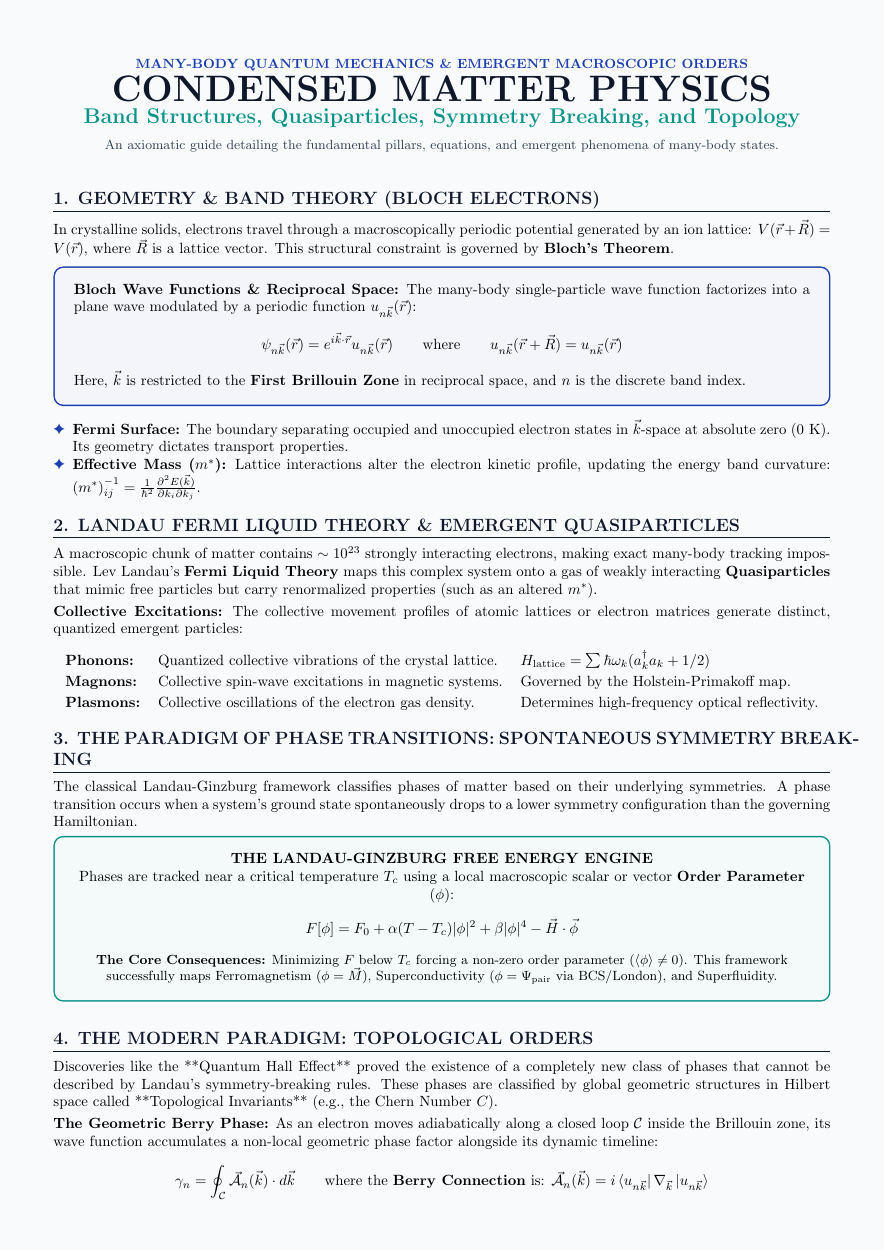
1. GEOMETRY & BAND THEORY (BLOCH ELECTRONS)
In crystalline solids, electrons travel through a macroscopically periodic potential generated by an ion lattice: V (⃗r+ ⃗R) =
V (⃗r), where ⃗R is a lattice vector. This structural constraint is governed by Bloch’s Theorem.
Bloch Wave Functions & Reciprocal Space: The many-body single-particle wave function factorizes into a
plane wave modulated by a periodic function un⃗k(⃗r):
ψn⃗k(⃗r) = ei⃗k·⃗run⃗k(⃗r) where un⃗k(⃗r + ⃗R) = un⃗k(⃗r)
Here, ⃗k is restricted to the First Brillouin Zone in reciprocal space, and n is the discrete band index.
✦Fermi Surface: The boundary separating occupied and unoccupied electron states in ⃗k-space at absolute zero (0 K).
Its geometry dictates transport properties.
✦Effective Mass (m∗): Lattice interactions alter the electron kinetic profile, updating the energy band curvature:
. (m∗)−1ij = ℏ21 ∂2E(⃗k)∂ki∂kj
Extract · PDF page 1
2. LANDAU FERMI LIQUID THEORY & EMERGENT QUASIPARTICLES
A macroscopic chunk of matter contains ∼1023 strongly interacting electrons, making exact many-body tracking impos-
sible. Lev Landau’s Fermi Liquid Theory maps this complex system onto a gas of weakly interacting Quasiparticles
that mimic free particles but carry renormalized properties (such as an altered m∗).
Collective Excitations: The collective movement profiles of atomic lattices or electron matrices generate distinct,
quantized emergent particles:
Phonons: Quantized collective vibrations of the crystal lattice. Hlattice = P ℏωk(a†kak + 1/2)
Magnons: Collective spin-wave excitations in magnetic systems. Governed by the Holstein-Primakoff map.
Plasmons: Collective oscillations of the electron gas density. Determines high-frequency optical reflectivity.
Extract · PDF page 1
3. THE PARADIGM OF PHASE TRANSITIONS: SPONTANEOUS SYMMETRY BREAK-
ING
The classical Landau-Ginzburg framework classifies phases of matter based on their underlying symmetries. A phase
transition occurs when a system’s ground state spontaneously drops to a lower symmetry configuration than the governing
Hamiltonian.
THE LANDAU-GINZBURG FREE ENERGY ENGINE
Phases are tracked near a critical temperature Tc using a local macroscopic scalar or vector Order Parameter
(ϕ):
F[ϕ] = F0 + α(T −Tc)|ϕ|2 + β|ϕ|4 −⃗H · ⃗ϕ
The Core Consequences: Minimizing F below Tc forcing a non-zero order parameter (⟨ϕ⟩̸= 0). This framework
successfully maps Ferromagnetism (ϕ = M),⃗ Superconductivity (ϕ = Ψpair via BCS/London), and Superfluidity.
Extract · PDF page 1
4. THE MODERN PARADIGM: TOPOLOGICAL ORDERS
Discoveries like the **Quantum Hall Effect** proved the existence of a completely new class of phases that cannot be
described by Landau’s symmetry-breaking rules. These phases are classified by global geometric structures in Hilbert
space called **Topological Invariants** (e.g., the Chern Number C).
The Geometric Berry Phase: As an electron moves adiabatically along a closed loop C inside the Brillouin zone, its
wave function accumulates a non-local geometric phase factor alongside its dynamic timeline:
I
γn = ⃗An(⃗k) · d⃗k where the Berry Connection is: ⃗An(⃗k) = i ⟨un⃗k| ∇⃗k |un⃗k⟩
C
Extract · PDF page 2
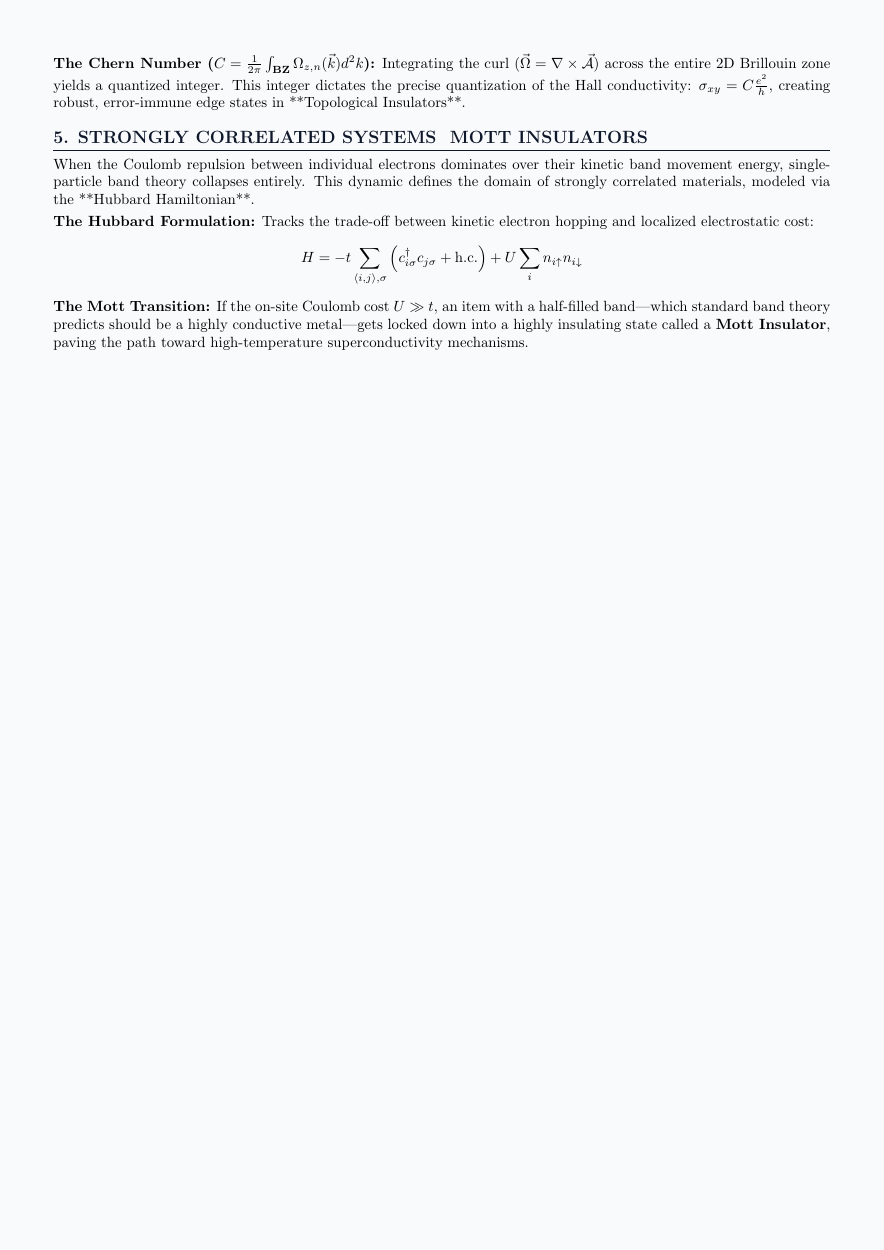
The Chern Number (C = 2π1 R BZ Ωz,n(⃗k)d2k): Integrating the curl (⃗Ω= ∇× ⃗A) across the entire 2D Brillouin zone
e2
yields a quantized integer. This integer dictates the precise quantization of the Hall conductivity: σxy = C h , creating
robust, error-immune edge states in **Topological Insulators**.
Extract · PDF page 2
5. STRONGLY CORRELATED SYSTEMS MOTT INSULATORS
When the Coulomb repulsion between individual electrons dominates over their kinetic band movement energy, single-
particle band theory collapses entirely. This dynamic defines the domain of strongly correlated materials, modeled via
the **Hubbard Hamiltonian**.
The Hubbard Formulation: Tracks the trade-off between kinetic electron hopping and localized electrostatic cost:
H = −t X c†iσcjσ + h.c. + U X ni↑ni↓
⟨i,j⟩,σ i
The Mott Transition: If the on-site Coulomb cost U ≫t, an item with a half-filled band—which standard band theory
predicts should be a highly conductive metal—gets locked down into a highly insulating state called a Mott Insulator,
paving the path toward high-temperature superconductivity mechanisms.