Mathematical fidelity: These page images preserve the exact notation and visual layout of the supplied PDF. The optional text extract below is for searching/copying only and may contain transcription errors.
Original pages — equations and symbols preserved
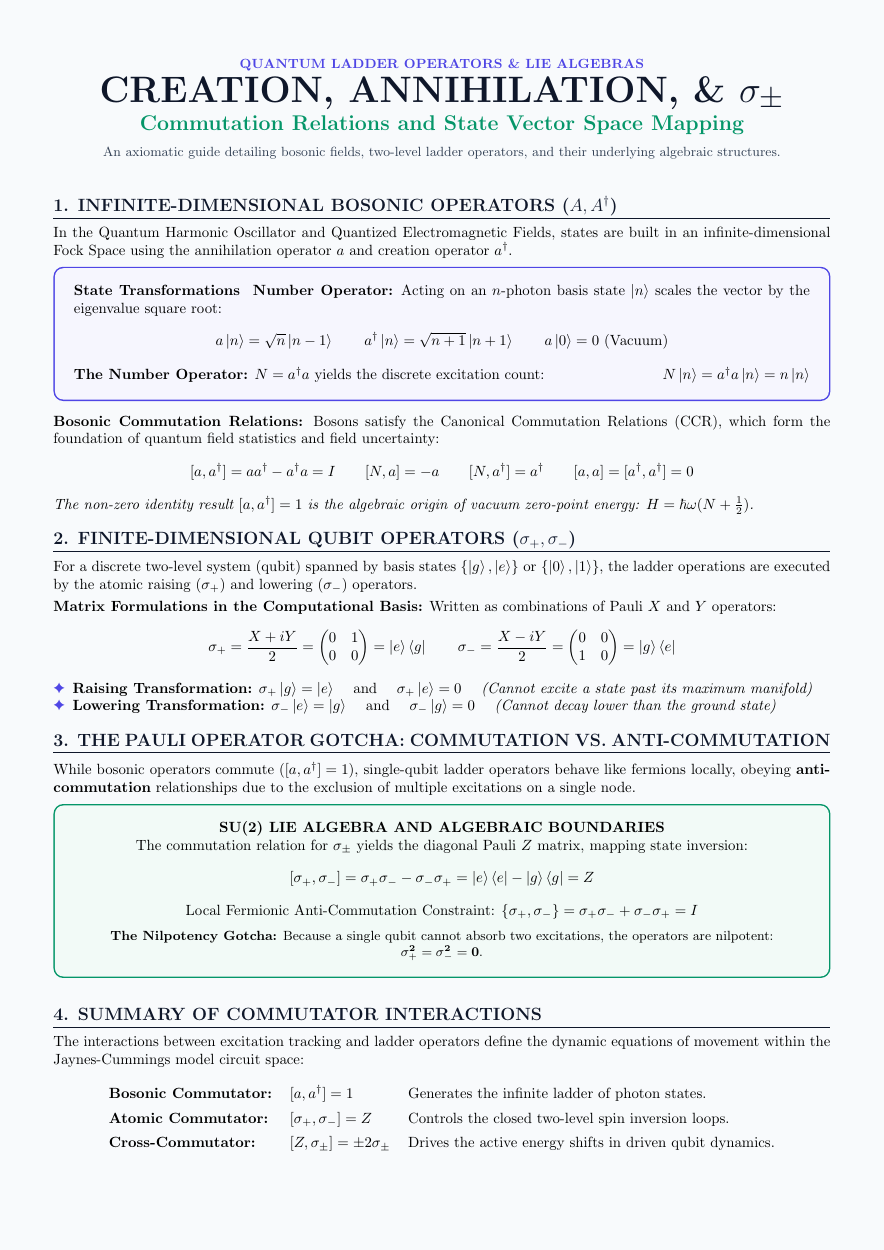
Show extracted text (searchable; equations may be imperfect)
Extract · PDF page 1
QUANTUM LADDER OPERATORS & LIE ALGEBRAS
CREATION, ANNIHILATION, & σ±
Commutation Relations and State Vector Space Mapping
An axiomatic guide detailing bosonic fields, two-level ladder operators, and their underlying algebraic structures.
Extract · PDF page 1
1. INFINITE-DIMENSIONAL BOSONIC OPERATORS (A, A†)
In the Quantum Harmonic Oscillator and Quantized Electromagnetic Fields, states are built in an infinite-dimensional
Fock Space using the annihilation operator a and creation operator a†.
State Transformations Number Operator: Acting on an n-photon basis state |n⟩scales the vector by the
eigenvalue square root:
√ a |n⟩= √n |n −1⟩ a† |n⟩= n + 1 |n + 1⟩ a |0⟩= 0 (Vacuum)
The Number Operator: N = a†a yields the discrete excitation count: N |n⟩= a†a |n⟩= n |n⟩
Bosonic Commutation Relations: Bosons satisfy the Canonical Commutation Relations (CCR), which form the
foundation of quantum field statistics and field uncertainty:
[a, a†] = aa† −a†a = I [N, a] = −a [N, a†] = a† [a, a] = [a†, a†] = 0
The non-zero identity result [a, a†] = 1 is the algebraic origin of vacuum zero-point energy: H = ℏω(N + 12).
Extract · PDF page 1
2. FINITE-DIMENSIONAL QUBIT OPERATORS (σ+, σ−)
For a discrete two-level system (qubit) spanned by basis states {|g⟩, |e⟩} or {|0⟩, |1⟩}, the ladder operations are executed
by the atomic raising (σ+) and lowering (σ−) operators.
Matrix Formulations in the Computational Basis: Written as combinations of Pauli X and Y operators:
X + iY 0 1 X −iY 0 0
σ+ = = = |e⟩⟨g| σ−= = = |g⟩⟨e|
2 0 0 2 1 0
✦Raising Transformation: σ+ |g⟩= |e⟩ and σ+ |e⟩= 0 (Cannot excite a state past its maximum manifold)
✦Lowering Transformation: σ−|e⟩= |g⟩ and σ−|g⟩= 0 (Cannot decay lower than the ground state)
Extract · PDF page 1
3. THE PAULI OPERATOR GOTCHA: COMMUTATION VS. ANTI-COMMUTATION
While bosonic operators commute ([a, a†] = 1), single-qubit ladder operators behave like fermions locally, obeying anti-
commutation relationships due to the exclusion of multiple excitations on a single node.
SU(2) LIE ALGEBRA AND ALGEBRAIC BOUNDARIES
The commutation relation for σ± yields the diagonal Pauli Z matrix, mapping state inversion:
[σ+, σ−] = σ+σ−−σ−σ+ = |e⟩⟨e| −|g⟩⟨g| = Z
Local Fermionic Anti-Commutation Constraint: {σ+, σ−} = σ+σ−+ σ−σ+ = I
The Nilpotency Gotcha: Because a single qubit cannot absorb two excitations, the operators are nilpotent:
σ2+ = σ2−= 0.
Extract · PDF page 1
4. SUMMARY OF COMMUTATOR INTERACTIONS
The interactions between excitation tracking and ladder operators define the dynamic equations of movement within the
Jaynes-Cummings model circuit space:
Bosonic Commutator: [a, a†] = 1 Generates the infinite ladder of photon states.
Atomic Commutator: [σ+, σ−] = Z Controls the closed two-level spin inversion loops.
Cross-Commutator: [Z, σ±] = ±2σ± Drives the active energy shifts in driven qubit dynamics.