Mathematical fidelity: These page images preserve the exact notation and visual layout of the supplied PDF. The optional text extract below is for searching/copying only and may contain transcription errors.
Original pages — equations and symbols preserved
Show extracted text (searchable; equations may be imperfect)
Extract · PDF page 1
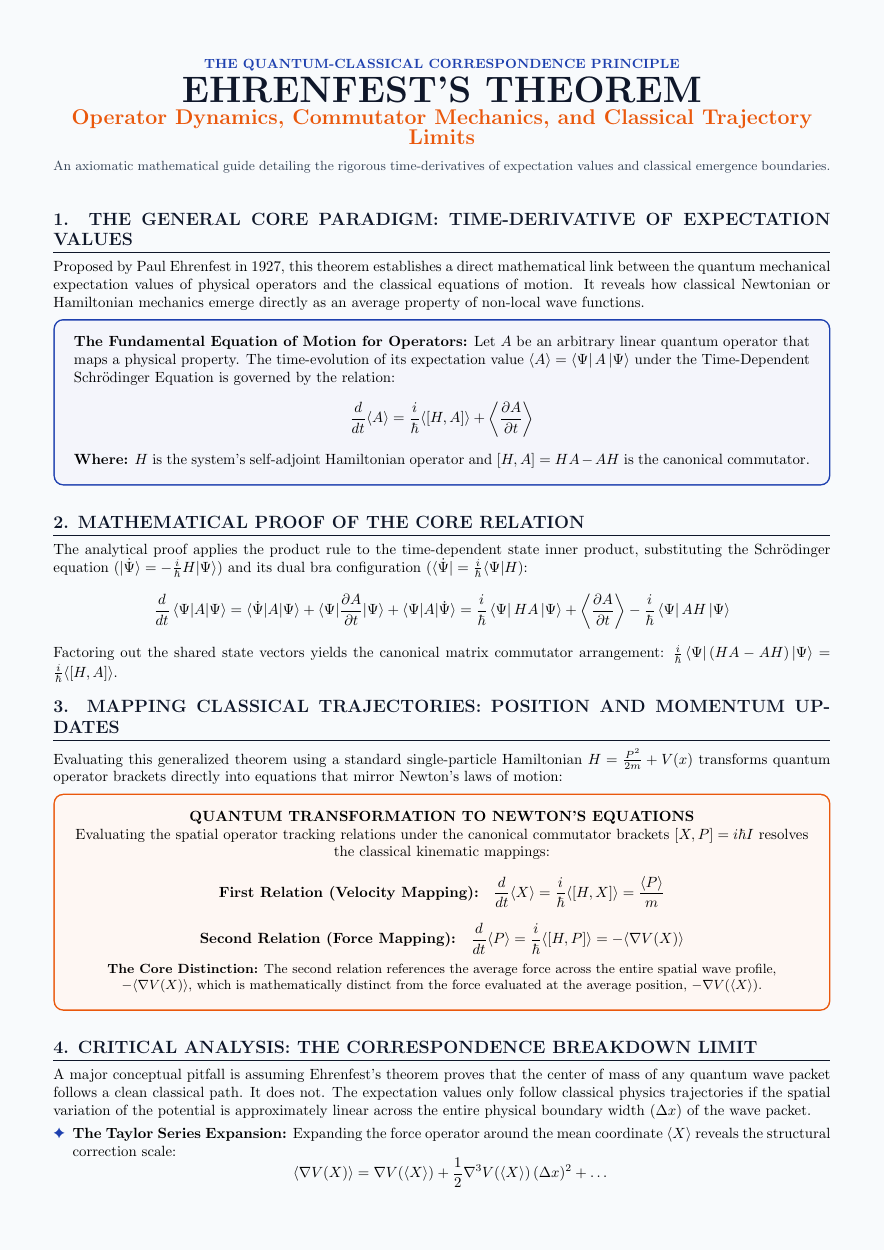
THE QUANTUM-CLASSICAL CORRESPONDENCE PRINCIPLE
EHRENFEST’S THEOREM
Operator Dynamics, Commutator Mechanics, and Classical Trajectory
Limits
An axiomatic mathematical guide detailing the rigorous time-derivatives of expectation values and classical emergence boundaries.
Extract · PDF page 1
1. THE GENERAL CORE PARADIGM: TIME-DERIVATIVE OF EXPECTATION
VALUES
Proposed by Paul Ehrenfest in 1927, this theorem establishes a direct mathematical link between the quantum mechanical
expectation values of physical operators and the classical equations of motion. It reveals how classical Newtonian or
Hamiltonian mechanics emerge directly as an average property of non-local wave functions.
The Fundamental Equation of Motion for Operators: Let A be an arbitrary linear quantum operator that
maps a physical property. The time-evolution of its expectation value ⟨A⟩= ⟨Ψ| A |Ψ⟩under the Time-Dependent
Schr¨odinger Equation is governed by the relation:
d i ∂A
dt⟨A⟩= ℏ⟨[H, A]⟩+ ∂t
Where: H is the system’s self-adjoint Hamiltonian operator and [H, A] = HA−AH is the canonical commutator.
Extract · PDF page 1
2. MATHEMATICAL PROOF OF THE CORE RELATION
The analytical proof applies the product rule to the time-dependent state inner product, substituting the Schr¨odinger
equation (|˙Ψ⟩= −iℏH|Ψ⟩) and its dual bra configuration (⟨˙Ψ| = ℏ⟨Ψ|H):i
d ⟨Ψ|A|Ψ⟩= ⟨˙Ψ|A|Ψ⟩+ ⟨Ψ|∂A |Ψ⟩+ ⟨Ψ|A|˙Ψ⟩= i HA |Ψ⟩+ ∂A −i AH |Ψ⟩ dt ∂t ℏ⟨Ψ| ∂t ℏ⟨Ψ|
Factoring out the shared state vectors yields the canonical matrix commutator arrangement: ℏ⟨Ψ|i (HA −AH) |Ψ⟩=
ℏ⟨[H,i A]⟩.
Extract · PDF page 1
3. MAPPING CLASSICAL TRAJECTORIES: POSITION AND MOMENTUM UP-
DATES
P 2
Evaluating this generalized theorem using a standard single-particle Hamiltonian H = 2m + V (x) transforms quantum
operator brackets directly into equations that mirror Newton’s laws of motion:
QUANTUM TRANSFORMATION TO NEWTON’S EQUATIONS
Evaluating the spatial operator tracking relations under the canonical commutator brackets [X, P] = iℏI resolves
the classical kinematic mappings:
d i ⟨P⟩
First Relation (Velocity Mapping): dt⟨X⟩= ℏ⟨[H, X]⟩= m
d i
Second Relation (Force Mapping): dt⟨P⟩= ℏ⟨[H, P]⟩= −⟨∇V (X)⟩
The Core Distinction: The second relation references the average force across the entire spatial wave profile,
−⟨∇V (X)⟩, which is mathematically distinct from the force evaluated at the average position, −∇V (⟨X⟩).
Extract · PDF page 1
4. CRITICAL ANALYSIS: THE CORRESPONDENCE BREAKDOWN LIMIT
A major conceptual pitfall is assuming Ehrenfest’s theorem proves that the center of mass of any quantum wave packet
follows a clean classical path. It does not. The expectation values only follow classical physics trajectories if the spatial
variation of the potential is approximately linear across the entire physical boundary width (∆x) of the wave packet.
✦The Taylor Series Expansion: Expanding the force operator around the mean coordinate ⟨X⟩reveals the structural
correction scale:
1
⟨∇V (X)⟩= ∇V (⟨X⟩) + 2∇3V (⟨X⟩) (∆x)2 + . . .
Extract · PDF page 2
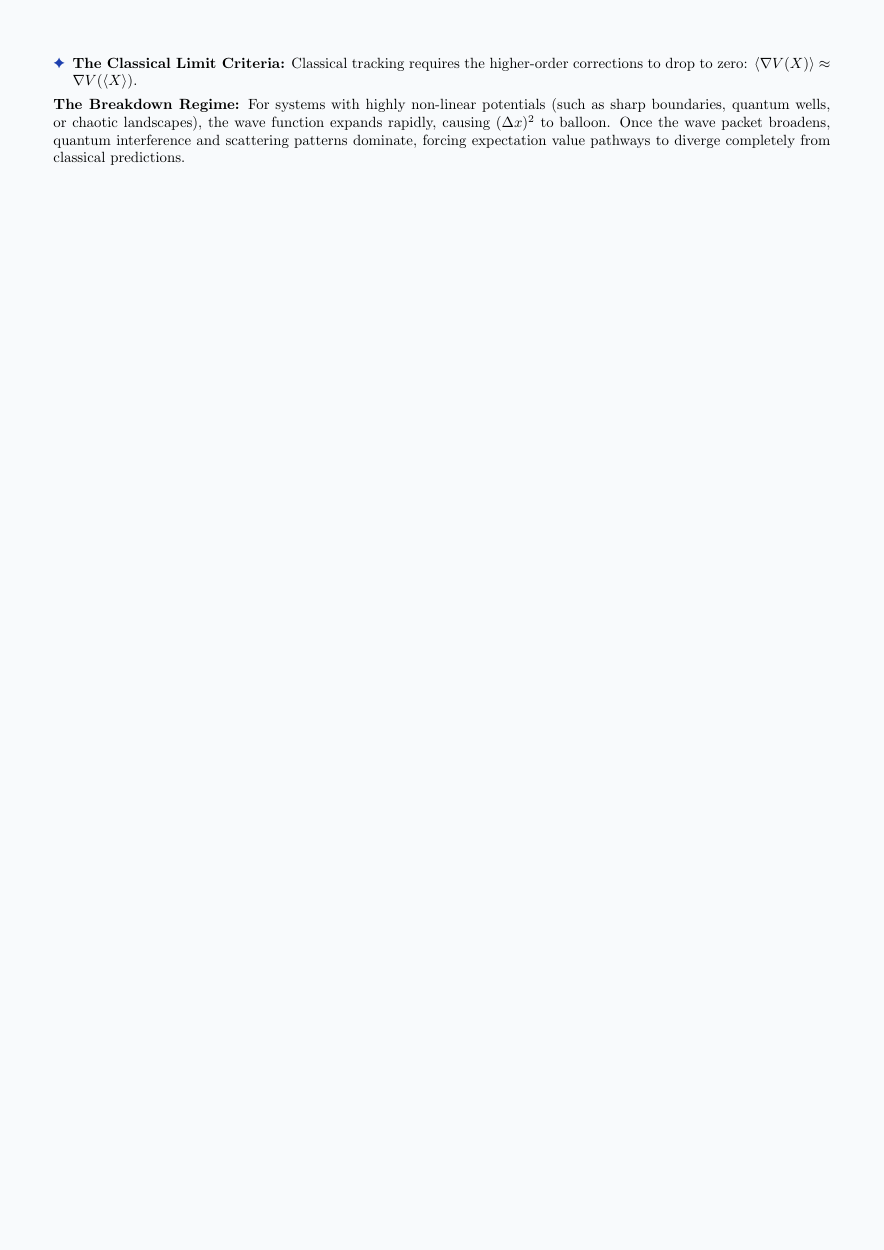
✦The Classical Limit Criteria: Classical tracking requires the higher-order corrections to drop to zero: ⟨∇V (X)⟩≈
∇V (⟨X⟩).
The Breakdown Regime: For systems with highly non-linear potentials (such as sharp boundaries, quantum wells,
or chaotic landscapes), the wave function expands rapidly, causing (∆x)2 to balloon. Once the wave packet broadens,
quantum interference and scattering patterns dominate, forcing expectation value pathways to diverge completely from
classical predictions.