Mathematical fidelity: These page images preserve the exact notation and visual layout of the supplied PDF. The optional text extract below is for searching/copying only and may contain transcription errors.
Original pages — equations and symbols preserved

Show extracted text (searchable; equations may be imperfect)
Extract · PDF page 1
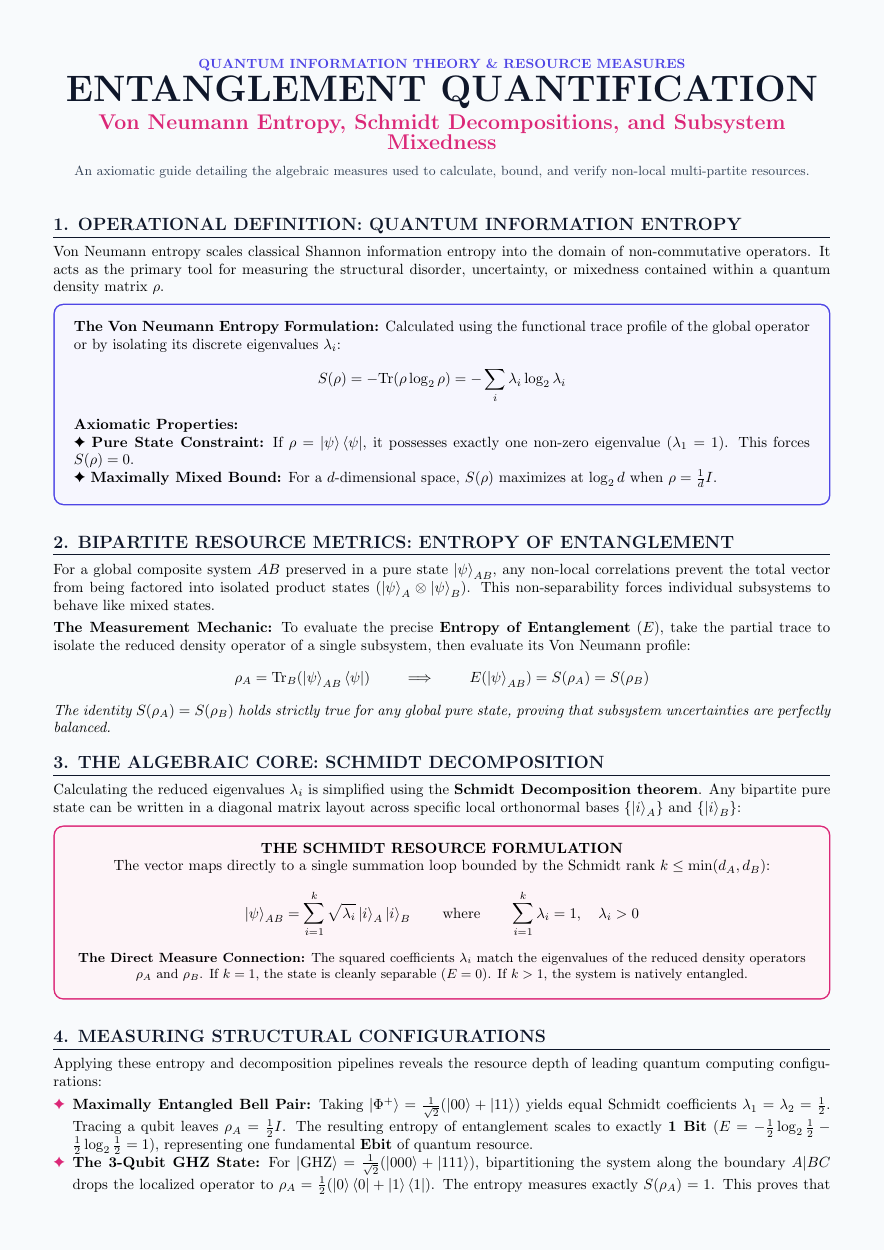
QUANTUM INFORMATION THEORY & RESOURCE MEASURES
ENTANGLEMENT QUANTIFICATION
Von Neumann Entropy, Schmidt Decompositions, and Subsystem
Mixedness
An axiomatic guide detailing the algebraic measures used to calculate, bound, and verify non-local multi-partite resources.
Extract · PDF page 1
1. OPERATIONAL DEFINITION: QUANTUM INFORMATION ENTROPY
Von Neumann entropy scales classical Shannon information entropy into the domain of non-commutative operators. It
acts as the primary tool for measuring the structural disorder, uncertainty, or mixedness contained within a quantum
density matrix ρ.
The Von Neumann Entropy Formulation: Calculated using the functional trace profile of the global operator
or by isolating its discrete eigenvalues λi:
S(ρ) = −Tr(ρ log2 ρ) = − X λi log2 λi
i
Axiomatic Properties:
✦Pure State Constraint: If ρ = |ψ⟩⟨ψ|, it possesses exactly one non-zero eigenvalue (λ1 = 1). This forces
S(ρ) = 0.
✦Maximally Mixed Bound: For a d-dimensional space, S(ρ) maximizes at log2 d when ρ = dI.1
Extract · PDF page 1
2. BIPARTITE RESOURCE METRICS: ENTROPY OF ENTANGLEMENT
For a global composite system AB preserved in a pure state |ψ⟩AB, any non-local correlations prevent the total vector
from being factored into isolated product states (|ψ⟩A ⊗|ψ⟩B). This non-separability forces individual subsystems to
behave like mixed states.
The Measurement Mechanic: To evaluate the precise Entropy of Entanglement (E), take the partial trace to
isolate the reduced density operator of a single subsystem, then evaluate its Von Neumann profile:
ρA = TrB(|ψ⟩AB ⟨ψ|) =⇒ E(|ψ⟩AB) = S(ρA) = S(ρB)
The identity S(ρA) = S(ρB) holds strictly true for any global pure state, proving that subsystem uncertainties are perfectly
balanced.
Extract · PDF page 1
3. THE ALGEBRAIC CORE: SCHMIDT DECOMPOSITION
Calculating the reduced eigenvalues λi is simplified using the Schmidt Decomposition theorem. Any bipartite pure
state can be written in a diagonal matrix layout across specific local orthonormal bases {|i⟩A} and {|i⟩B}:
THE SCHMIDT RESOURCE FORMULATION
The vector maps directly to a single summation loop bounded by the Schmidt rank k ≤min(dA, dB):
k k
|ψ⟩AB = X p λi |i⟩A |i⟩B where X λi = 1, λi > 0
i=1 i=1
The Direct Measure Connection: The squared coefficients λi match the eigenvalues of the reduced density operators
ρA and ρB. If k = 1, the state is cleanly separable (E = 0). If k > 1, the system is natively entangled.
Extract · PDF page 1
4. MEASURING STRUCTURAL CONFIGURATIONS
Applying these entropy and decomposition pipelines reveals the resource depth of leading quantum computing configu-
rations:
✦Maximally Entangled Bell Pair: Taking |Φ+⟩= √12(|00⟩+ |11⟩) yields equal Schmidt coefficients λ1 = λ2 = 12.
Tracing a qubit leaves ρA = 12I. The resulting entropy of entanglement scales to exactly 1 Bit (E = −12 log2 21 −
1
2 log2 12 = 1), representing one fundamental Ebit of quantum resource.
✦The 3-Qubit GHZ State: For |GHZ⟩= √12(|000⟩+ |111⟩), bipartitioning the system along the boundary A|BC
drops the localized operator to ρA = 12(|0⟩⟨0| + |1⟩⟨1|). The entropy measures exactly S(ρA) = 1. This proves that
Extract · PDF page 2
despite scaling out to larger registers, the maximum bipartite entanglement across any single qubit boundary remains
fixed at 1 Ebit.