Mathematical fidelity: These page images preserve the exact notation and visual layout of the supplied PDF. The optional text extract below is for searching/copying only and may contain transcription errors.
Original pages — equations and symbols preserved

Show extracted text (searchable; equations may be imperfect)
Extract · PDF page 1
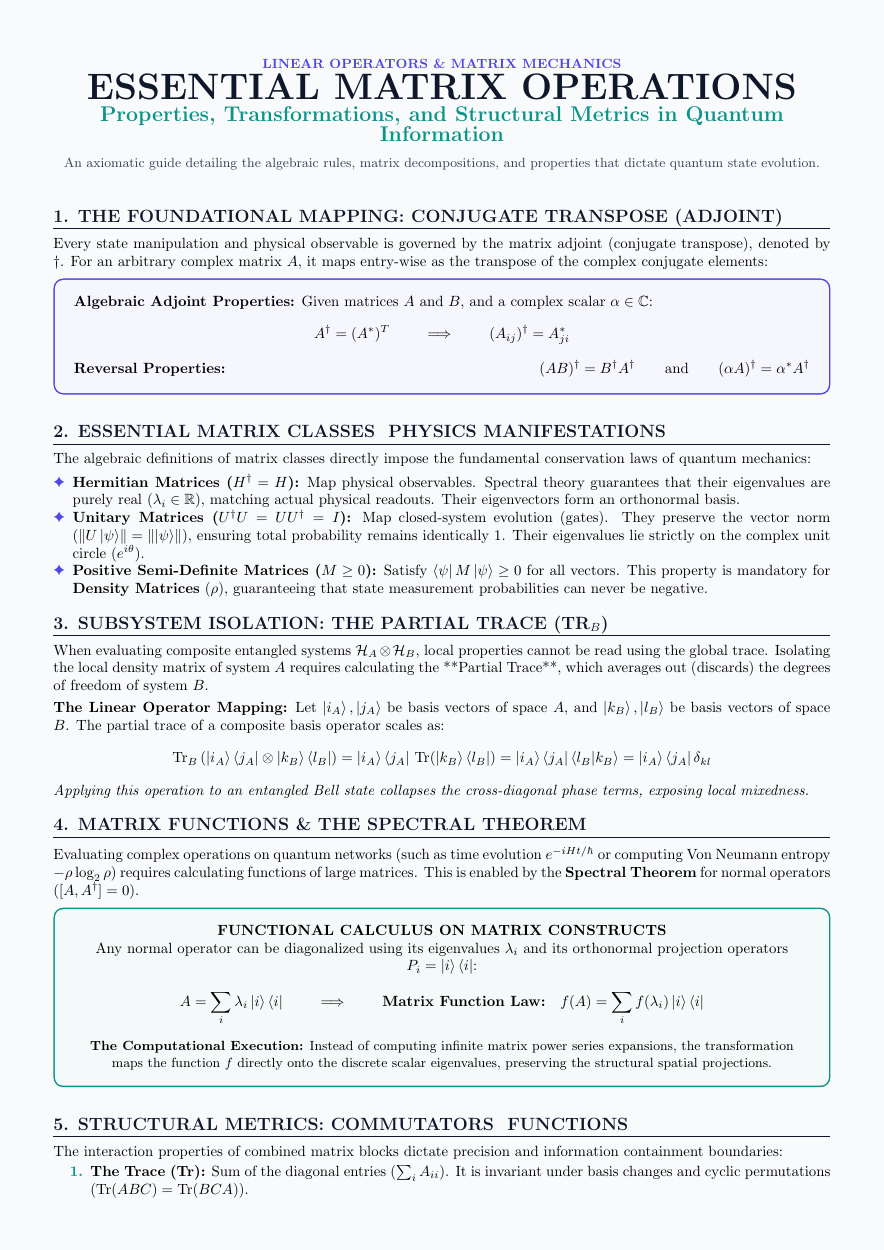
LINEAR OPERATORS & MATRIX MECHANICS
ESSENTIAL MATRIX OPERATIONS
Properties, Transformations, and Structural Metrics in Quantum
Information
An axiomatic guide detailing the algebraic rules, matrix decompositions, and properties that dictate quantum state evolution.
Extract · PDF page 1
1. THE FOUNDATIONAL MAPPING: CONJUGATE TRANSPOSE (ADJOINT)
Every state manipulation and physical observable is governed by the matrix adjoint (conjugate transpose), denoted by
†. For an arbitrary complex matrix A, it maps entry-wise as the transpose of the complex conjugate elements:
Algebraic Adjoint Properties: Given matrices A and B, and a complex scalar α ∈C:
A† = (A∗)T =⇒ (Aij)† = A∗ji
Reversal Properties: (AB)† = B†A† and (αA)† = α∗A†
Extract · PDF page 1
2. ESSENTIAL MATRIX CLASSES PHYSICS MANIFESTATIONS
The algebraic definitions of matrix classes directly impose the fundamental conservation laws of quantum mechanics:
✦Hermitian Matrices (H† = H): Map physical observables. Spectral theory guarantees that their eigenvalues are
purely real (λi ∈R), matching actual physical readouts. Their eigenvectors form an orthonormal basis.
✦Unitary Matrices (U †U = UU † = I): Map closed-system evolution (gates). They preserve the vector norm
(∥U |ψ⟩∥= ∥|ψ⟩∥), ensuring total probability remains identically 1. Their eigenvalues lie strictly on the complex unit
circle (eiθ).
✦Positive Semi-Definite Matrices (M ≥0): Satisfy ⟨ψ| M |ψ⟩≥0 for all vectors. This property is mandatory for
Density Matrices (ρ), guaranteeing that state measurement probabilities can never be negative.
Extract · PDF page 1
3. SUBSYSTEM ISOLATION: THE PARTIAL TRACE (TRB)
When evaluating composite entangled systems HA ⊗HB, local properties cannot be read using the global trace. Isolating
the local density matrix of system A requires calculating the **Partial Trace**, which averages out (discards) the degrees
of freedom of system B.
The Linear Operator Mapping: Let |iA⟩, |jA⟩be basis vectors of space A, and |kB⟩, |lB⟩be basis vectors of space
B. The partial trace of a composite basis operator scales as:
TrB (|iA⟩⟨jA| ⊗|kB⟩⟨lB|) = |iA⟩⟨jA| Tr(|kB⟩⟨lB|) = |iA⟩⟨jA| ⟨lB|kB⟩= |iA⟩⟨jA| δkl
Applying this operation to an entangled Bell state collapses the cross-diagonal phase terms, exposing local mixedness.
Extract · PDF page 1
4. MATRIX FUNCTIONS & THE SPECTRAL THEOREM
Evaluating complex operations on quantum networks (such as time evolution e−iHt/ℏor computing Von Neumann entropy
−ρ log2 ρ) requires calculating functions of large matrices. This is enabled by the Spectral Theorem for normal operators
([A, A†] = 0).
FUNCTIONAL CALCULUS ON MATRIX CONSTRUCTS
Any normal operator can be diagonalized using its eigenvalues λi and its orthonormal projection operators
Pi = |i⟩⟨i|:
A = X λi |i⟩⟨i| =⇒ Matrix Function Law: f(A) = X f(λi) |i⟩⟨i|
i i
The Computational Execution: Instead of computing infinite matrix power series expansions, the transformation
maps the function f directly onto the discrete scalar eigenvalues, preserving the structural spatial projections.
Extract · PDF page 1
5. STRUCTURAL METRICS: COMMUTATORS FUNCTIONS
The interaction properties of combined matrix blocks dictate precision and information containment boundaries:
1. The Trace (Tr): Sum of the diagonal entries (Pi Aii). It is invariant under basis changes and cyclic permutations
(Tr(ABC) = Tr(BCA)).
Extract · PDF page 2
2. The Commutator ([A, B] = AB −BA): Measures non-commutativity. If [A, B] ̸= 0, the matrices cannot be
simultaneously diagonalized, generating physical uncertainty.
3. The Anti-Commutator ({A, B} = AB + BA): Governs fermionic statistics and updates mapping configurations
in error correction.