Mathematical fidelity: These page images preserve the exact notation and visual layout of the supplied PDF. The optional text extract below is for searching/copying only and may contain transcription errors.
Original pages — equations and symbols preserved
Show extracted text (searchable; equations may be imperfect)
Extract · PDF page 1
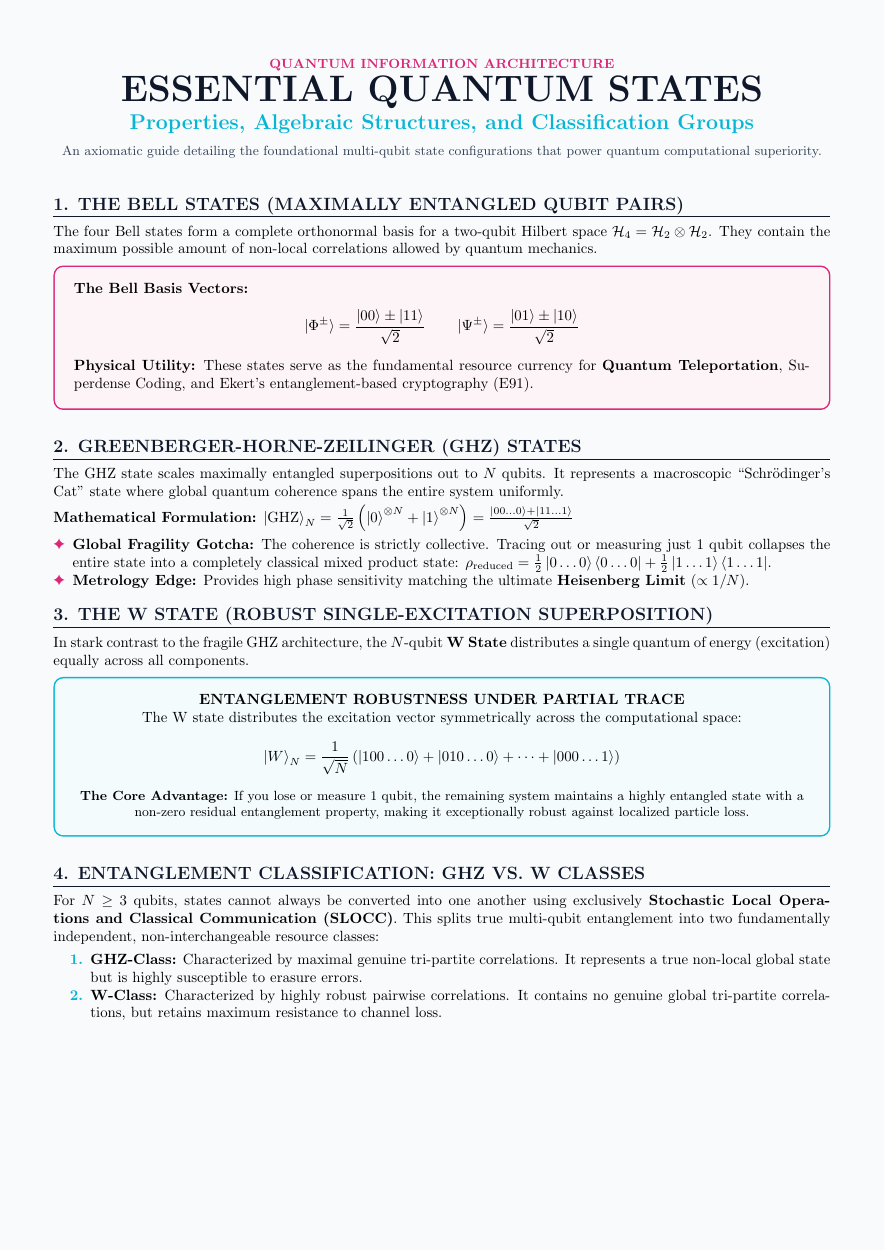
QUANTUM INFORMATION ARCHITECTURE
ESSENTIAL QUANTUM STATES
Properties, Algebraic Structures, and Classification Groups
An axiomatic guide detailing the foundational multi-qubit state configurations that power quantum computational superiority.
Extract · PDF page 1
1. THE BELL STATES (MAXIMALLY ENTANGLED QUBIT PAIRS)
The four Bell states form a complete orthonormal basis for a two-qubit Hilbert space H4 = H2 ⊗H2. They contain the
maximum possible amount of non-local correlations allowed by quantum mechanics.
The Bell Basis Vectors:
|00⟩± |11⟩ |01⟩± |10⟩
|Φ±⟩= √ |Ψ±⟩= √
2 2
Physical Utility: These states serve as the fundamental resource currency for Quantum Teleportation, Su-
perdense Coding, and Ekert’s entanglement-based cryptography (E91).
Extract · PDF page 1
2. GREENBERGER-HORNE-ZEILINGER (GHZ) STATES
The GHZ state scales maximally entangled superpositions out to N qubits. It represents a macroscopic “Schr¨odinger’s
Cat” state where global quantum coherence spans the entire system uniformly.
√Mathematical Formulation: |GHZ⟩N = √12 |0⟩⊗N + |1⟩⊗N = |00...0⟩+|11...1⟩ 2
✦Global Fragility Gotcha: The coherence is strictly collective. Tracing out or measuring just 1 qubit collapses the
entire state into a completely classical mixed product state: ρreduced = 12 |0 . . . 0⟩⟨0 . . . 0| + 12 |1 . . . 1⟩⟨1 . . . 1|.
✦Metrology Edge: Provides high phase sensitivity matching the ultimate Heisenberg Limit (∝1/N).
Extract · PDF page 1
3. THE W STATE (ROBUST SINGLE-EXCITATION SUPERPOSITION)
In stark contrast to the fragile GHZ architecture, the N-qubit W State distributes a single quantum of energy (excitation)
equally across all components.
ENTANGLEMENT ROBUSTNESS UNDER PARTIAL TRACE
The W state distributes the excitation vector symmetrically across the computational space:
1
|W⟩N = √ (|100 . . . 0⟩+ |010 . . . 0⟩+ · · · + |000 . . . 1⟩)
N
The Core Advantage: If you lose or measure 1 qubit, the remaining system maintains a highly entangled state with a
non-zero residual entanglement property, making it exceptionally robust against localized particle loss.
Extract · PDF page 1
4. ENTANGLEMENT CLASSIFICATION: GHZ VS. W CLASSES
For N ≥3 qubits, states cannot always be converted into one another using exclusively Stochastic Local Opera-
tions and Classical Communication (SLOCC). This splits true multi-qubit entanglement into two fundamentally
independent, non-interchangeable resource classes:
1. GHZ-Class: Characterized by maximal genuine tri-partite correlations. It represents a true non-local global state
but is highly susceptible to erasure errors.
2. W-Class: Characterized by highly robust pairwise correlations. It contains no genuine global tri-partite correla-
tions, but retains maximum resistance to channel loss.