Mathematical fidelity: These page images preserve the exact notation and visual layout of the supplied PDF. The optional text extract below is for searching/copying only and may contain transcription errors.
Original pages — equations and symbols preserved
Show extracted text (searchable; equations may be imperfect)
Extract · PDF page 1
QUANTUM STATISTICS, INDISTINGUISHABILITY, & MULTI-PARTICLE ALGEBRAS
FERMIONS, BOSONS, & ANYONS
Permutation Symmetries, Operator Algebras, and Collective Quantum
Phases
An axiomatic guide detailing identical particle classifications, commutation limits, and thermodynamic properties.
Extract · PDF page 1
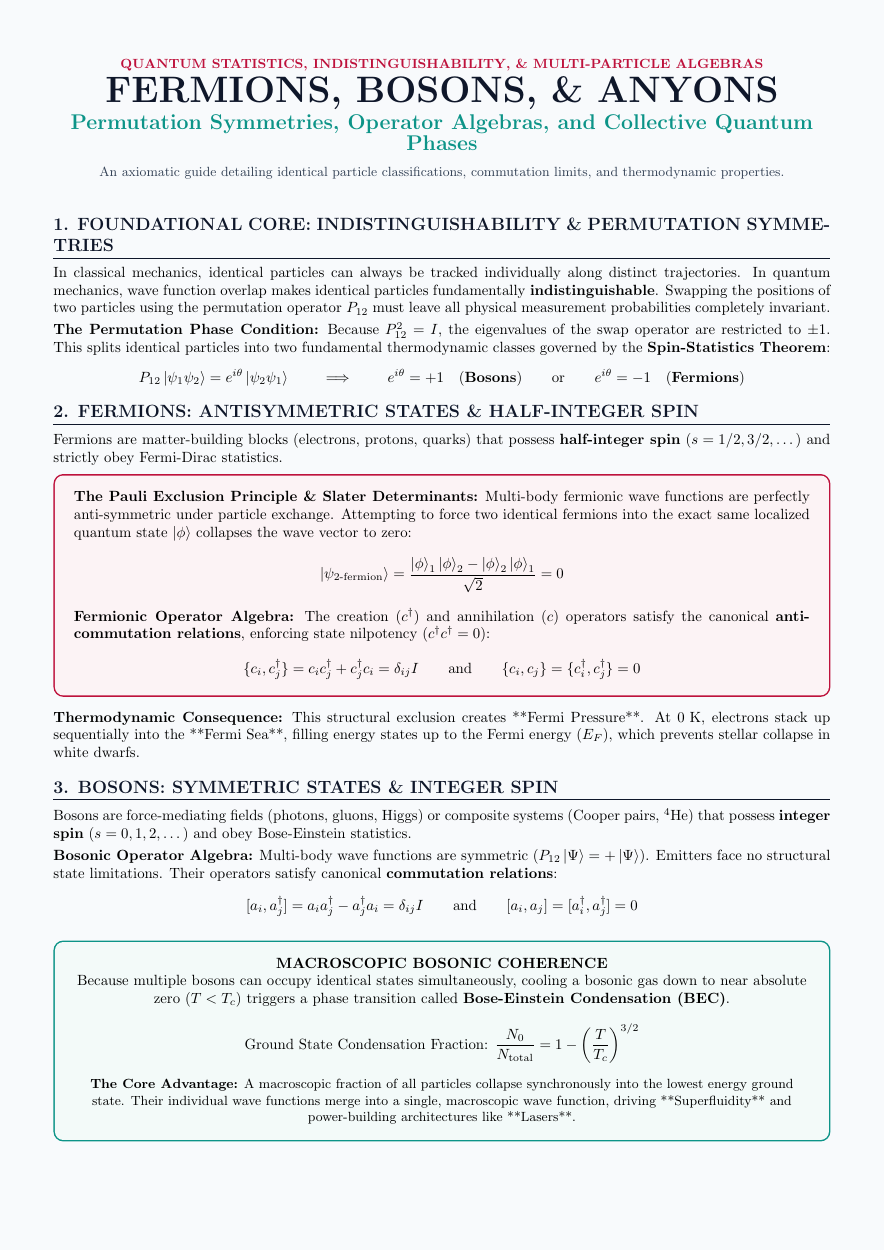
1. FOUNDATIONAL CORE: INDISTINGUISHABILITY & PERMUTATION SYMME-
TRIES
In classical mechanics, identical particles can always be tracked individually along distinct trajectories. In quantum
mechanics, wave function overlap makes identical particles fundamentally indistinguishable. Swapping the positions of
two particles using the permutation operator P12 must leave all physical measurement probabilities completely invariant.
The Permutation Phase Condition: Because P 122 = I, the eigenvalues of the swap operator are restricted to ±1.
This splits identical particles into two fundamental thermodynamic classes governed by the Spin-Statistics Theorem:
P12 |ψ1ψ2⟩= eiθ |ψ2ψ1⟩ =⇒ eiθ = +1 (Bosons) or eiθ = −1 (Fermions)
Extract · PDF page 1
2. FERMIONS: ANTISYMMETRIC STATES & HALF-INTEGER SPIN
Fermions are matter-building blocks (electrons, protons, quarks) that possess half-integer spin (s = 1/2, 3/2, . . . ) and
strictly obey Fermi-Dirac statistics.
The Pauli Exclusion Principle & Slater Determinants: Multi-body fermionic wave functions are perfectly
anti-symmetric under particle exchange. Attempting to force two identical fermions into the exact same localized
quantum state |ϕ⟩collapses the wave vector to zero:
|ϕ⟩1 |ϕ⟩2 −|ϕ⟩2 |ϕ⟩1 |ψ2-fermion⟩= √ = 0
2
Fermionic Operator Algebra: The creation (c†) and annihilation (c) operators satisfy the canonical anti-
commutation relations, enforcing state nilpotency (c†c† = 0):
{ci, c†j} = cic†j + c†jci = δijI and {ci, cj} = {c†i, c†j} = 0
Thermodynamic Consequence: This structural exclusion creates **Fermi Pressure**. At 0 K, electrons stack up
sequentially into the **Fermi Sea**, filling energy states up to the Fermi energy (EF ), which prevents stellar collapse in
white dwarfs.
Extract · PDF page 1
3. BOSONS: SYMMETRIC STATES & INTEGER SPIN
Bosons are force-mediating fields (photons, gluons, Higgs) or composite systems (Cooper pairs, 4He) that possess integer
spin (s = 0, 1, 2, . . . ) and obey Bose-Einstein statistics.
Bosonic Operator Algebra: Multi-body wave functions are symmetric (P12 |Ψ⟩= + |Ψ⟩). Emitters face no structural
state limitations. Their operators satisfy canonical commutation relations:
[ai, a†j] = aia†j −a†jai = δijI and [ai, aj] = [a†i, a†j] = 0
MACROSCOPIC BOSONIC COHERENCE
Because multiple bosons can occupy identical states simultaneously, cooling a bosonic gas down to near absolute
zero (T < Tc) triggers a phase transition called Bose-Einstein Condensation (BEC).
N0 T 3/2
Ground State Condensation Fraction: = 1 −
Ntotal Tc
The Core Advantage: A macroscopic fraction of all particles collapse synchronously into the lowest energy ground
state. Their individual wave functions merge into a single, macroscopic wave function, driving **Superfluidity** and
power-building architectures like **Lasers**.
Extract · PDF page 2
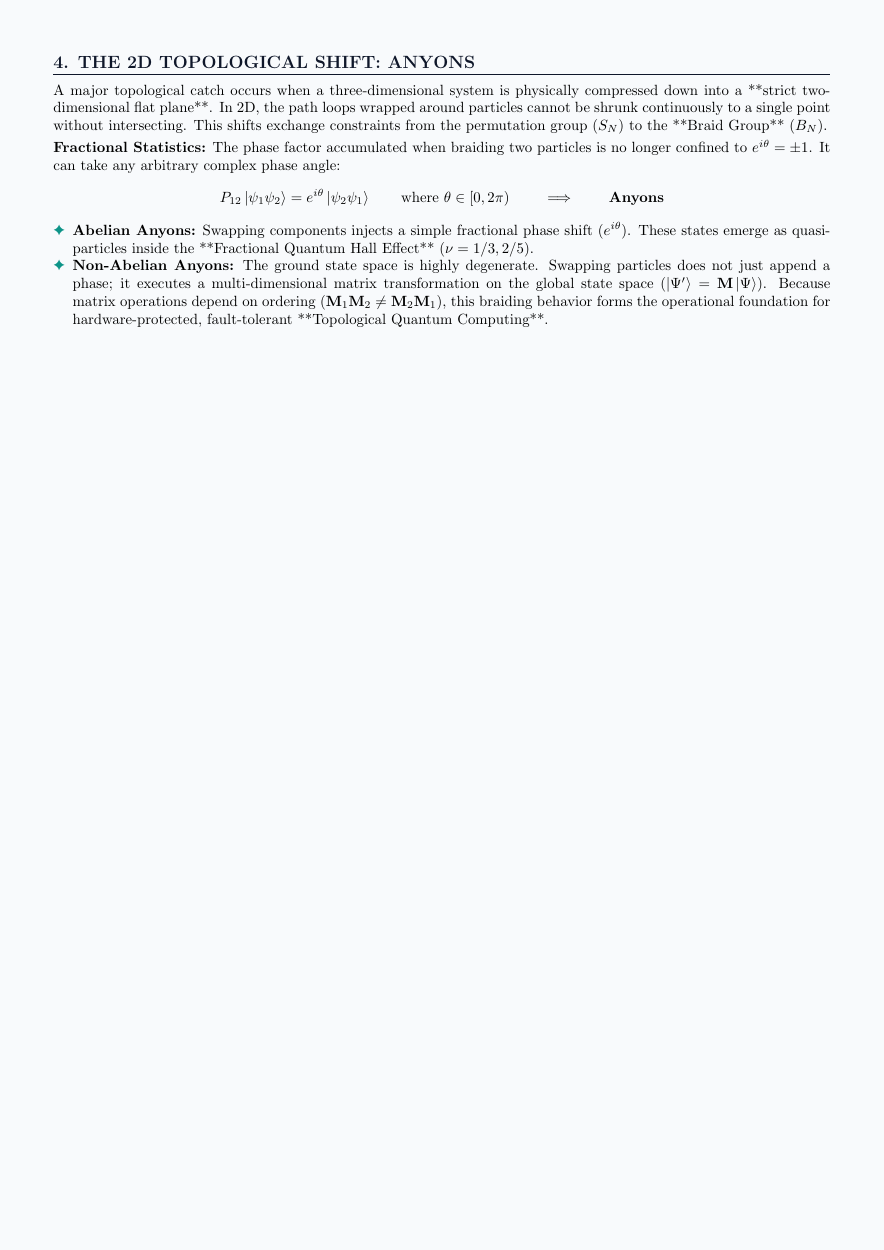
4. THE 2D TOPOLOGICAL SHIFT: ANYONS
A major topological catch occurs when a three-dimensional system is physically compressed down into a **strict two-
dimensional flat plane**. In 2D, the path loops wrapped around particles cannot be shrunk continuously to a single point
without intersecting. This shifts exchange constraints from the permutation group (SN) to the **Braid Group** (BN).
Fractional Statistics: The phase factor accumulated when braiding two particles is no longer confined to eiθ = ±1. It
can take any arbitrary complex phase angle:
P12 |ψ1ψ2⟩= eiθ |ψ2ψ1⟩ where θ ∈[0, 2π) =⇒ Anyons
✦Abelian Anyons: Swapping components injects a simple fractional phase shift (eiθ). These states emerge as quasi-
particles inside the **Fractional Quantum Hall Effect** (ν = 1/3, 2/5).
✦Non-Abelian Anyons: The ground state space is highly degenerate. Swapping particles does not just append a
phase; it executes a multi-dimensional matrix transformation on the global state space (|Ψ′⟩= M |Ψ⟩). Because
matrix operations depend on ordering (M1M2 ̸= M2M1), this braiding behavior forms the operational foundation for
hardware-protected, fault-tolerant **Topological Quantum Computing**.