Mathematical fidelity: These page images preserve the exact notation and visual layout of the supplied PDF. The optional text extract below is for searching/copying only and may contain transcription errors.
Original pages — equations and symbols preserved
Show extracted text (searchable; equations may be imperfect)
Extract · PDF page 1
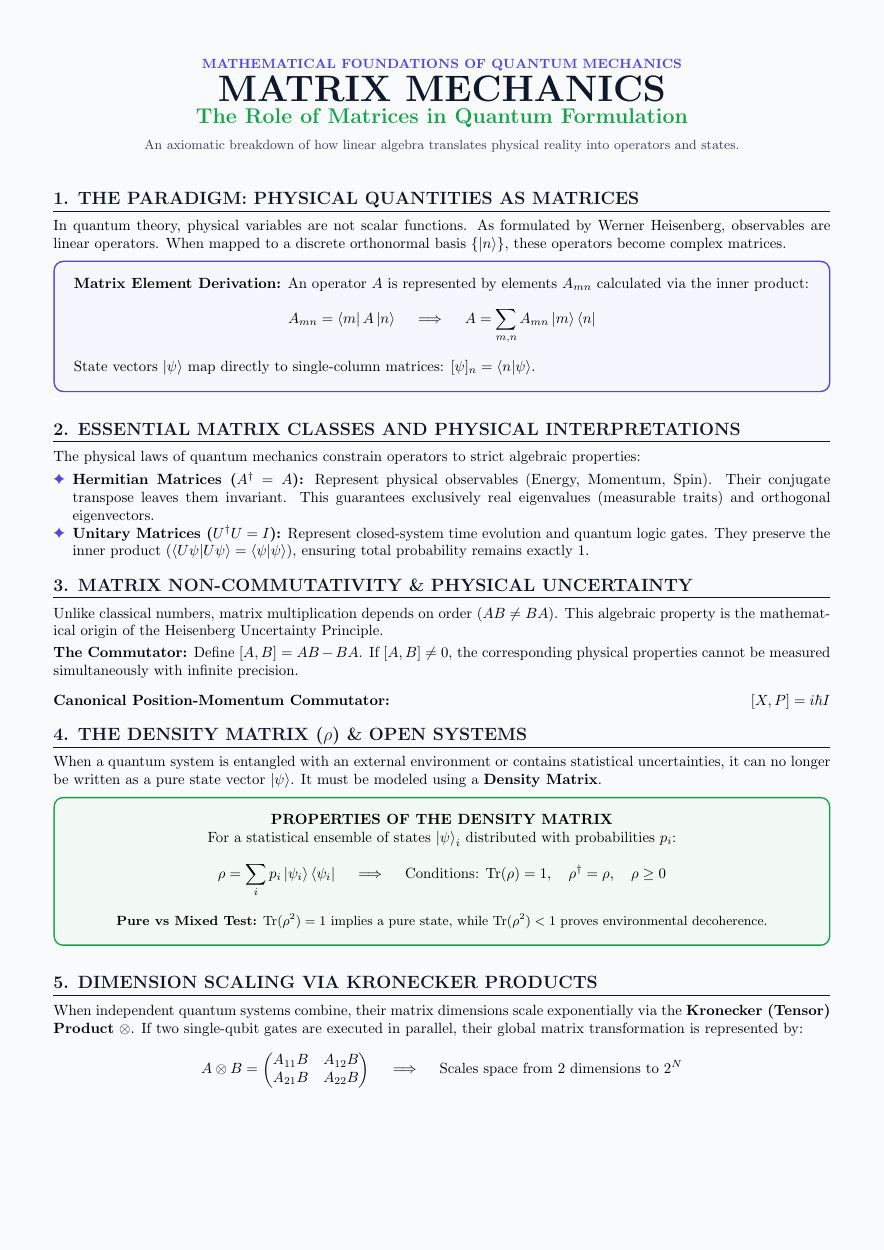
MATHEMATICAL FOUNDATIONS OF QUANTUM MECHANICS
MATRIX MECHANICS
The Role of Matrices in Quantum Formulation
An axiomatic breakdown of how linear algebra translates physical reality into operators and states.
Extract · PDF page 1
1. THE PARADIGM: PHYSICAL QUANTITIES AS MATRICES
In quantum theory, physical variables are not scalar functions. As formulated by Werner Heisenberg, observables are
linear operators. When mapped to a discrete orthonormal basis {|n⟩}, these operators become complex matrices.
Matrix Element Derivation: An operator A is represented by elements Amn calculated via the inner product:
Amn = ⟨m| A |n⟩ =⇒ A = X Amn |m⟩⟨n|
m,n
State vectors |ψ⟩map directly to single-column matrices: [ψ]n = ⟨n|ψ⟩.
Extract · PDF page 1
2. ESSENTIAL MATRIX CLASSES AND PHYSICAL INTERPRETATIONS
The physical laws of quantum mechanics constrain operators to strict algebraic properties:
✦Hermitian Matrices (A† = A): Represent physical observables (Energy, Momentum, Spin). Their conjugate
transpose leaves them invariant. This guarantees exclusively real eigenvalues (measurable traits) and orthogonal
eigenvectors.
✦Unitary Matrices (U †U = I): Represent closed-system time evolution and quantum logic gates. They preserve the
inner product (⟨Uψ|Uψ⟩= ⟨ψ|ψ⟩), ensuring total probability remains exactly 1.
Extract · PDF page 1
3. MATRIX NON-COMMUTATIVITY & PHYSICAL UNCERTAINTY
Unlike classical numbers, matrix multiplication depends on order (AB ̸= BA). This algebraic property is the mathemat-
ical origin of the Heisenberg Uncertainty Principle.
The Commutator: Define [A, B] = AB −BA. If [A, B] ̸= 0, the corresponding physical properties cannot be measured
simultaneously with infinite precision.
Canonical Position-Momentum Commutator: [X, P] = iℏI
Extract · PDF page 1
4. THE DENSITY MATRIX (ρ) & OPEN SYSTEMS
When a quantum system is entangled with an external environment or contains statistical uncertainties, it can no longer
be written as a pure state vector |ψ⟩. It must be modeled using a Density Matrix.
PROPERTIES OF THE DENSITY MATRIX
For a statistical ensemble of states |ψ⟩i distributed with probabilities pi:
ρ = X pi |ψi⟩⟨ψi| =⇒ Conditions: Tr(ρ) = 1, ρ† = ρ, ρ ≥0
i
Pure vs Mixed Test: Tr(ρ2) = 1 implies a pure state, while Tr(ρ2) < 1 proves environmental decoherence.
Extract · PDF page 1
5. DIMENSION SCALING VIA KRONECKER PRODUCTS
When independent quantum systems combine, their matrix dimensions scale exponentially via the Kronecker (Tensor)
Product ⊗. If two single-qubit gates are executed in parallel, their global matrix transformation is represented by:
A11B A12B A ⊗B = =⇒ Scales space from 2 dimensions to 2N
A21B A22B