Mathematical fidelity: These page images preserve the exact notation and visual layout of the supplied PDF. The optional text extract below is for searching/copying only and may contain transcription errors.
Original pages — equations and symbols preserved
Show extracted text (searchable; equations may be imperfect)
Extract · PDF page 1
★NOBEL PRIZE WINNING DISCOVERIES IN QUANTUM PHYSICS
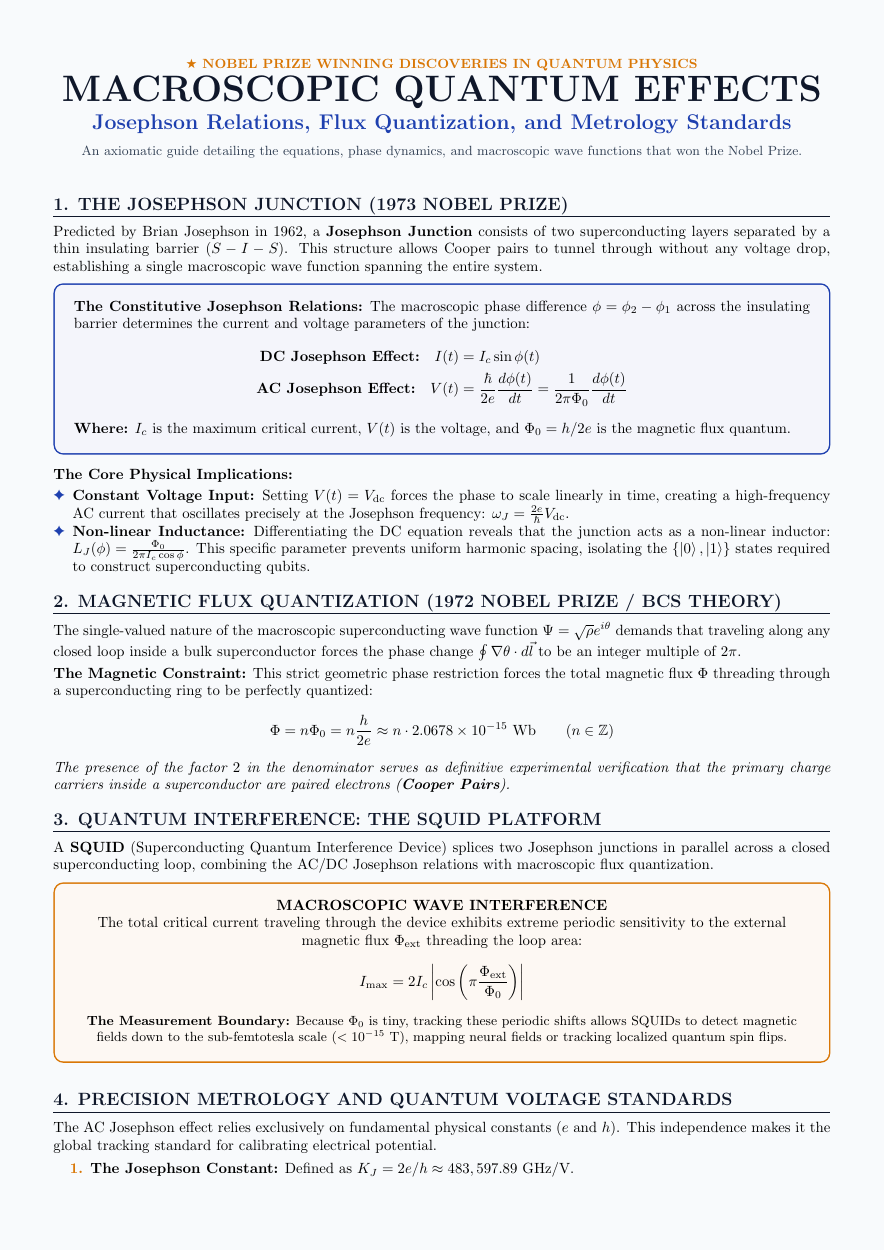
MACROSCOPIC QUANTUM EFFECTS
Josephson Relations, Flux Quantization, and Metrology Standards
An axiomatic guide detailing the equations, phase dynamics, and macroscopic wave functions that won the Nobel Prize.
Extract · PDF page 1
1. THE JOSEPHSON JUNCTION (1973 NOBEL PRIZE)
Predicted by Brian Josephson in 1962, a Josephson Junction consists of two superconducting layers separated by a
thin insulating barrier (S −I −S). This structure allows Cooper pairs to tunnel through without any voltage drop,
establishing a single macroscopic wave function spanning the entire system.
The Constitutive Josephson Relations: The macroscopic phase difference ϕ = ϕ2 −ϕ1 across the insulating
barrier determines the current and voltage parameters of the junction:
DC Josephson Effect: I(t) = Ic sin ϕ(t)
ℏ dϕ(t) 1 dϕ(t)
AC Josephson Effect: V (t) = =
2e dt 2πΦ0 dt
Where: Ic is the maximum critical current, V (t) is the voltage, and Φ0 = h/2e is the magnetic flux quantum.
The Core Physical Implications:
✦Constant Voltage Input: Setting V (t) = Vdc forces the phase to scale linearly in time, creating a high-frequency
AC current that oscillates precisely at the Josephson frequency: ωJ = 2eℏVdc.
✦Non-linear Inductance: Differentiating the DC equation reveals that the junction acts as a non-linear inductor:
LJ(ϕ) = 2πIcΦ0cos ϕ. This specific parameter prevents uniform harmonic spacing, isolating the {|0⟩, |1⟩} states required
to construct superconducting qubits.
Extract · PDF page 1
2. MAGNETIC FLUX QUANTIZATION (1972 NOBEL PRIZE / BCS THEORY)
The single-valued nature of the macroscopic superconducting wave function Ψ = √ρeiθ demands that traveling along any
closed loop inside a bulk superconductor forces the phase change H ∇θ · d⃗l to be an integer multiple of 2π.
The Magnetic Constraint: This strict geometric phase restriction forces the total magnetic flux Φ threading through
a superconducting ring to be perfectly quantized:
h
Φ = nΦ0 = n ≈n · 2.0678 × 10⁻¹⁵ Wb (n ∈Z)
2e
The presence of the factor 2 in the denominator serves as definitive experimental verification that the primary charge
carriers inside a superconductor are paired electrons (Cooper Pairs).
Extract · PDF page 1
3. QUANTUM INTERFERENCE: THE SQUID PLATFORM
A SQUID (Superconducting Quantum Interference Device) splices two Josephson junctions in parallel across a closed
superconducting loop, combining the AC/DC Josephson relations with macroscopic flux quantization.
MACROSCOPIC WAVE INTERFERENCE
The total critical current traveling through the device exhibits extreme periodic sensitivity to the external
magnetic flux Φext threading the loop area:
Φext
Imax = 2Ic cos π
Φ0
The Measurement Boundary: Because Φ0 is tiny, tracking these periodic shifts allows SQUIDs to detect magnetic
fields down to the sub-femtotesla scale (< 10−15 T), mapping neural fields or tracking localized quantum spin flips.
Extract · PDF page 1
4. PRECISION METROLOGY AND QUANTUM VOLTAGE STANDARDS
The AC Josephson effect relies exclusively on fundamental physical constants (e and h). This independence makes it the
global tracking standard for calibrating electrical potential.
Extract · PDF page 1
1. The Josephson Constant: Defined as KJ = 2e/h ≈483, 597.89 GHz/V.
Extract · PDF page 2
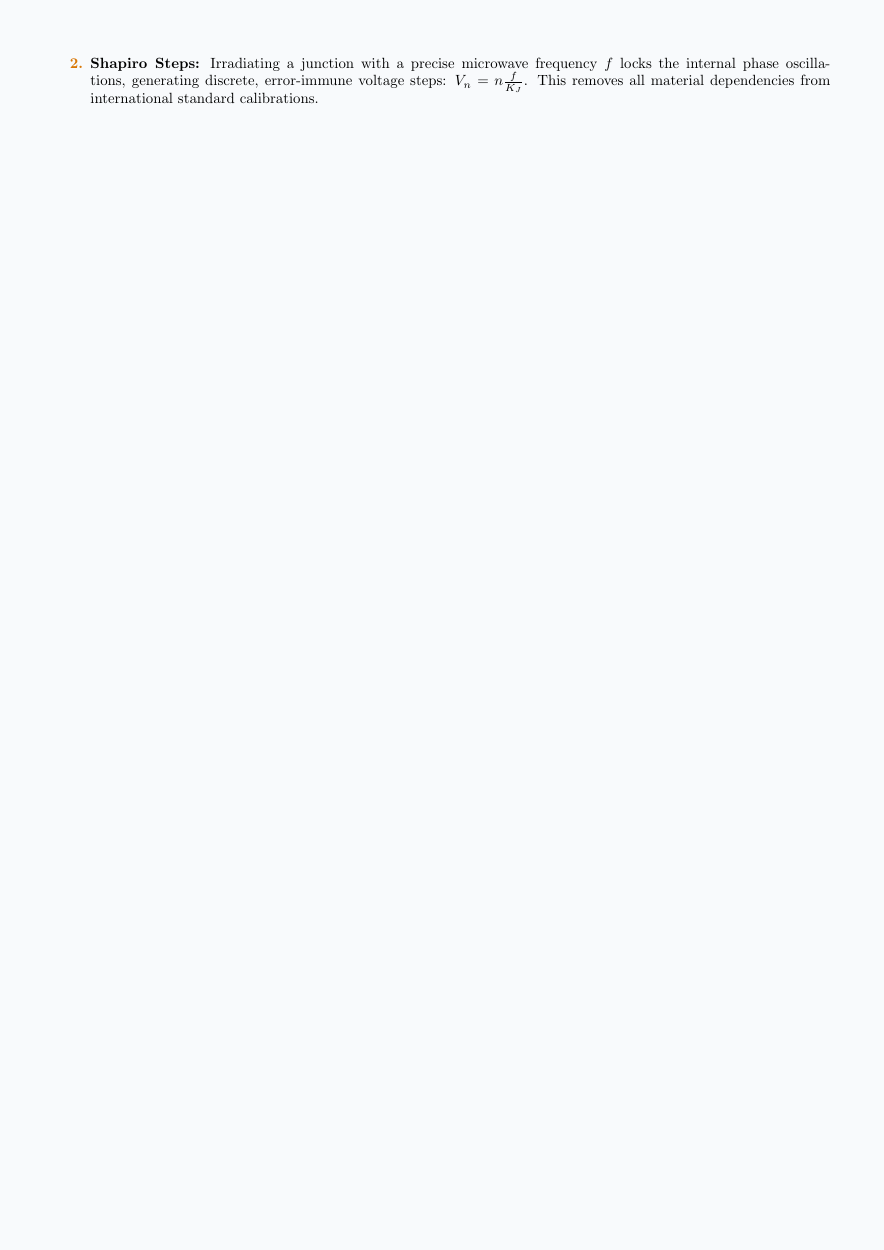
2. Shapiro Steps: Irradiating a junction with a precise microwave frequency f locks the internal phase oscilla-
tions, generating discrete, error-immune voltage steps: Vn = n KJf . This removes all material dependencies from
international standard calibrations.