Mathematical fidelity: These page images preserve the exact notation and visual layout of the supplied PDF. The optional text extract below is for searching/copying only and may contain transcription errors.
Original pages — equations and symbols preserved
Show extracted text (searchable; equations may be imperfect)
Extract · PDF page 1
THE MICROSCOPIC AND PHENOMENOLOGICAL FOUNDATIONS OF SUPERCONDUCTIVITY
LONDON & BCS THEORIES
Electrodynamics, Electron-Phonon Coupling, and Cooper Pairing
An axiomatic guide detailing macroscopic shielding, microscopic quantum pairing, and the BCS ground state.
Extract · PDF page 1
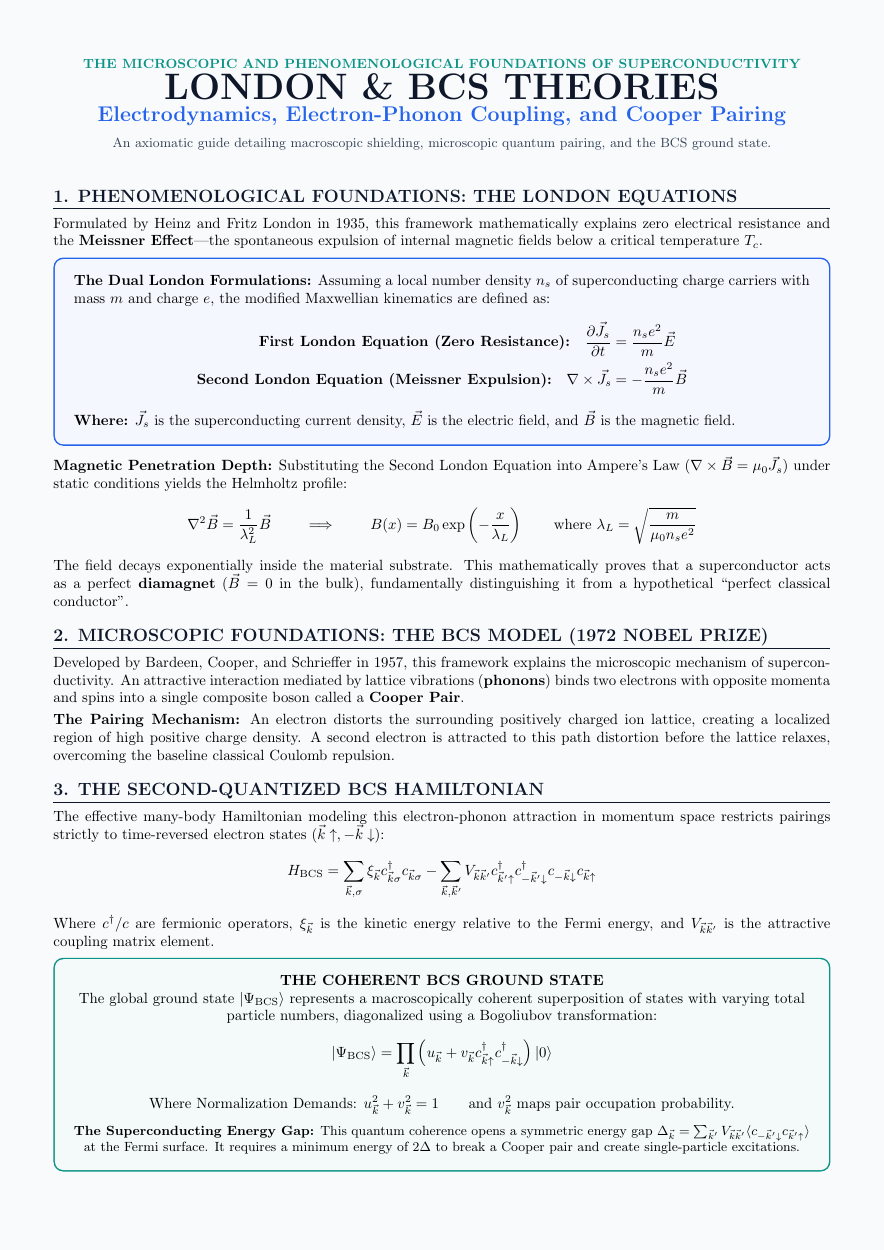
1. PHENOMENOLOGICAL FOUNDATIONS: THE LONDON EQUATIONS
Formulated by Heinz and Fritz London in 1935, this framework mathematically explains zero electrical resistance and
the Meissner Effect—the spontaneous expulsion of internal magnetic fields below a critical temperature Tc.
The Dual London Formulations: Assuming a local number density ns of superconducting charge carriers with
mass m and charge e, the modified Maxwellian kinematics are defined as:
∂⃗Js nse2 First London Equation (Zero Resistance): = ⃗E
∂t m
Second London Equation (Meissner Expulsion): ∇× ⃗Js = −nse2 ⃗B
m
Where: ⃗Js is the superconducting current density, ⃗E is the electric field, and ⃗B is the magnetic field.
Magnetic Penetration Depth: Substituting the Second London Equation into Ampere’s Law (∇× ⃗B = µ0 ⃗Js) under
static conditions yields the Helmholtz profile:
1
∇2 ⃗B = ⃗B =⇒ B(x) = B0 exp −x where λL = r m
λ2L λL µ0nse2
The field decays exponentially inside the material substrate. This mathematically proves that a superconductor acts
as a perfect diamagnet ( ⃗B = 0 in the bulk), fundamentally distinguishing it from a hypothetical “perfect classical
conductor”.
Extract · PDF page 1
2. MICROSCOPIC FOUNDATIONS: THE BCS MODEL (1972 NOBEL PRIZE)
Developed by Bardeen, Cooper, and Schrieffer in 1957, this framework explains the microscopic mechanism of supercon-
ductivity. An attractive interaction mediated by lattice vibrations (phonons) binds two electrons with opposite momenta
and spins into a single composite boson called a Cooper Pair.
The Pairing Mechanism: An electron distorts the surrounding positively charged ion lattice, creating a localized
region of high positive charge density. A second electron is attracted to this path distortion before the lattice relaxes,
overcoming the baseline classical Coulomb repulsion.
Extract · PDF page 1
3. THE SECOND-QUANTIZED BCS HAMILTONIAN
The effective many-body Hamiltonian modeling this electron-phonon attraction in momentum space restricts pairings
strictly to time-reversed electron states (⃗k ↑, −⃗k ↓):
HBCS = X ξ⃗kc†⃗kσc⃗kσ − X V⃗k⃗k′c†⃗k′↑c†−⃗k′↓c−⃗k↓c⃗k↑
⃗k,σ ⃗k,⃗k′
Where c†/c are fermionic operators, ξ⃗k is the kinetic energy relative to the Fermi energy, and V⃗k⃗k′ is the attractive
coupling matrix element.
THE COHERENT BCS GROUND STATE
The global ground state |ΨBCS⟩represents a macroscopically coherent superposition of states with varying total
particle numbers, diagonalized using a Bogoliubov transformation:
|ΨBCS⟩= Y u⃗k + v⃗kc†⃗k↑c†−⃗k↓ |0⟩
⃗k
Where Normalization Demands: u2 + v2 = 1 and v2 maps pair occupation probability. ⃗k ⃗k ⃗k
The Superconducting Energy Gap: This quantum coherence opens a symmetric energy gap ∆⃗k = P⃗k′ V⃗k⃗k′⟨c−⃗k′↓c⃗k′↑⟩
at the Fermi surface. It requires a minimum energy of 2∆to break a Cooper pair and create single-particle excitations.
Extract · PDF page 2
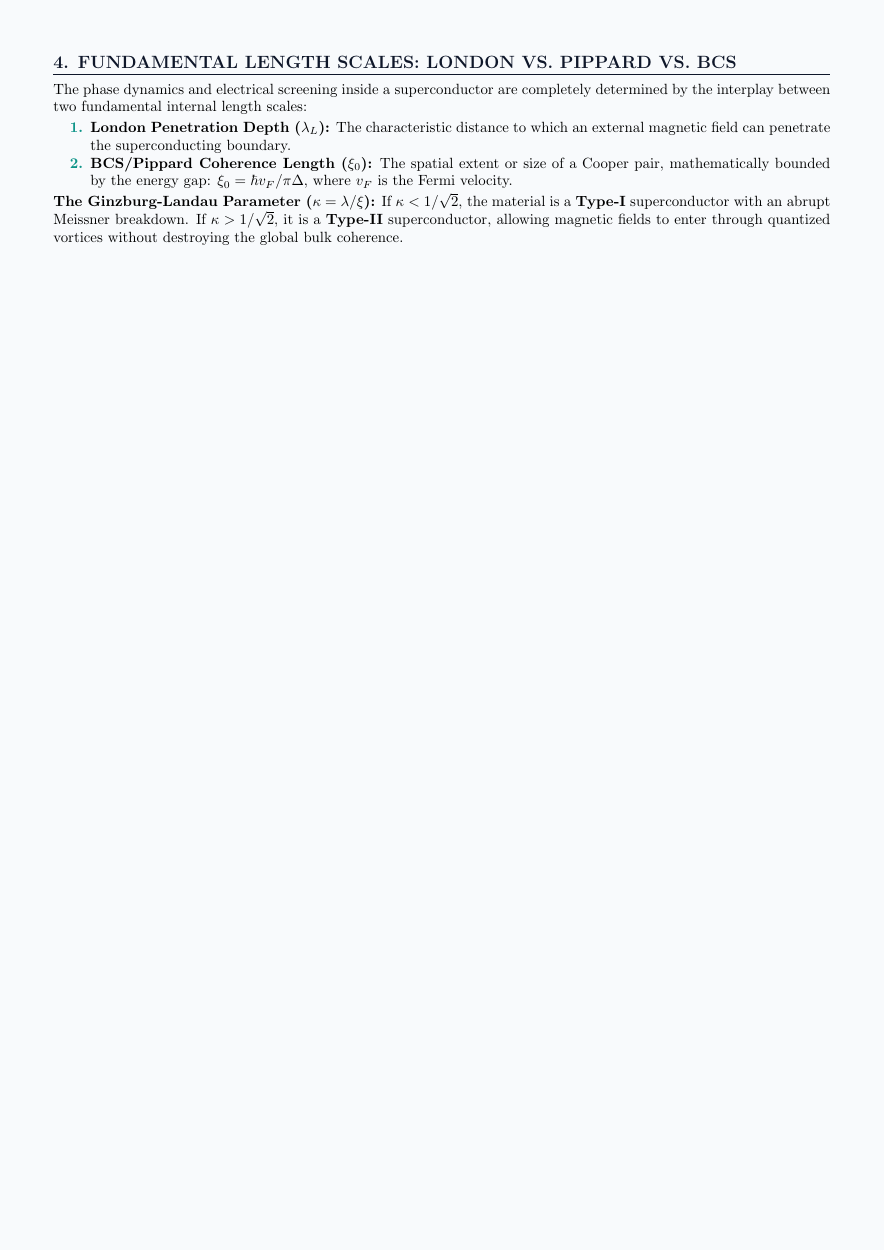
4. FUNDAMENTAL LENGTH SCALES: LONDON VS. PIPPARD VS. BCS
The phase dynamics and electrical screening inside a superconductor are completely determined by the interplay between
two fundamental internal length scales:
1. London Penetration Depth (λL): The characteristic distance to which an external magnetic field can penetrate
the superconducting boundary.
2. BCS/Pippard Coherence Length (ξ0): The spatial extent or size of a Cooper pair, mathematically bounded
by the energy gap: ξ0 = ℏvF /π∆, where vF is the Fermi velocity. √
The Ginzburg-Landau Parameter (κ = λ/ξ): If κ < 1/ 2, the material is a Type-I superconductor with an abrupt √
Meissner breakdown. If κ > 1/ 2, it is a Type-II superconductor, allowing magnetic fields to enter through quantized
vortices without destroying the global bulk coherence.