Mathematical fidelity: These page images preserve the exact notation and visual layout of the supplied PDF. The optional text extract below is for searching/copying only and may contain transcription errors.
Original pages — equations and symbols preserved

Show extracted text (searchable; equations may be imperfect)
Extract · PDF page 1
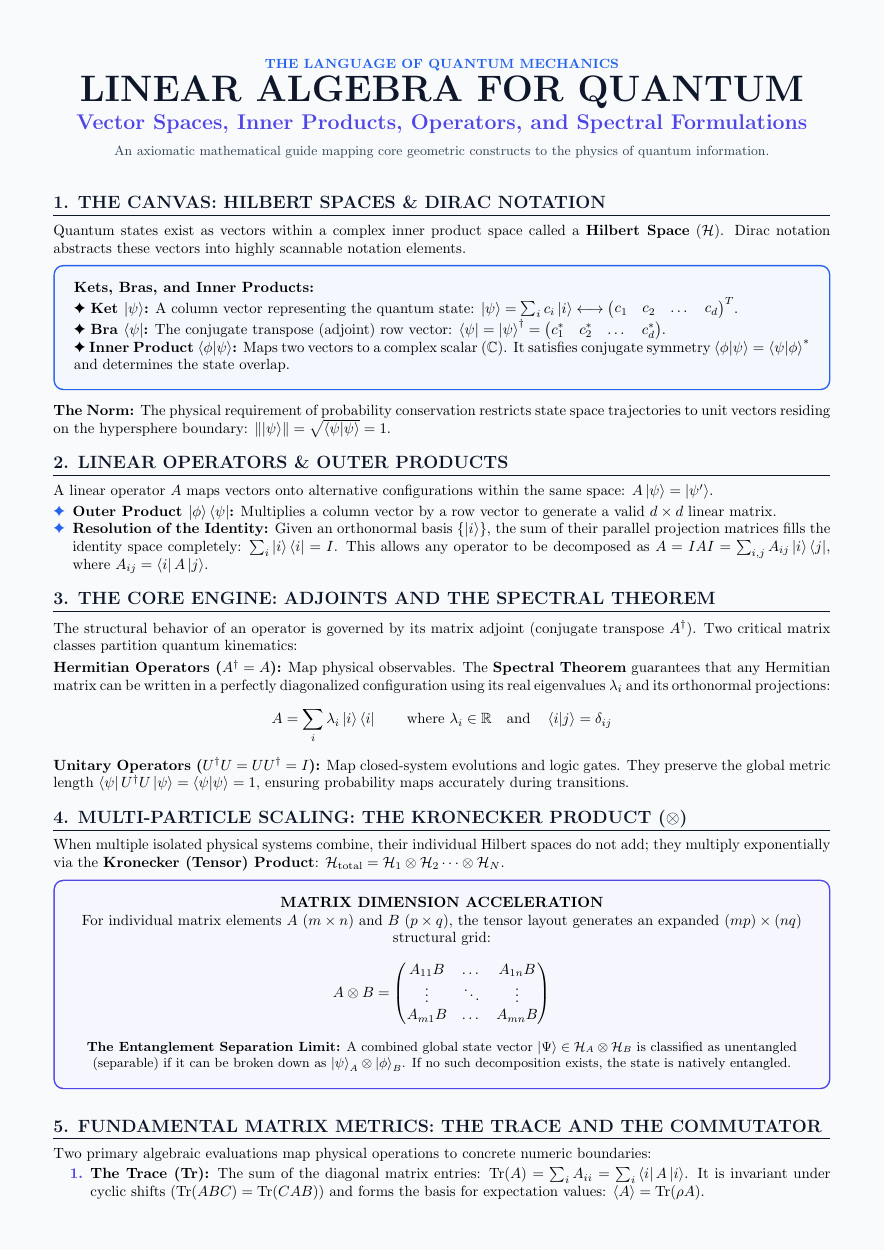
THE LANGUAGE OF QUANTUM MECHANICS
LINEAR ALGEBRA FOR QUANTUM
Vector Spaces, Inner Products, Operators, and Spectral Formulations
An axiomatic mathematical guide mapping core geometric constructs to the physics of quantum information.
Extract · PDF page 1
1. THE CANVAS: HILBERT SPACES & DIRAC NOTATION
Quantum states exist as vectors within a complex inner product space called a Hilbert Space (H). Dirac notation
abstracts these vectors into highly scannable notation elements.
Kets, Bras, and Inner Products:
✦Ket |ψ⟩: A column vector representing the quantum state: |ψ⟩= Pi ci |i⟩←→ c1 c2 . . . cd T .
✦Bra ⟨ψ|: The conjugate transpose (adjoint) row vector: ⟨ψ| = |ψ⟩† = c∗1 c∗2 . . . c∗d .
✦Inner Product ⟨ϕ|ψ⟩: Maps two vectors to a complex scalar (C). It satisfies conjugate symmetry ⟨ϕ|ψ⟩= ⟨ψ|ϕ⟩∗
and determines the state overlap.
The Norm: The physical requirement of probability conservation restricts state space trajectories to unit vectors residing
on the hypersphere boundary: ∥|ψ⟩∥= p ⟨ψ|ψ⟩= 1.
Extract · PDF page 1
2. LINEAR OPERATORS & OUTER PRODUCTS
A linear operator A maps vectors onto alternative configurations within the same space: A |ψ⟩= |ψ′⟩.
✦Outer Product |ϕ⟩⟨ψ|: Multiplies a column vector by a row vector to generate a valid d × d linear matrix.
✦Resolution of the Identity: Given an orthonormal basis {|i⟩}, the sum of their parallel projection matrices fills the
identity space completely: Pi |i⟩⟨i| = I. This allows any operator to be decomposed as A = IAI = Pi,j Aij |i⟩⟨j|,
where Aij = ⟨i| A |j⟩.
Extract · PDF page 1
3. THE CORE ENGINE: ADJOINTS AND THE SPECTRAL THEOREM
The structural behavior of an operator is governed by its matrix adjoint (conjugate transpose A†). Two critical matrix
classes partition quantum kinematics:
Hermitian Operators (A† = A): Map physical observables. The Spectral Theorem guarantees that any Hermitian
matrix can be written in a perfectly diagonalized configuration using its real eigenvalues λi and its orthonormal projections:
A = X λi |i⟩⟨i| where λi ∈R and ⟨i|j⟩= δij
i
Unitary Operators (U †U = UU † = I): Map closed-system evolutions and logic gates. They preserve the global metric
length ⟨ψ| U †U |ψ⟩= ⟨ψ|ψ⟩= 1, ensuring probability maps accurately during transitions.
Extract · PDF page 1
4. MULTI-PARTICLE SCALING: THE KRONECKER PRODUCT (⊗)
When multiple isolated physical systems combine, their individual Hilbert spaces do not add; they multiply exponentially
via the Kronecker (Tensor) Product: Htotal = H1 ⊗H2 · · · ⊗HN.
MATRIX DIMENSION ACCELERATION
For individual matrix elements A (m × n) and B (p × q), the tensor layout generates an expanded (mp) × (nq)
structural grid:
A11B . . . A1nB
A ⊗B = ... ... ...
Am1B . . . AmnB
The Entanglement Separation Limit: A combined global state vector |Ψ⟩∈HA ⊗HB is classified as unentangled
(separable) if it can be broken down as |ψ⟩A ⊗|ϕ⟩B. If no such decomposition exists, the state is natively entangled.
Extract · PDF page 1
5. FUNDAMENTAL MATRIX METRICS: THE TRACE AND THE COMMUTATOR
Two primary algebraic evaluations map physical operations to concrete numeric boundaries:
1. The Trace (Tr): The sum of the diagonal matrix entries: Tr(A) = Pi Aii = Pi ⟨i| A |i⟩. It is invariant under
cyclic shifts (Tr(ABC) = Tr(CAB)) and forms the basis for expectation values: ⟨A⟩= Tr(ρA).
Extract · PDF page 2
2. The Commutator ([A, B] = AB −BA): Quantifies matrix non-commutativity. If [A, B] ̸= 0, the corresponding
matrices do not share a common basis, preventing concurrent deterministic measurements.