Mathematical fidelity: These page images preserve the exact notation and visual layout of the supplied PDF. The optional text extract below is for searching/copying only and may contain transcription errors.
Original pages — equations and symbols preserved

Show extracted text (searchable; equations may be imperfect)
Extract · PDF page 1
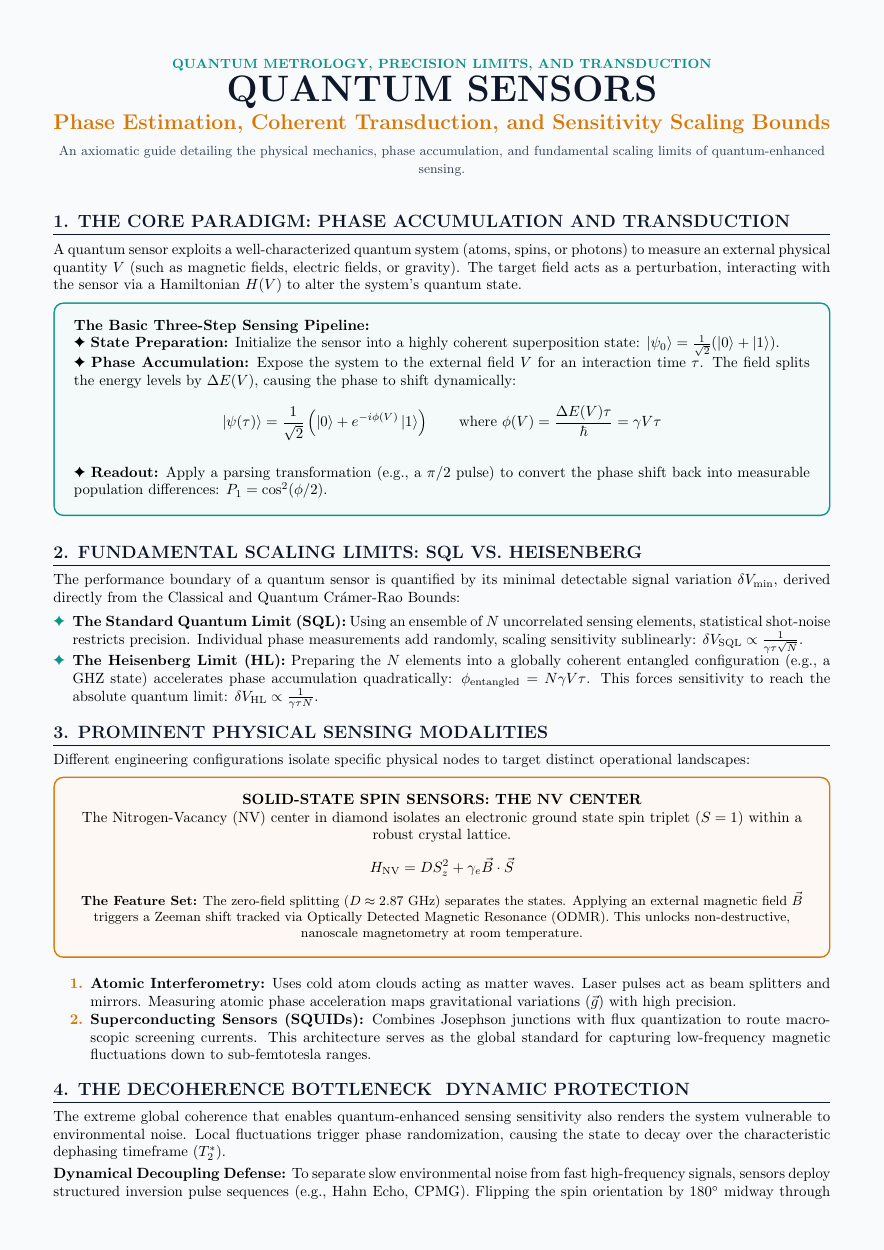
QUANTUM METROLOGY, PRECISION LIMITS, AND TRANSDUCTION
QUANTUM SENSORS
Phase Estimation, Coherent Transduction, and Sensitivity Scaling Bounds
An axiomatic guide detailing the physical mechanics, phase accumulation, and fundamental scaling limits of quantum-enhanced
sensing.
Extract · PDF page 1
1. THE CORE PARADIGM: PHASE ACCUMULATION AND TRANSDUCTION
A quantum sensor exploits a well-characterized quantum system (atoms, spins, or photons) to measure an external physical
quantity V (such as magnetic fields, electric fields, or gravity). The target field acts as a perturbation, interacting with
the sensor via a Hamiltonian H(V ) to alter the system’s quantum state.
The Basic Three-Step Sensing Pipeline:
✦State Preparation: Initialize the sensor into a highly coherent superposition state: |ψ0⟩= √12(|0⟩+ |1⟩).
✦Phase Accumulation: Expose the system to the external field V for an interaction time τ. The field splits
the energy levels by ∆E(V ), causing the phase to shift dynamically:
1 ) ∆E(V )τ |ψ(τ)⟩= √ |0⟩+ e−iϕ(V |1⟩ where ϕ(V ) = = γV τ ℏ 2
✦Readout: Apply a parsing transformation (e.g., a π/2 pulse) to convert the phase shift back into measurable
population differences: P1 = cos2(ϕ/2).
Extract · PDF page 1
2. FUNDAMENTAL SCALING LIMITS: SQL VS. HEISENBERG
The performance boundary of a quantum sensor is quantified by its minimal detectable signal variation δVmin, derived
directly from the Classical and Quantum Cr´amer-Rao Bounds:
✦The Standard Quantum Limit (SQL): Using an ensemble of N uncorrelated sensing elements, statistical shot-noise
restricts precision. Individual phase measurements add randomly, scaling sensitivity sublinearly: δVSQL ∝ √1 . γτ N
✦The Heisenberg Limit (HL): Preparing the N elements into a globally coherent entangled configuration (e.g., a
GHZ state) accelerates phase accumulation quadratically: ϕentangled = NγV τ. This forces sensitivity to reach the
absolute quantum limit: δVHL ∝ γτN1 .
Extract · PDF page 1
3. PROMINENT PHYSICAL SENSING MODALITIES
Different engineering configurations isolate specific physical nodes to target distinct operational landscapes:
SOLID-STATE SPIN SENSORS: THE NV CENTER
The Nitrogen-Vacancy (NV) center in diamond isolates an electronic ground state spin triplet (S = 1) within a
robust crystal lattice.
HNV = DS2z + γe ⃗B · ⃗S
The Feature Set: The zero-field splitting (D ≈2.87 GHz) separates the states. Applying an external magnetic field ⃗B
triggers a Zeeman shift tracked via Optically Detected Magnetic Resonance (ODMR). This unlocks non-destructive,
nanoscale magnetometry at room temperature.
1. Atomic Interferometry: Uses cold atom clouds acting as matter waves. Laser pulses act as beam splitters and
mirrors. Measuring atomic phase acceleration maps gravitational variations (⃗g) with high precision.
Extract · PDF page 1
2. Superconducting Sensors (SQUIDs): Combines Josephson junctions with flux quantization to route macro-
scopic screening currents. This architecture serves as the global standard for capturing low-frequency magnetic
fluctuations down to sub-femtotesla ranges.
Extract · PDF page 1
4. THE DECOHERENCE BOTTLENECK DYNAMIC PROTECTION
The extreme global coherence that enables quantum-enhanced sensing sensitivity also renders the system vulnerable to
environmental noise. Local fluctuations trigger phase randomization, causing the state to decay over the characteristic
dephasing timeframe (T2∗ ).
Dynamical Decoupling Defense: To separate slow environmental noise from fast high-frequency signals, sensors deploy
structured inversion pulse sequences (e.g., Hahn Echo, CPMG). Flipping the spin orientation by 180◦midway through
Extract · PDF page 2
the accumulation profile rewinds the path errors induced by stationary noise, preserving global quantum coherence over
extended runtimes.