Mathematical fidelity: These page images preserve the exact notation and visual layout of the supplied PDF. The optional text extract below is for searching/copying only and may contain transcription errors.
Original pages — equations and symbols preserved
Show extracted text (searchable; equations may be imperfect)
Extract · PDF page 1
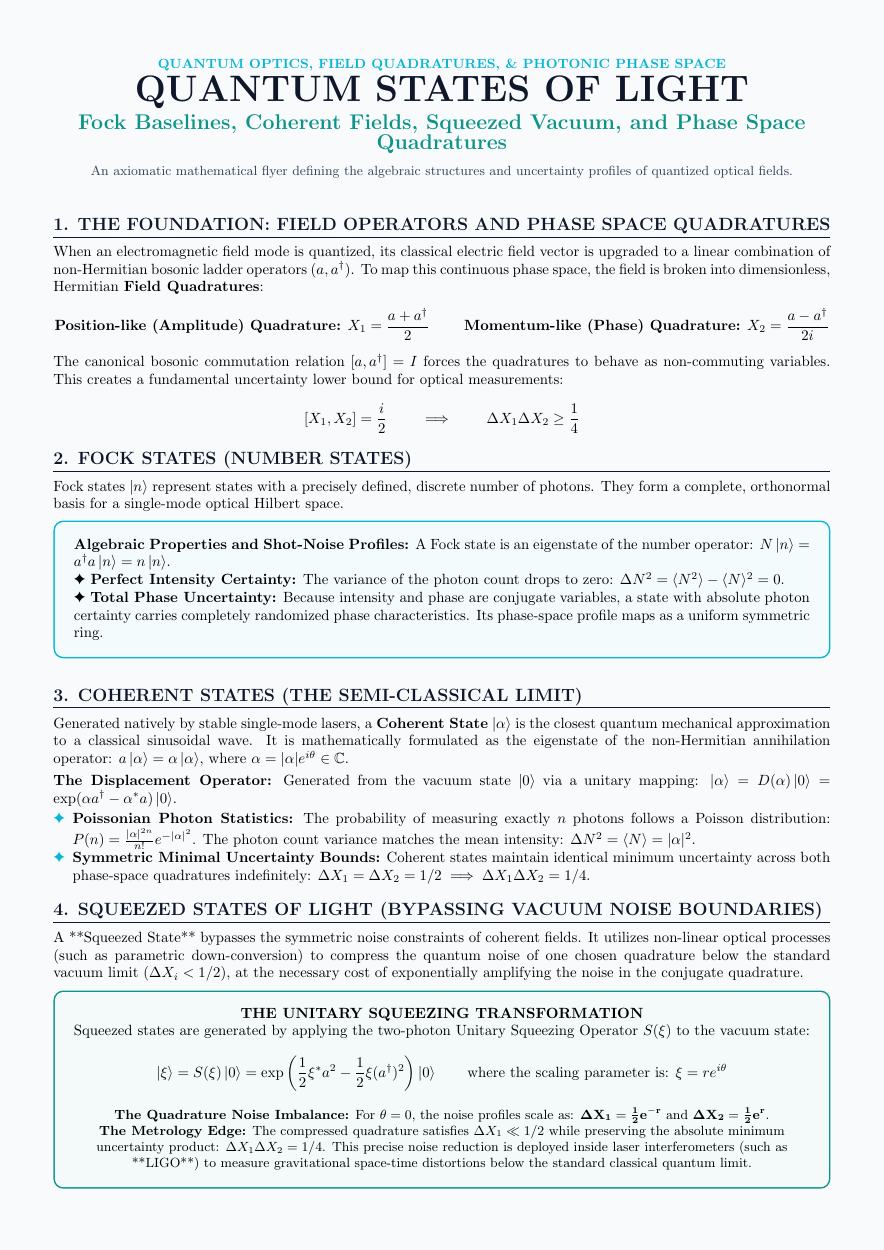
QUANTUM OPTICS, FIELD QUADRATURES, & PHOTONIC PHASE SPACE
QUANTUM STATES OF LIGHT
Fock Baselines, Coherent Fields, Squeezed Vacuum, and Phase Space
Quadratures
An axiomatic mathematical flyer defining the algebraic structures and uncertainty profiles of quantized optical fields.
Extract · PDF page 1
1. THE FOUNDATION: FIELD OPERATORS AND PHASE SPACE QUADRATURES
When an electromagnetic field mode is quantized, its classical electric field vector is upgraded to a linear combination of
non-Hermitian bosonic ladder operators (a, a†). To map this continuous phase space, the field is broken into dimensionless,
Hermitian Field Quadratures:
a + a† a −a†
Position-like (Amplitude) Quadrature: X1 = Momentum-like (Phase) Quadrature: X2 =
2 2i
The canonical bosonic commutation relation [a, a†] = I forces the quadratures to behave as non-commuting variables.
This creates a fundamental uncertainty lower bound for optical measurements:
i
[X1, X2] = =⇒ ∆X1∆X2 ≥1
2 4
Extract · PDF page 1
2. FOCK STATES (NUMBER STATES)
Fock states |n⟩represent states with a precisely defined, discrete number of photons. They form a complete, orthonormal
basis for a single-mode optical Hilbert space.
Algebraic Properties and Shot-Noise Profiles: A Fock state is an eigenstate of the number operator: N |n⟩=
a†a |n⟩= n |n⟩.
✦Perfect Intensity Certainty: The variance of the photon count drops to zero: ∆N 2 = ⟨N 2⟩−⟨N⟩2 = 0.
✦Total Phase Uncertainty: Because intensity and phase are conjugate variables, a state with absolute photon
certainty carries completely randomized phase characteristics. Its phase-space profile maps as a uniform symmetric
ring.
Extract · PDF page 1
3. COHERENT STATES (THE SEMI-CLASSICAL LIMIT)
Generated natively by stable single-mode lasers, a Coherent State |α⟩is the closest quantum mechanical approximation
to a classical sinusoidal wave. It is mathematically formulated as the eigenstate of the non-Hermitian annihilation
operator: a |α⟩= α |α⟩, where α = |α|eiθ ∈C.
The Displacement Operator: Generated from the vacuum state |0⟩via a unitary mapping: |α⟩= D(α) |0⟩=
exp(αa† −α∗a) |0⟩.
✦Poissonian Photon Statistics: The probability of measuring exactly n photons follows a Poisson distribution:
|α|2n 2 P(n) = n! e−|α|2. The photon count variance matches the mean intensity: ∆N = ⟨N⟩= |α|2.
✦Symmetric Minimal Uncertainty Bounds: Coherent states maintain identical minimum uncertainty across both
phase-space quadratures indefinitely: ∆X1 = ∆X2 = 1/2 =⇒∆X1∆X2 = 1/4.
Extract · PDF page 1
4. SQUEEZED STATES OF LIGHT (BYPASSING VACUUM NOISE BOUNDARIES)
A **Squeezed State** bypasses the symmetric noise constraints of coherent fields. It utilizes non-linear optical processes
(such as parametric down-conversion) to compress the quantum noise of one chosen quadrature below the standard
vacuum limit (∆Xi < 1/2), at the necessary cost of exponentially amplifying the noise in the conjugate quadrature.
THE UNITARY SQUEEZING TRANSFORMATION
Squeezed states are generated by applying the two-photon Unitary Squeezing Operator S(ξ) to the vacuum state:
|ξ⟩= S(ξ) |0⟩= exp 1 −1 |0⟩ where the scaling parameter is: ξ = reiθ 2ξ∗a2 2ξ(a†)2
The Quadrature Noise Imbalance: For θ = 0, the noise profiles scale as: ∆X1 = 12e−r and ∆X2 = 2er.1
The Metrology Edge: The compressed quadrature satisfies ∆X1 ≪1/2 while preserving the absolute minimum
uncertainty product: ∆X1∆X2 = 1/4. This precise noise reduction is deployed inside laser interferometers (such as
**LIGO**) to measure gravitational space-time distortions below the standard classical quantum limit.
Extract · PDF page 2
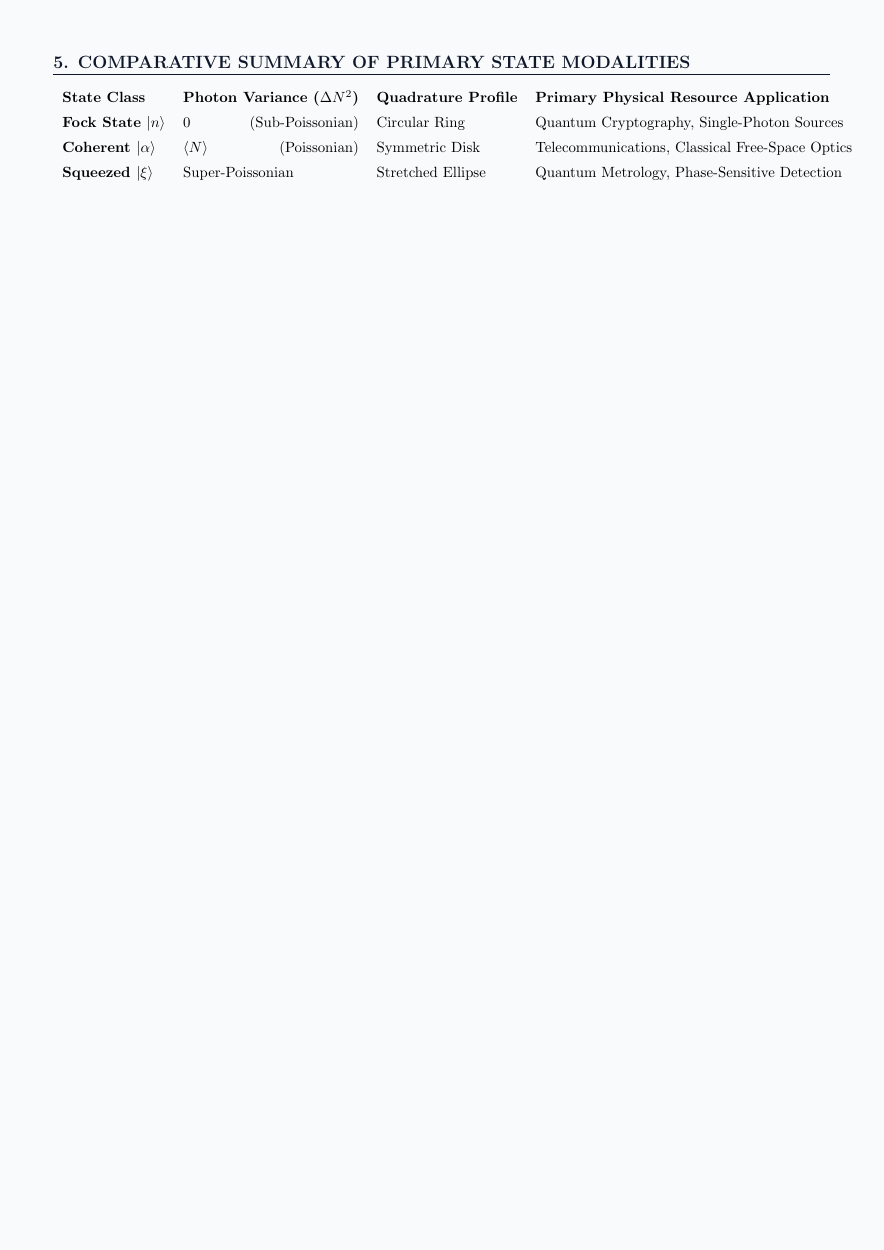
5. COMPARATIVE SUMMARY OF PRIMARY STATE MODALITIES
State Class Photon Variance (∆N 2) Quadrature Profile Primary Physical Resource Application
Fock State |n⟩ 0 (Sub-Poissonian) Circular Ring Quantum Cryptography, Single-Photon Sources
Coherent |α⟩ ⟨N⟩ (Poissonian) Symmetric Disk Telecommunications, Classical Free-Space Optics
Squeezed |ξ⟩ Super-Poissonian Stretched Ellipse Quantum Metrology, Phase-Sensitive Detection