Mathematical fidelity: These page images preserve the exact notation and visual layout of the supplied PDF. The optional text extract below is for searching/copying only and may contain transcription errors.
Original pages — equations and symbols preserved

Show extracted text (searchable; equations may be imperfect)
Extract · PDF page 1
WAVE FUNCTION EVANESCENCE & POTENTIAL BARRIER PENETRATION
QUANTUM TUNNELING
Boundary Boundary Matching, Transmission Coefficients, and Solid-State
Systems
An axiomatic mathematical guide mapping the explicit wave mechanics that allow particles to bypass classical energy barriers.
Extract · PDF page 1
1. THE PARADIGM SHIFT: DEFYING ABSOLUTE KINETIC BOUNDARIES
In classical mechanics, a particle of mass m and total energy E encountering a localized spatial potential energy barrier
V (x) = V0 is governed by strict energy conservation constraints. If E < V0, the particle’s classical kinetic energy becomes
negative, forcing a deterministic reflection at the boundary interface. Quantum mechanics rejects this absolute barrier
constraint by re-mapping particle dynamics into a continuous, non-local probability wave distribution.
Extract · PDF page 1
2. EXPLICIT ANALYTICAL DERIVATION: THE FINITE RECTANGULAR BAR-
RIER
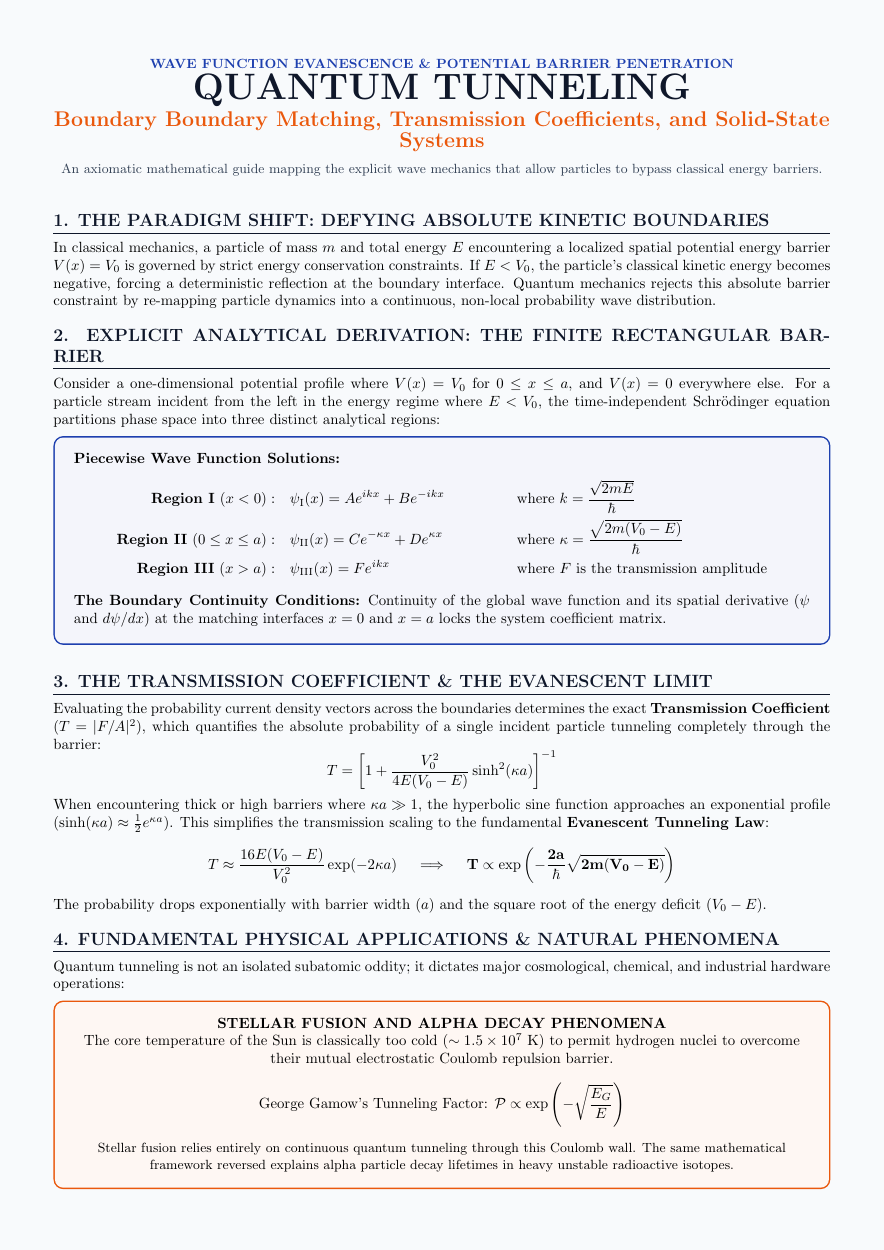
Consider a one-dimensional potential profile where V (x) = V0 for 0 ≤x ≤a, and V (x) = 0 everywhere else. For a
particle stream incident from the left in the energy regime where E < V0, the time-independent Schr¨odinger equation
partitions phase space into three distinct analytical regions:
Piecewise Wave Function Solutions:
√
2mE
Region I (x < 0) : ψI(x) = Aeikx + Be−ikx where k = ℏ
p2m(V0 −E)
Region II (0 ≤x ≤a) : ψII(x) = Ce−κx + Deκx where κ = ℏ
Region III (x > a) : ψIII(x) = Feikx where F is the transmission amplitude
The Boundary Continuity Conditions: Continuity of the global wave function and its spatial derivative (ψ
and dψ/dx) at the matching interfaces x = 0 and x = a locks the system coefficient matrix.
Extract · PDF page 1
3. THE TRANSMISSION COEFFICIENT & THE EVANESCENT LIMIT
Evaluating the probability current density vectors across the boundaries determines the exact Transmission Coefficient
(T = |F/A|2), which quantifies the absolute probability of a single incident particle tunneling completely through the
barrier:
2 −1
V 0 T = 1 + sinh2(κa)
4E(V0 −E)
When encountering thick or high barriers where κa ≫1, the hyperbolic sine function approaches an exponential profile
(sinh(κa) ≈12eκa). This simplifies the transmission scaling to the fundamental Evanescent Tunneling Law:
−E) T ≈16E(V0 exp(−2κa) =⇒ T ∝exp −2a p 2m(V0 −E) ℏ V 02
The probability drops exponentially with barrier width (a) and the square root of the energy deficit (V0 −E).
Extract · PDF page 1
4. FUNDAMENTAL PHYSICAL APPLICATIONS & NATURAL PHENOMENA
Quantum tunneling is not an isolated subatomic oddity; it dictates major cosmological, chemical, and industrial hardware
operations:
STELLAR FUSION AND ALPHA DECAY PHENOMENA
The core temperature of the Sun is classically too cold (∼1.5 × 10⁷ K) to permit hydrogen nuclei to overcome
their mutual electrostatic Coulomb repulsion barrier.
r EG !
George Gamow’s Tunneling Factor: P ∝exp −
E
Stellar fusion relies entirely on continuous quantum tunneling through this Coulomb wall. The same mathematical
framework reversed explains alpha particle decay lifetimes in heavy unstable radioactive isotopes.
Extract · PDF page 2
1. Scanning Tunneling Microscopy (STM): Maps surface atomic structures with picometer resolution by sweeping
a sharp conductive tip past a sample. Because the tunneling current tracks exponentially with the air gap (I ∝
T ∝e−2κa), sub-angstrom distance changes trigger massive, clean electrical current shifts.
2. Flash Memory Architectures: Solid-state drives write and erase data bits using Fowler-Nordheim tunneling
mechanics. Applying a localized electric field tilts the oxide potential barrier into a triangular shape, allowing
electrons to slip into a floating gate to store charge data.