Mathematical fidelity: These page images preserve the exact notation and visual layout of the supplied PDF. The optional text extract below is for searching/copying only and may contain transcription errors.
Original pages — equations and symbols preserved
Show extracted text (searchable; equations may be imperfect)
Extract · PDF page 1
LIGHT-MATTER INTERACTION & QUANTUM CONTROL
RABI OSCILLATIONS & THE JC
MODEL
Coherent Coaxial Dynamics of Atom-Cavity Coupled Systems
An axiomatic guide detailing semi-classical drives, fully quantized fields, and the Rotating Wave Approximation.
Extract · PDF page 1
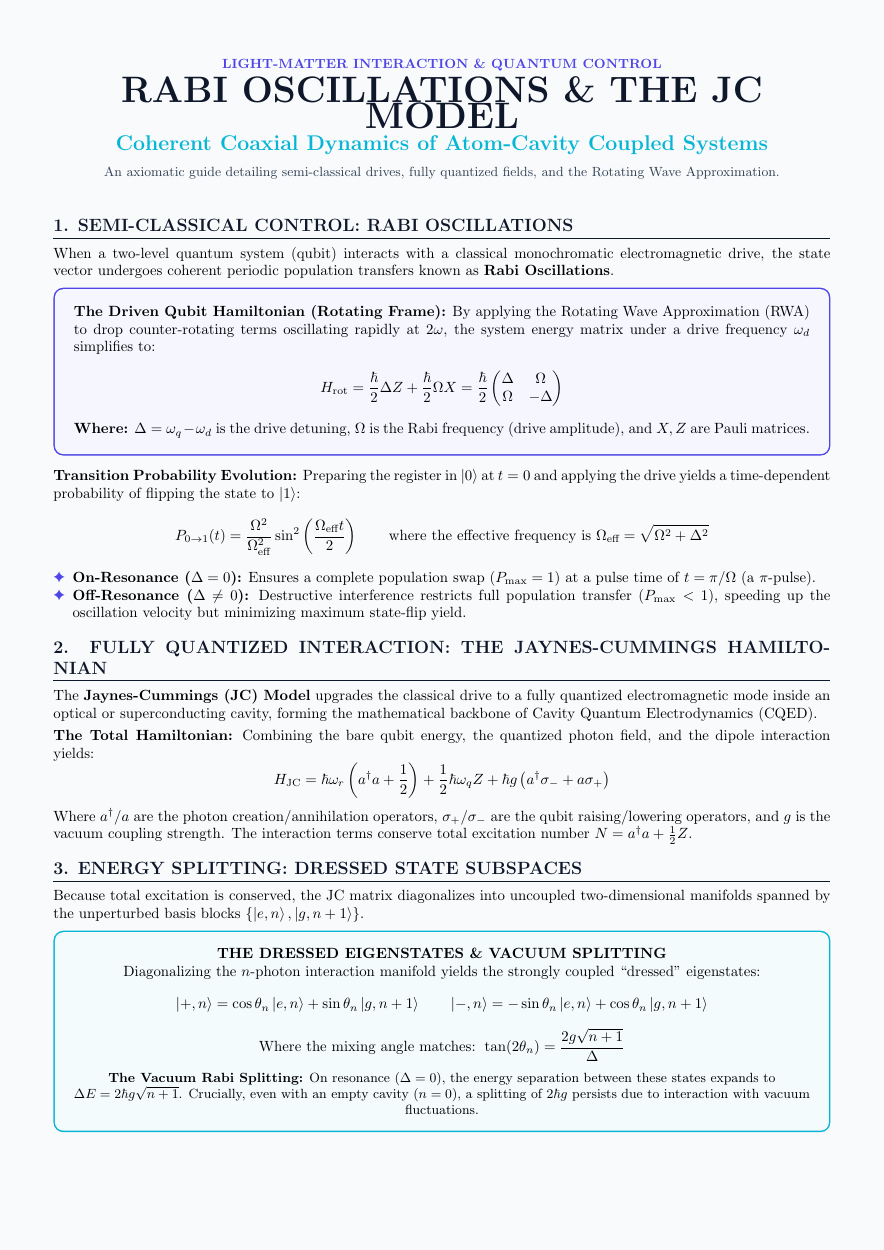
1. SEMI-CLASSICAL CONTROL: RABI OSCILLATIONS
When a two-level quantum system (qubit) interacts with a classical monochromatic electromagnetic drive, the state
vector undergoes coherent periodic population transfers known as Rabi Oscillations.
The Driven Qubit Hamiltonian (Rotating Frame): By applying the Rotating Wave Approximation (RWA)
to drop counter-rotating terms oscillating rapidly at 2ω, the system energy matrix under a drive frequency ωd
simplifies to:
ℏ ℏ ℏ ∆ Ω
Hrot = 2∆Z + 2ΩX = 2 Ω −∆
Where: ∆= ωq −ωd is the drive detuning, Ωis the Rabi frequency (drive amplitude), and X, Z are Pauli matrices.
Transition Probability Evolution: Preparing the register in |0⟩at t = 0 and applying the drive yields a time-dependent
probability of flipping the state to |1⟩:
Ω2 Ωefft
P0→1(t) = sin2 where the effective frequency is Ωeff = p Ω2 + ∆2
Ω2eff 2
✦On-Resonance (∆= 0): Ensures a complete population swap (Pmax = 1) at a pulse time of t = π/Ω(a π-pulse).
✦Off-Resonance (∆̸= 0): Destructive interference restricts full population transfer (Pmax < 1), speeding up the
oscillation velocity but minimizing maximum state-flip yield.
Extract · PDF page 1
2. FULLY QUANTIZED INTERACTION: THE JAYNES-CUMMINGS HAMILTO-
NIAN
The Jaynes-Cummings (JC) Model upgrades the classical drive to a fully quantized electromagnetic mode inside an
optical or superconducting cavity, forming the mathematical backbone of Cavity Quantum Electrodynamics (CQED).
The Total Hamiltonian: Combining the bare qubit energy, the quantized photon field, and the dipole interaction
yields:
1 1
HJC = ℏωr a†a + + + ℏg a†σ−+ aσ+ 2 2ℏωqZ
Where a†/a are the photon creation/annihilation operators, σ+/σ−are the qubit raising/lowering operators, and g is the
vacuum coupling strength. The interaction terms conserve total excitation number N = a†a + 12Z.
Extract · PDF page 1
3. ENERGY SPLITTING: DRESSED STATE SUBSPACES
Because total excitation is conserved, the JC matrix diagonalizes into uncoupled two-dimensional manifolds spanned by
the unperturbed basis blocks {|e, n⟩, |g, n + 1⟩}.
THE DRESSED EIGENSTATES & VACUUM SPLITTING
Diagonalizing the n-photon interaction manifold yields the strongly coupled “dressed” eigenstates:
|+, n⟩= cos θn |e, n⟩+ sin θn |g, n + 1⟩ |−, n⟩= −sin θn |e, n⟩+ cos θn |g, n + 1⟩
2g√n + 1
Where the mixing angle matches: tan(2θn) =
∆
The Vacuum Rabi Splitting: On resonance (∆= 0), the energy separation between these states expands to
∆E = 2ℏg√n + 1. Crucially, even with an empty cavity (n = 0), a splitting of 2ℏg persists due to interaction with vacuum
fluctuations.
Extract · PDF page 2
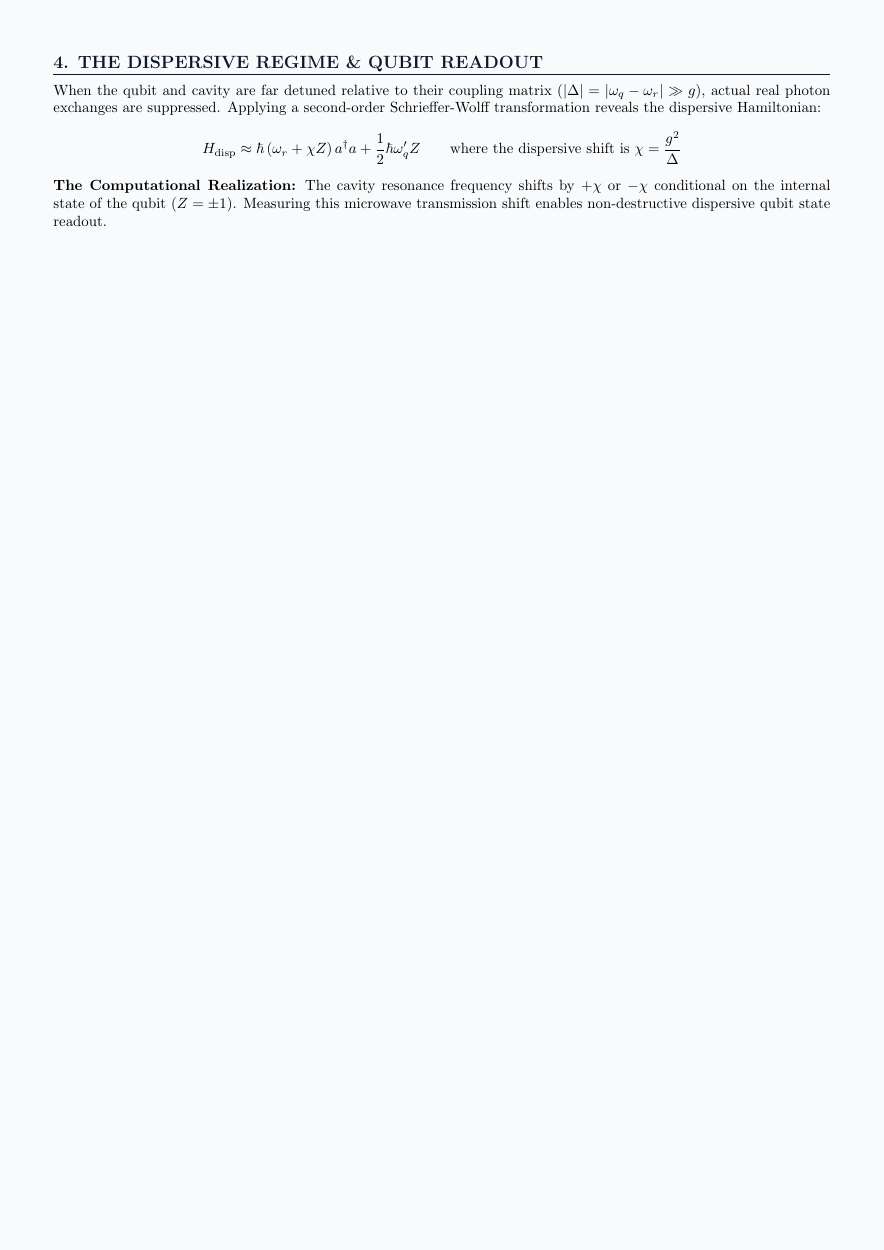
4. THE DISPERSIVE REGIME & QUBIT READOUT
When the qubit and cavity are far detuned relative to their coupling matrix (|∆| = |ωq −ωr| ≫g), actual real photon
exchanges are suppressed. Applying a second-order Schrieffer-Wolff transformation reveals the dispersive Hamiltonian:
1 g2
Hdisp ≈ℏ(ωr + χZ) a†a + 2ℏω′qZ where the dispersive shift is χ = ∆
The Computational Realization: The cavity resonance frequency shifts by +χ or −χ conditional on the internal
state of the qubit (Z = ±1). Measuring this microwave transmission shift enables non-destructive dispersive qubit state
readout.