Mathematical fidelity: These page images preserve the exact notation and visual layout of the supplied PDF. The optional text extract below is for searching/copying only and may contain transcription errors.
Original pages — equations and symbols preserved
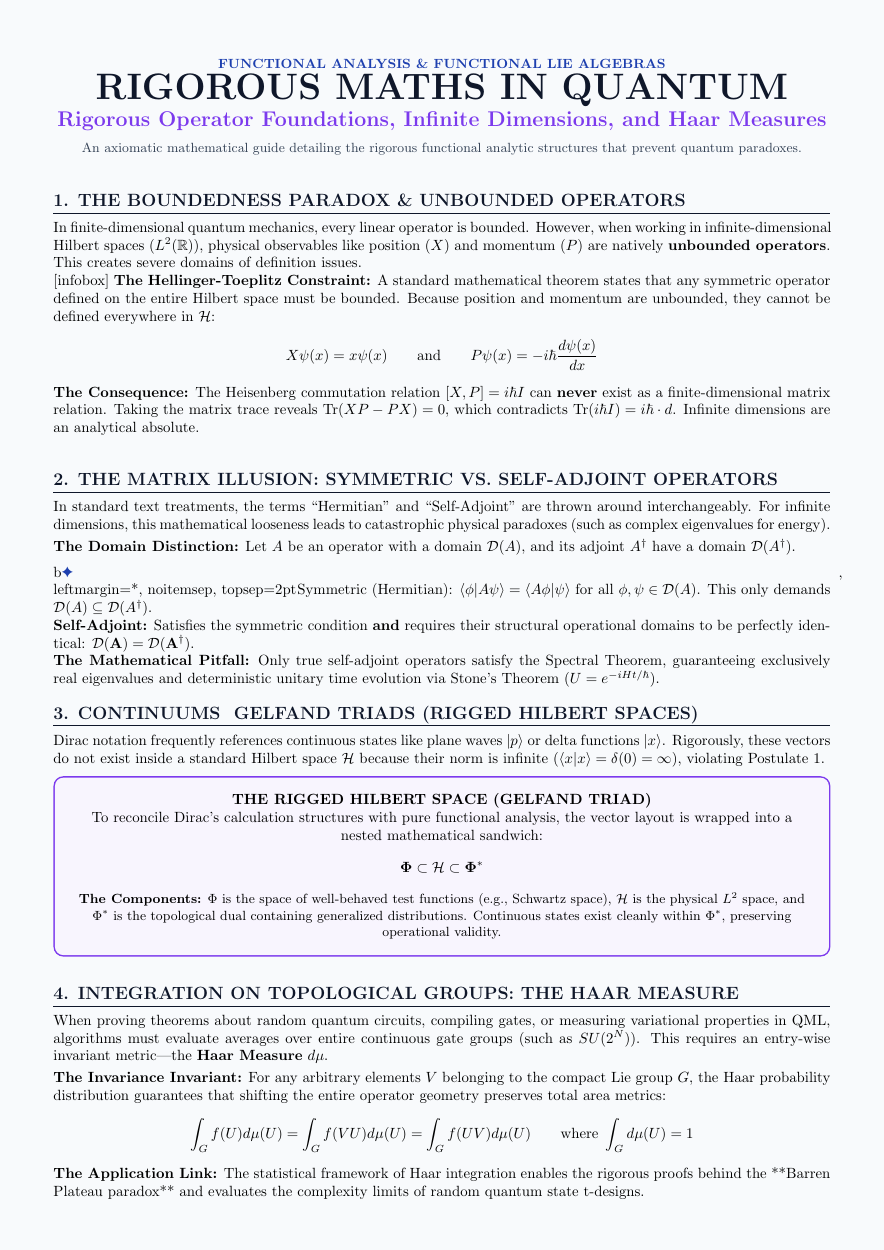
Show extracted text (searchable; equations may be imperfect)
Extract · PDF page 1
FUNCTIONAL ANALYSIS & FUNCTIONAL LIE ALGEBRAS
RIGOROUS MATHS IN QUANTUM
Rigorous Operator Foundations, Infinite Dimensions, and Haar Measures
An axiomatic mathematical guide detailing the rigorous functional analytic structures that prevent quantum paradoxes.
Extract · PDF page 1
1. THE BOUNDEDNESS PARADOX & UNBOUNDED OPERATORS
In finite-dimensional quantum mechanics, every linear operator is bounded. However, when working in infinite-dimensional
Hilbert spaces (L2(R)), physical observables like position (X) and momentum (P) are natively unbounded operators.
This creates severe domains of definition issues.
[infobox] The Hellinger-Toeplitz Constraint: A standard mathematical theorem states that any symmetric operator
defined on the entire Hilbert space must be bounded. Because position and momentum are unbounded, they cannot be
defined everywhere in H:
Xψ(x) = xψ(x) and Pψ(x) = −iℏdψ(x)
dx
The Consequence: The Heisenberg commutation relation [X, P] = iℏI can never exist as a finite-dimensional matrix
relation. Taking the matrix trace reveals Tr(XP −PX) = 0, which contradicts Tr(iℏI) = iℏ· d. Infinite dimensions are
an analytical absolute.
Extract · PDF page 1
2. THE MATRIX ILLUSION: SYMMETRIC VS. SELF-ADJOINT OPERATORS
In standard text treatments, the terms “Hermitian” and “Self-Adjoint” are thrown around interchangeably. For infinite
dimensions, this mathematical looseness leads to catastrophic physical paradoxes (such as complex eigenvalues for energy).
The Domain Distinction: Let A be an operator with a domain D(A), and its adjoint A† have a domain D(A†).
b✦ ,
leftmargin=*, noitemsep, topsep=2ptSymmetric (Hermitian): ⟨ϕ|Aψ⟩= ⟨Aϕ|ψ⟩for all ϕ, ψ ∈D(A). This only demands
D(A) ⊆D(A†).
Self-Adjoint: Satisfies the symmetric condition and requires their structural operational domains to be perfectly iden-
tical: D(A) = D(A†).
The Mathematical Pitfall: Only true self-adjoint operators satisfy the Spectral Theorem, guaranteeing exclusively
real eigenvalues and deterministic unitary time evolution via Stone’s Theorem (U = e−iHt/ℏ).
Extract · PDF page 1
3. CONTINUUMS GELFAND TRIADS (RIGGED HILBERT SPACES)
Dirac notation frequently references continuous states like plane waves |p⟩or delta functions |x⟩. Rigorously, these vectors
do not exist inside a standard Hilbert space H because their norm is infinite (⟨x|x⟩= δ(0) = ∞), violating Postulate 1.
THE RIGGED HILBERT SPACE (GELFAND TRIAD)
To reconcile Dirac’s calculation structures with pure functional analysis, the vector layout is wrapped into a
nested mathematical sandwich:
Φ ⊂H ⊂Φ∗
The Components: Φ is the space of well-behaved test functions (e.g., Schwartz space), H is the physical L2 space, and
Φ∗is the topological dual containing generalized distributions. Continuous states exist cleanly within Φ∗, preserving
operational validity.
Extract · PDF page 1
4. INTEGRATION ON TOPOLOGICAL GROUPS: THE HAAR MEASURE
When proving theorems about random quantum circuits, compiling gates, or measuring variational properties in QML,
algorithms must evaluate averages over entire continuous gate groups (such as SU(2N)). This requires an entry-wise
invariant metric—the Haar Measure dµ.
The Invariance Invariant: For any arbitrary elements V belonging to the compact Lie group G, the Haar probability
distribution guarantees that shifting the entire operator geometry preserves total area metrics:
Z Z Z Z
f(U)dµ(U) = f(V U)dµ(U) = f(UV )dµ(U) where dµ(U) = 1
G G G G
The Application Link: The statistical framework of Haar integration enables the rigorous proofs behind the **Barren
Plateau paradox** and evaluates the complexity limits of random quantum state t-designs.