Mathematical fidelity: These page images preserve the exact notation and visual layout of the supplied PDF. The optional text extract below is for searching/copying only and may contain transcription errors.
Original pages — equations and symbols preserved
Show extracted text (searchable; equations may be imperfect)
Extract · PDF page 1
❍COUNTER-INTUITIVE REALITIES & FOUNDATIONAL ANOMALIES
SURPRISING QUANTUM FACTS
Where Classical Intuition Fails and Matrix Mechanics Rule
An axiomatic flyer exposing mathematically verified anomalies that defy classical macro-world experiences.
Extract · PDF page 1
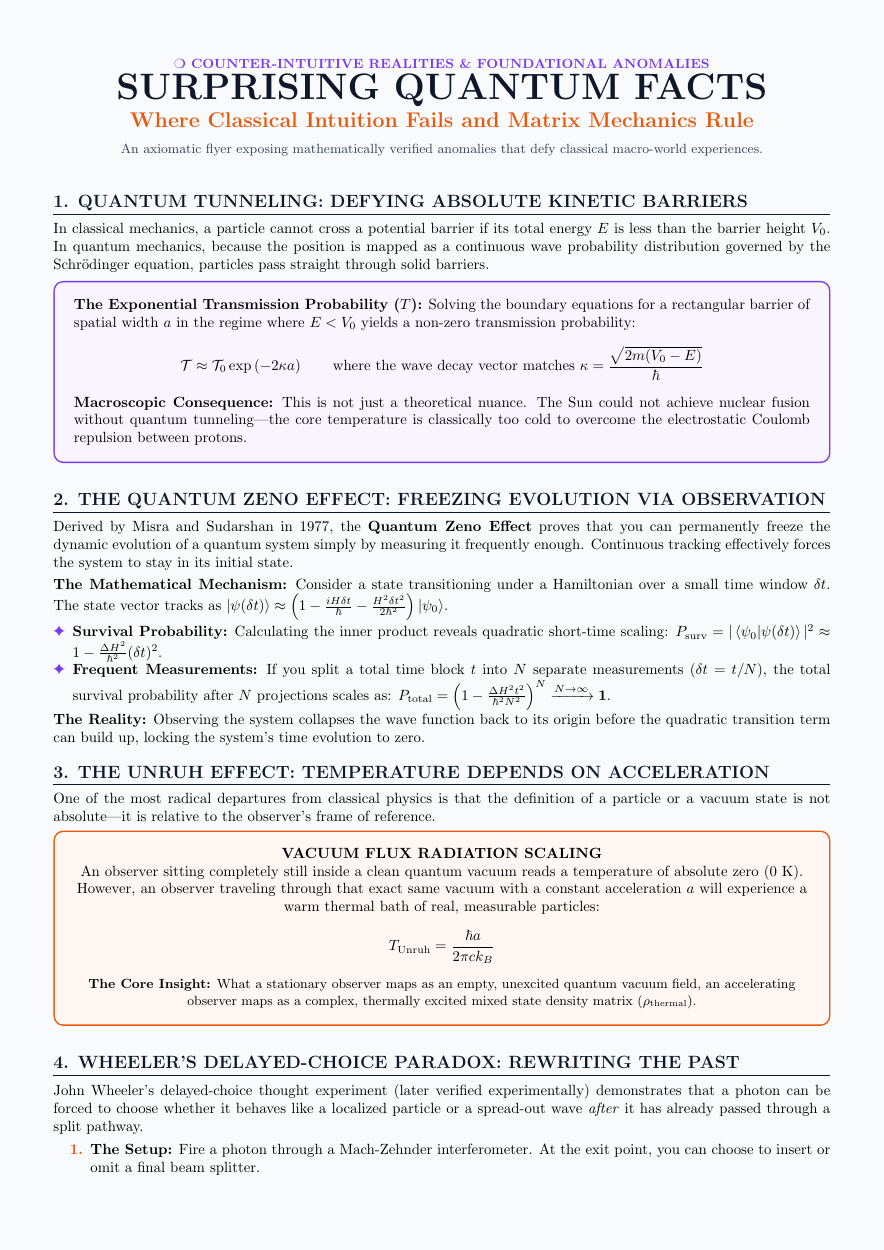
1. QUANTUM TUNNELING: DEFYING ABSOLUTE KINETIC BARRIERS
In classical mechanics, a particle cannot cross a potential barrier if its total energy E is less than the barrier height V0.
In quantum mechanics, because the position is mapped as a continuous wave probability distribution governed by the
Schr¨odinger equation, particles pass straight through solid barriers.
The Exponential Transmission Probability (T): Solving the boundary equations for a rectangular barrier of
spatial width a in the regime where E < V0 yields a non-zero transmission probability:
p 2m(V0 −E)
T ≈T0 exp (−2κa) where the wave decay vector matches κ = ℏ
Macroscopic Consequence: This is not just a theoretical nuance. The Sun could not achieve nuclear fusion
without quantum tunneling—the core temperature is classically too cold to overcome the electrostatic Coulomb
repulsion between protons.
Extract · PDF page 1
2. THE QUANTUM ZENO EFFECT: FREEZING EVOLUTION VIA OBSERVATION
Derived by Misra and Sudarshan in 1977, the Quantum Zeno Effect proves that you can permanently freeze the
dynamic evolution of a quantum system simply by measuring it frequently enough. Continuous tracking effectively forces
the system to stay in its initial state.
The Mathematical Mechanism: Consider a state transitioning under a Hamiltonian over a small time window δt.
The state vector tracks as |ψ(δt)⟩≈ 1 −iHδtℏ −H2δt22ℏ2 |ψ0⟩.
✦Survival Probability: Calculating the inner product reveals quadratic short-time scaling: Psurv = | ⟨ψ0|ψ(δt)⟩|2 ≈
1 −∆H2ℏ2 (δt)2.
✦Frequent Measurements: If you split a total time block t into N separate measurements (δt = t/N), the total
N
survival probability after N projections scales as: Ptotal = 1 −∆H2t2ℏ2N 2 −−−−→1.N→∞
The Reality: Observing the system collapses the wave function back to its origin before the quadratic transition term
can build up, locking the system’s time evolution to zero.
Extract · PDF page 1
3. THE UNRUH EFFECT: TEMPERATURE DEPENDS ON ACCELERATION
One of the most radical departures from classical physics is that the definition of a particle or a vacuum state is not
absolute—it is relative to the observer’s frame of reference.
VACUUM FLUX RADIATION SCALING
An observer sitting completely still inside a clean quantum vacuum reads a temperature of absolute zero (0 K).
However, an observer traveling through that exact same vacuum with a constant acceleration a will experience a
warm thermal bath of real, measurable particles:
ℏa
TUnruh =
2πckB
The Core Insight: What a stationary observer maps as an empty, unexcited quantum vacuum field, an accelerating
observer maps as a complex, thermally excited mixed state density matrix (ρthermal).
Extract · PDF page 1
4. WHEELER’S DELAYED-CHOICE PARADOX: REWRITING THE PAST
John Wheeler’s delayed-choice thought experiment (later verified experimentally) demonstrates that a photon can be
forced to choose whether it behaves like a localized particle or a spread-out wave after it has already passed through a
split pathway.
1. The Setup: Fire a photon through a Mach-Zehnder interferometer. At the exit point, you can choose to insert or
omit a final beam splitter.
Extract · PDF page 2
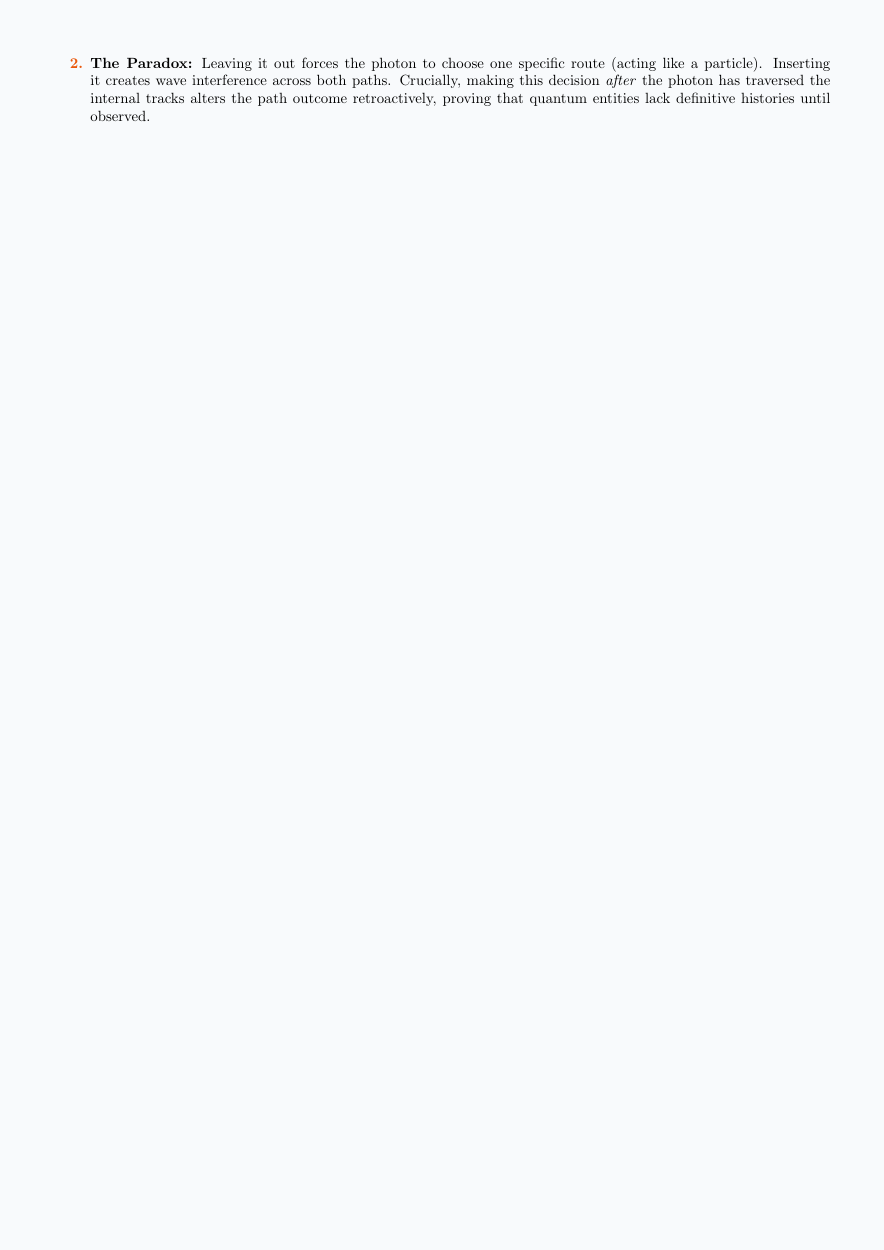
2. The Paradox: Leaving it out forces the photon to choose one specific route (acting like a particle). Inserting
it creates wave interference across both paths. Crucially, making this decision after the photon has traversed the
internal tracks alters the path outcome retroactively, proving that quantum entities lack definitive histories until
observed.