Mathematical fidelity: These page images preserve the exact notation and visual layout of the supplied PDF. The optional text extract below is for searching/copying only and may contain transcription errors.
Original pages — equations and symbols preserved
Show extracted text (searchable; equations may be imperfect)
Extract · PDF page 1
ELECTRODYNAMICS, MACROSCOPIC COHERENCE, & QUANTUM PHASE TRANSITIONS
SUPERCONDUCTING FEATURES
The Meissner Effect, Magnetic Flux Quantization, and Phase Coherence
Boundaries
An axiomatic mathematical guide detailing the macroscopic thermodynamic traits and field constraints of superconducting
phases.
Extract · PDF page 1
1. THE FOUNDATIONAL PARADOX: PERFECT CONDUCTOR VS. SUPERCON-
DUCTOR
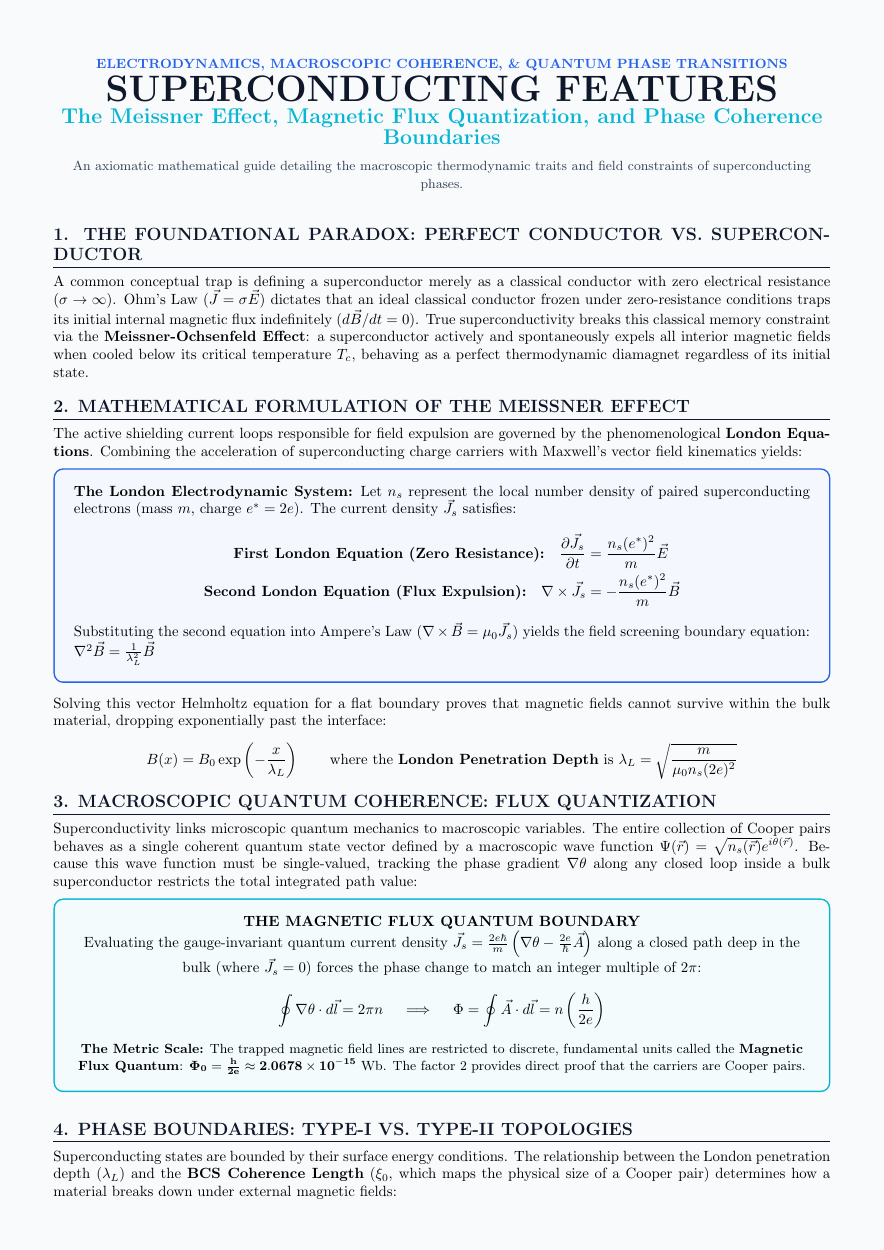
A common conceptual trap is defining a superconductor merely as a classical conductor with zero electrical resistance
(σ →∞). Ohm’s Law (⃗J = σ ⃗E) dictates that an ideal classical conductor frozen under zero-resistance conditions traps
its initial internal magnetic flux indefinitely (d⃗B/dt = 0). True superconductivity breaks this classical memory constraint
via the Meissner-Ochsenfeld Effect: a superconductor actively and spontaneously expels all interior magnetic fields
when cooled below its critical temperature Tc, behaving as a perfect thermodynamic diamagnet regardless of its initial
state.
Extract · PDF page 1
2. MATHEMATICAL FORMULATION OF THE MEISSNER EFFECT
The active shielding current loops responsible for field expulsion are governed by the phenomenological London Equa-
tions. Combining the acceleration of superconducting charge carriers with Maxwell’s vector field kinematics yields:
The London Electrodynamic System: Let ns represent the local number density of paired superconducting
electrons (mass m, charge e∗= 2e). The current density ⃗Js satisfies:
∂⃗Js ns(e∗)2 First London Equation (Zero Resistance): = ⃗E
∂t m
Second London Equation (Flux Expulsion): ∇× ⃗Js = −ns(e∗)2 ⃗B
m
Substituting the second equation into Ampere’s Law (∇× ⃗B = µ0 ⃗Js) yields the field screening boundary equation:
∇2 ⃗B = 1 ⃗B
λ2L
Solving this vector Helmholtz equation for a flat boundary proves that magnetic fields cannot survive within the bulk
material, dropping exponentially past the interface:
B(x) = B0 exp −x where the London Penetration Depth is λL = r m
λL µ0ns(2e)2
Extract · PDF page 1
3. MACROSCOPIC QUANTUM COHERENCE: FLUX QUANTIZATION
Superconductivity links microscopic quantum mechanics to macroscopic variables. The entire collection of Cooper pairs
behaves as a single coherent quantum state vector defined by a macroscopic wave function Ψ(⃗r) = p ns(⃗r)eiθ(⃗r). Be-
cause this wave function must be single-valued, tracking the phase gradient ∇θ along any closed loop inside a bulk
superconductor restricts the total integrated path value:
THE MAGNETIC FLUX QUANTUM BOUNDARY
Evaluating the gauge-invariant quantum current density ⃗Js = 2eℏm ∇θ −2eℏ⃗A along a closed path deep in the
bulk (where ⃗Js = 0) forces the phase change to match an integer multiple of 2π:
I I h
∇θ · d⃗l = 2πn =⇒ Φ = ⃗A · d⃗l = n
2e
The Metric Scale: The trapped magnetic field lines are restricted to discrete, fundamental units called the Magnetic
Flux Quantum: Φ0 = 2eh ≈2.0678 × 10⁻¹⁵ Wb. The factor 2 provides direct proof that the carriers are Cooper pairs.
Extract · PDF page 1
4. PHASE BOUNDARIES: TYPE-I VS. TYPE-II TOPOLOGIES
Superconducting states are bounded by their surface energy conditions. The relationship between the London penetration
depth (λL) and the BCS Coherence Length (ξ0, which maps the physical size of a Cooper pair) determines how a
material breaks down under external magnetic fields:
Extract · PDF page 2
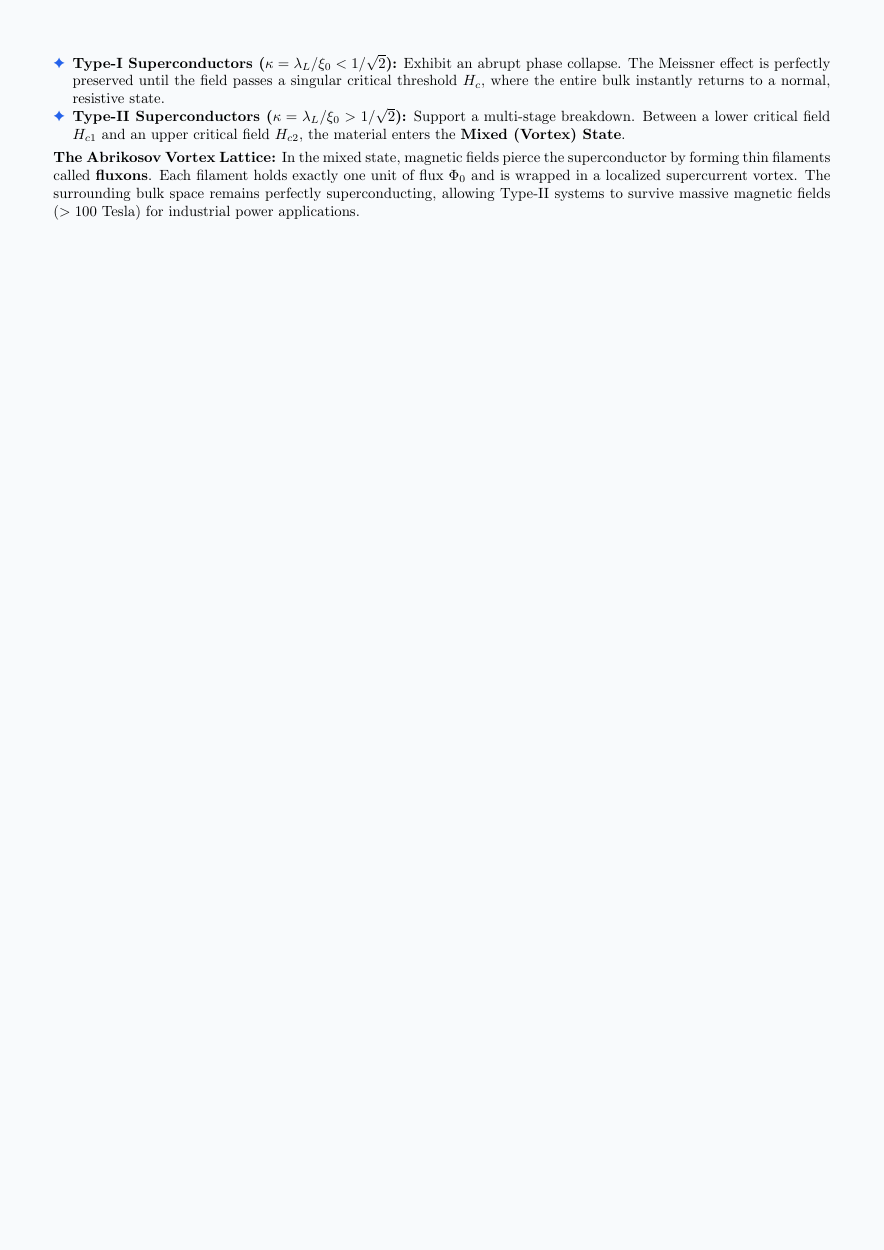
√
✦Type-I Superconductors (κ = λL/ξ0 < 1/ 2): Exhibit an abrupt phase collapse. The Meissner effect is perfectly
preserved until the field passes a singular critical threshold Hc, where the entire bulk instantly returns to a normal,
resistive state. √
✦Type-II Superconductors (κ = λL/ξ0 > 1/ 2): Support a multi-stage breakdown. Between a lower critical field
Hc1 and an upper critical field Hc2, the material enters the Mixed (Vortex) State.
The Abrikosov Vortex Lattice: In the mixed state, magnetic fields pierce the superconductor by forming thin filaments
called fluxons. Each filament holds exactly one unit of flux Φ0 and is wrapped in a localized supercurrent vortex. The
surrounding bulk space remains perfectly superconducting, allowing Type-II systems to survive massive magnetic fields
(> 100 Tesla) for industrial power applications.