Mathematical fidelity: These page images preserve the exact notation and visual layout of the supplied PDF. The optional text extract below is for searching/copying only and may contain transcription errors.
Original pages — equations and symbols preserved
Show extracted text (searchable; equations may be imperfect)
Extract · PDF page 1
GAUGE INVARIANCE, PHASE GEOMETRY, AND TOPOLOGICAL NON-LOCALITY
THE AHARONOV-BOHM EFFECT
Vector Potentials, Non-Local Gauge Phases, and Interlocking Field
Topology
An advanced mathematical guide detailing how electromagnetic potentials alter quantum wave phases in zero-field regions.
Extract · PDF page 1
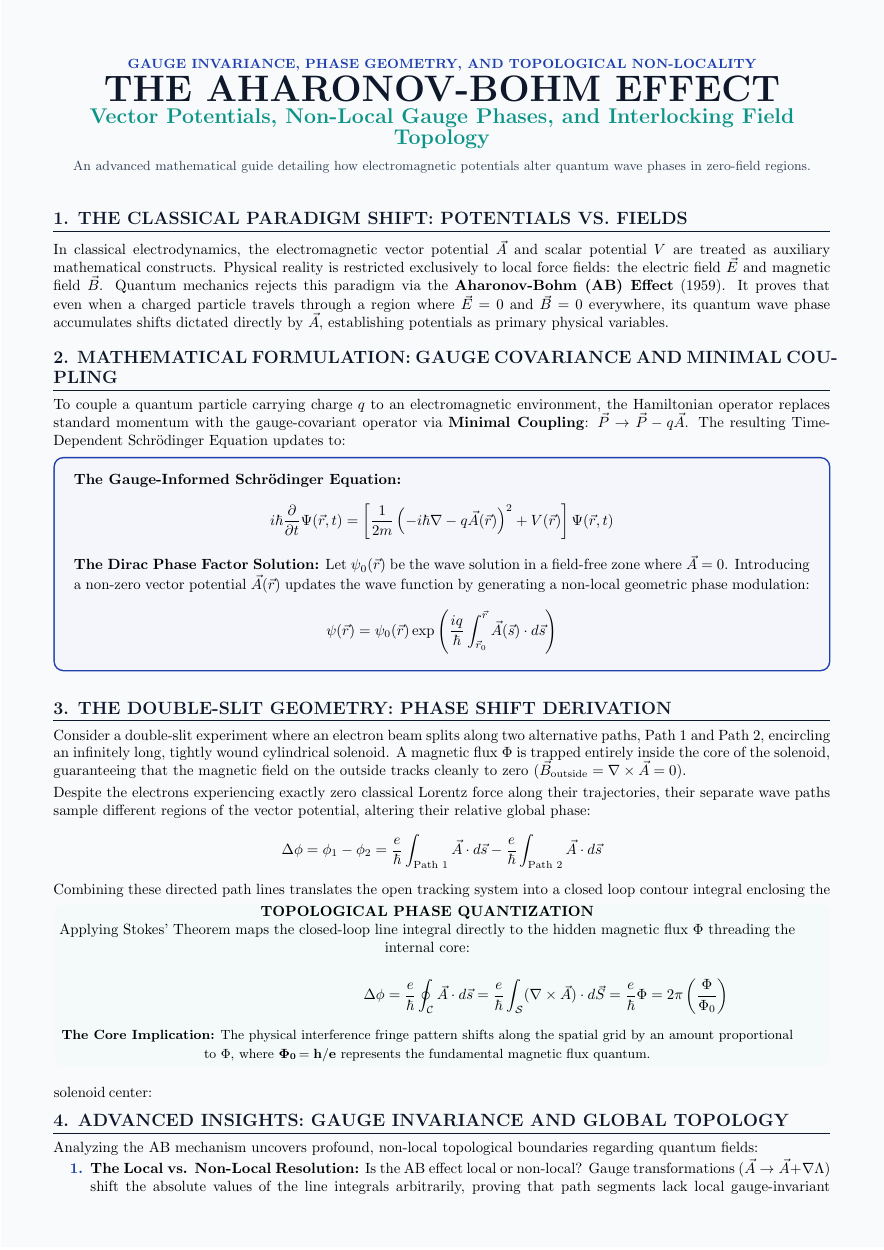
1. THE CLASSICAL PARADIGM SHIFT: POTENTIALS VS. FIELDS
In classical electrodynamics, the electromagnetic vector potential ⃗A and scalar potential V are treated as auxiliary
mathematical constructs. Physical reality is restricted exclusively to local force fields: the electric field ⃗E and magnetic
field ⃗B. Quantum mechanics rejects this paradigm via the Aharonov-Bohm (AB) Effect (1959). It proves that
even when a charged particle travels through a region where ⃗E = 0 and ⃗B = 0 everywhere, its quantum wave phase
accumulates shifts dictated directly by ⃗A, establishing potentials as primary physical variables.
Extract · PDF page 1
2. MATHEMATICAL FORMULATION: GAUGE COVARIANCE AND MINIMAL COU-
PLING
To couple a quantum particle carrying charge q to an electromagnetic environment, the Hamiltonian operator replaces
standard momentum with the gauge-covariant operator via Minimal Coupling: ⃗P →⃗P −q ⃗A. The resulting Time-
Dependent Schr¨odinger Equation updates to:
The Gauge-Informed Schr¨odinger Equation:
iℏ∂ t) = 1 −iℏ∇−q ⃗A(⃗r) 2 + V (⃗r) Ψ(⃗r, t) ∂tΨ(⃗r, 2m
The Dirac Phase Factor Solution: Let ψ0(⃗r) be the wave solution in a field-free zone where ⃗A = 0. Introducing
a non-zero vector potential ⃗A(⃗r) updates the wave function by generating a non-local geometric phase modulation:
⃗r ! iq Z
ψ(⃗r) = ψ0(⃗r) exp ⃗A(⃗s) · d⃗s ℏ
⃗r0
Extract · PDF page 1
3. THE DOUBLE-SLIT GEOMETRY: PHASE SHIFT DERIVATION
Consider a double-slit experiment where an electron beam splits along two alternative paths, Path 1 and Path 2, encircling
an infinitely long, tightly wound cylindrical solenoid. A magnetic flux Φ is trapped entirely inside the core of the solenoid,
guaranteeing that the magnetic field on the outside tracks cleanly to zero ( ⃗Boutside = ∇× ⃗A = 0).
Despite the electrons experiencing exactly zero classical Lorentz force along their trajectories, their separate wave paths
sample different regions of the vector potential, altering their relative global phase:
e Z Z ∆ϕ = ϕ1 −ϕ2 = ⃗A · d⃗s −e ⃗A · d⃗s ℏ ℏ
Path 1 Path 2
Combining these directed path lines translates the open tracking system into a closed loop contour integral enclosing the
TOPOLOGICAL PHASE QUANTIZATION
Applying Stokes’ Theorem maps the closed-loop line integral directly to the hidden magnetic flux Φ threading the
internal core:
e I e Z e Φ
∆ϕ = ⃗A · d⃗s = (∇× ⃗A) · d⃗S = = 2π ℏ ℏ ℏΦ C S Φ0
The Core Implication: The physical interference fringe pattern shifts along the spatial grid by an amount proportional
to Φ, where Φ 0 = h/e represents the fundamental magnetic flux quantum.
solenoid center:
Extract · PDF page 1
4. ADVANCED INSIGHTS: GAUGE INVARIANCE AND GLOBAL TOPOLOGY
Analyzing the AB mechanism uncovers profound, non-local topological boundaries regarding quantum fields:
1. The Local vs. Non-Local Resolution: Is the AB effect local or non-local? Gauge transformations ( ⃗A →⃗A+∇Λ)
shift the absolute values of the line integrals arbitrarily, proving that path segments lack local gauge-invariant
Extract · PDF page 2
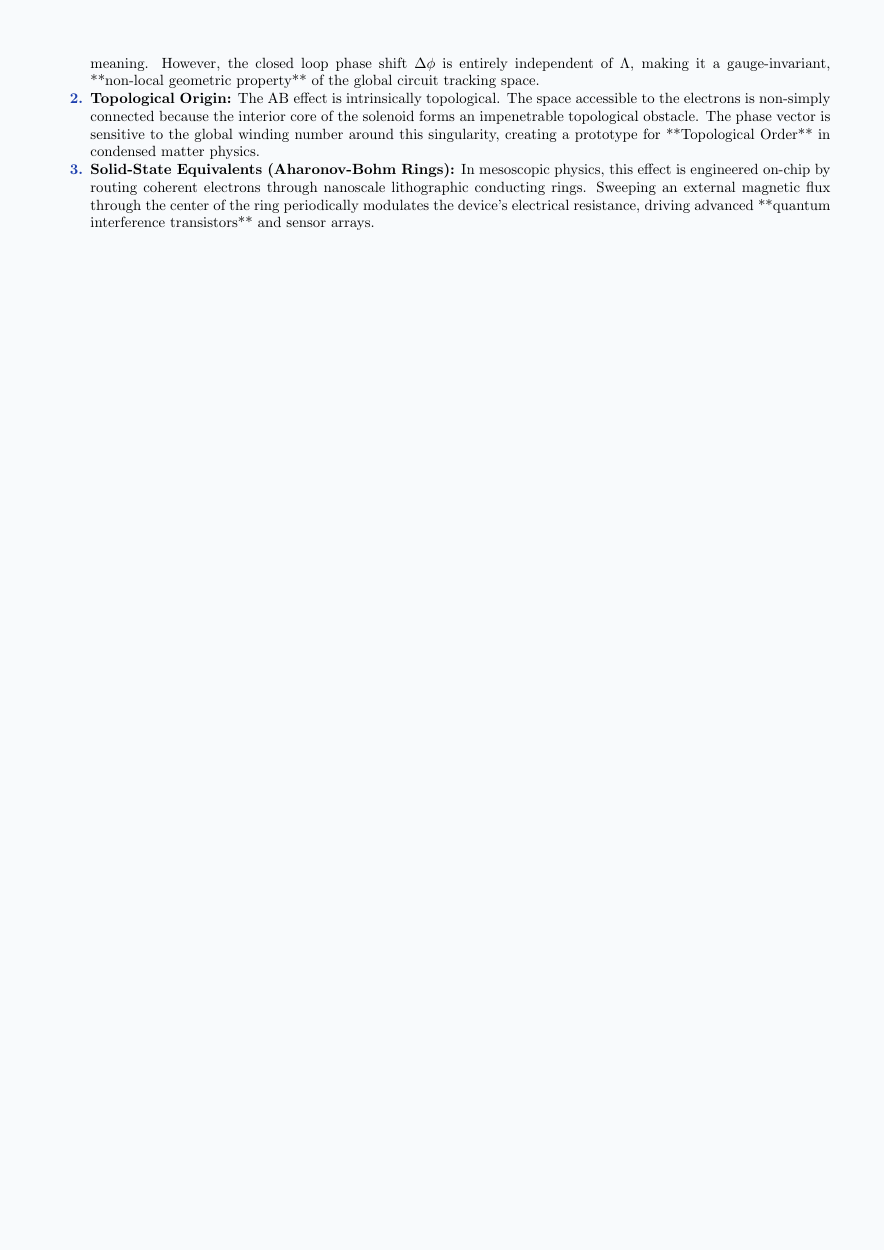
meaning. However, the closed loop phase shift ∆ϕ is entirely independent of Λ, making it a gauge-invariant,
**non-local geometric property** of the global circuit tracking space.
2. Topological Origin: The AB effect is intrinsically topological. The space accessible to the electrons is non-simply
connected because the interior core of the solenoid forms an impenetrable topological obstacle. The phase vector is
sensitive to the global winding number around this singularity, creating a prototype for **Topological Order** in
condensed matter physics.
3. Solid-State Equivalents (Aharonov-Bohm Rings): In mesoscopic physics, this effect is engineered on-chip by
routing coherent electrons through nanoscale lithographic conducting rings. Sweeping an external magnetic flux
through the center of the ring periodically modulates the device’s electrical resistance, driving advanced **quantum
interference transistors** and sensor arrays.