Mathematical fidelity: These page images preserve the exact notation and visual layout of the supplied PDF. The optional text extract below is for searching/copying only and may contain transcription errors.
Original pages — equations and symbols preserved
Show extracted text (searchable; equations may be imperfect)
Extract · PDF page 1
GEOMETRIC MAPPING OF TWO-LEVEL QUANTUM STATE SPACES
THE BLOCH SPHERE
Spherical Coordinates, Pure vs. Mixed States, and Universal Rotations
An axiomatic mathematical flyer mapping single-qubit kinematics directly onto a 3D unit sphere geometric layout.
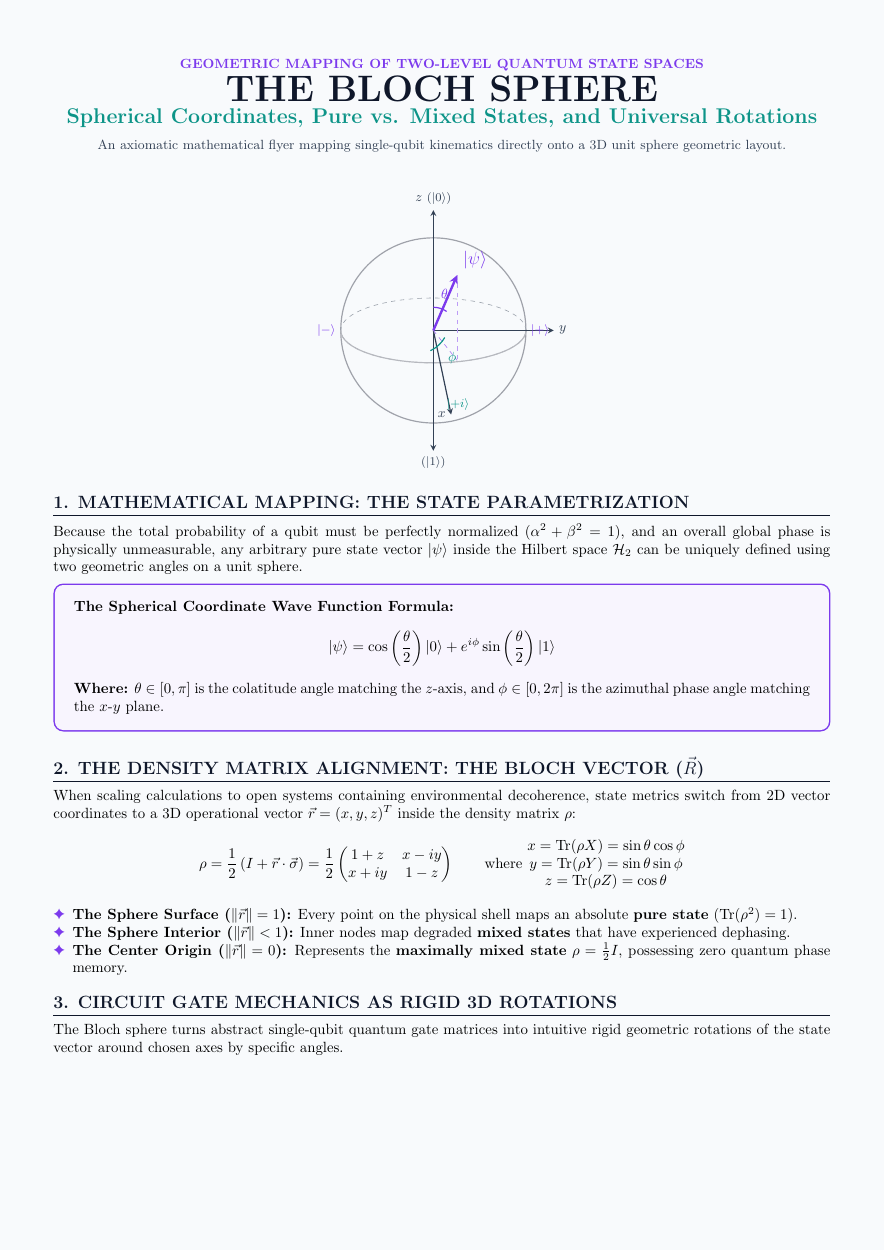
z (|0⟩)
|ψ⟩
θ
|−⟩ |+⟩ y
ϕ
|+i⟩
x
(|1⟩)
Extract · PDF page 1
1. MATHEMATICAL MAPPING: THE STATE PARAMETRIZATION
Because the total probability of a qubit must be perfectly normalized (α2 + β2 = 1), and an overall global phase is
physically unmeasurable, any arbitrary pure state vector |ψ⟩inside the Hilbert space H2 can be uniquely defined using
two geometric angles on a unit sphere.
The Spherical Coordinate Wave Function Formula:
θ θ
|ψ⟩= cos |0⟩+ eiϕ sin |1⟩
2 2
Where: θ ∈[0, π] is the colatitude angle matching the z-axis, and ϕ ∈[0, 2π] is the azimuthal phase angle matching
the x-y plane.
Extract · PDF page 1
2. THE DENSITY MATRIX ALIGNMENT: THE BLOCH VECTOR (⃗R)
When scaling calculations to open systems containing environmental decoherence, state metrics switch from 2D vector
coordinates to a 3D operational vector ⃗r = (x, y, z)T inside the density matrix ρ:
x = Tr(ρX) = sin θ cos ϕ
1 1 1 + z x −iy
ρ = (I + ⃗r · ⃗σ) = where y = Tr(ρY ) = sin θ sin ϕ
2 2 x + iy 1 −z
z = Tr(ρZ) = cos θ
✦The Sphere Surface (∥⃗r∥= 1): Every point on the physical shell maps an absolute pure state (Tr(ρ2) = 1).
✦The Sphere Interior (∥⃗r∥< 1): Inner nodes map degraded mixed states that have experienced dephasing.
✦The Center Origin (∥⃗r∥= 0): Represents the maximally mixed state ρ = 2I,1 possessing zero quantum phase
memory.
Extract · PDF page 1
3. CIRCUIT GATE MECHANICS AS RIGID 3D ROTATIONS
The Bloch sphere turns abstract single-qubit quantum gate matrices into intuitive rigid geometric rotations of the state
vector around chosen axes by specific angles.
Extract · PDF page 2
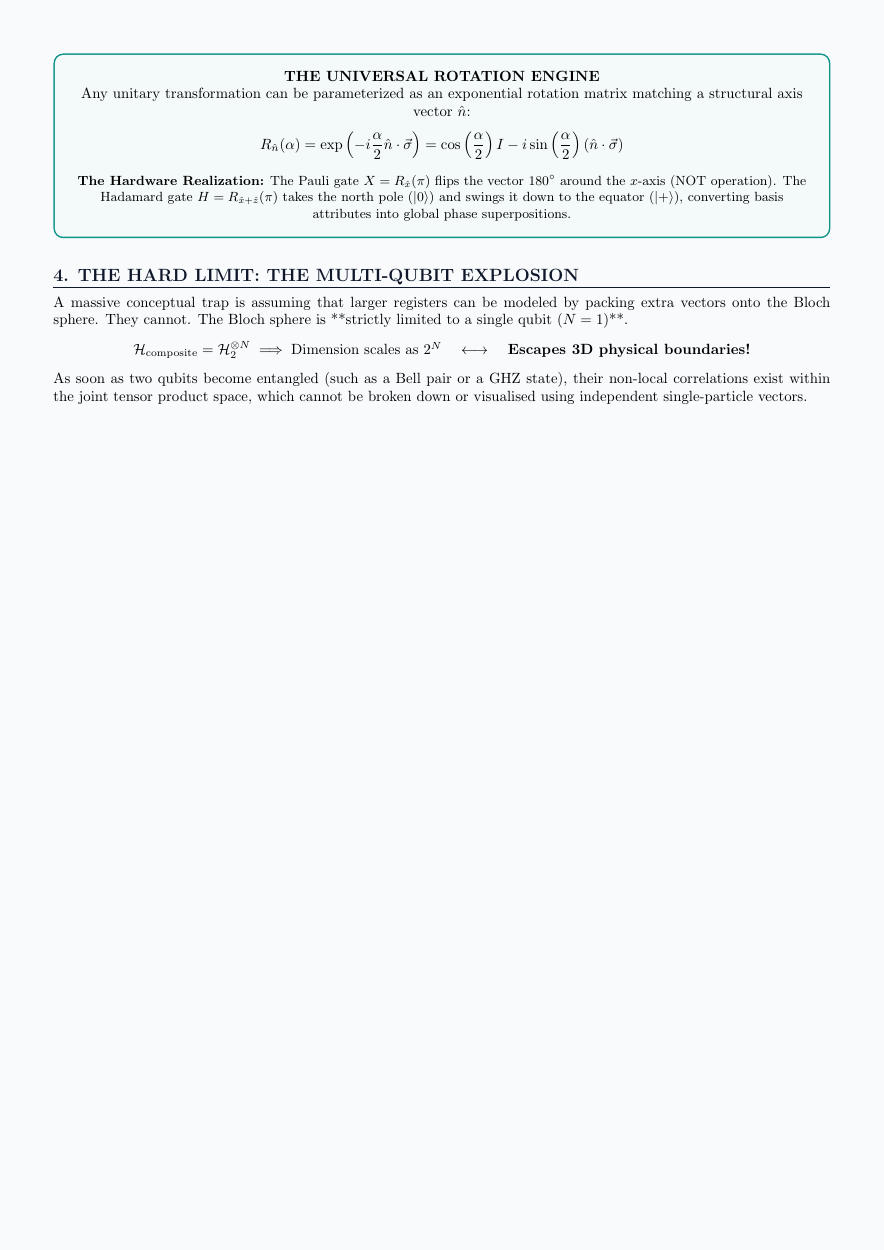
THE UNIVERSAL ROTATION ENGINE
Any unitary transformation can be parameterized as an exponential rotation matrix matching a structural axis
vector ˆn:
α α Rˆn(α) = exp −iα ˆn · ⃗σ = cos I −i sin (ˆn · ⃗σ)
2 2 2
The Hardware Realization: The Pauli gate X = Rˆx(π) flips the vector 180◦around the x-axis (NOT operation). The
Hadamard gate H = Rˆx+ˆz(π) takes the north pole (|0⟩) and swings it down to the equator (|+⟩), converting basis
attributes into global phase superpositions.
Extract · PDF page 2
4. THE HARD LIMIT: THE MULTI-QUBIT EXPLOSION
A massive conceptual trap is assuming that larger registers can be modeled by packing extra vectors onto the Bloch
sphere. They cannot. The Bloch sphere is **strictly limited to a single qubit (N = 1)**.
Hcomposite = H⊗N2 =⇒Dimension scales as 2N ←→ Escapes 3D physical boundaries!
As soon as two qubits become entangled (such as a Bell pair or a GHZ state), their non-local correlations exist within
the joint tensor product space, which cannot be broken down or visualised using independent single-particle vectors.