Mathematical fidelity: These page images preserve the exact notation and visual layout of the supplied PDF. The optional text extract below is for searching/copying only and may contain transcription errors.
Original pages — equations and symbols preserved
Show extracted text (searchable; equations may be imperfect)
Extract · PDF page 1
SOLVABLE HAMILTONIANS, ALGEBRAIC OPERATORS, & FIELD FOUNDATIONS
THE QUANTUM HARMONIC
OSCILLATOR
Canonical Quantization, Ladder Algebras, and Zero-Point Energy Fields
An axiomatic guide detailing the analytic, algebraic, and field-theoretic foundations of quadratic potentials.
Extract · PDF page 1
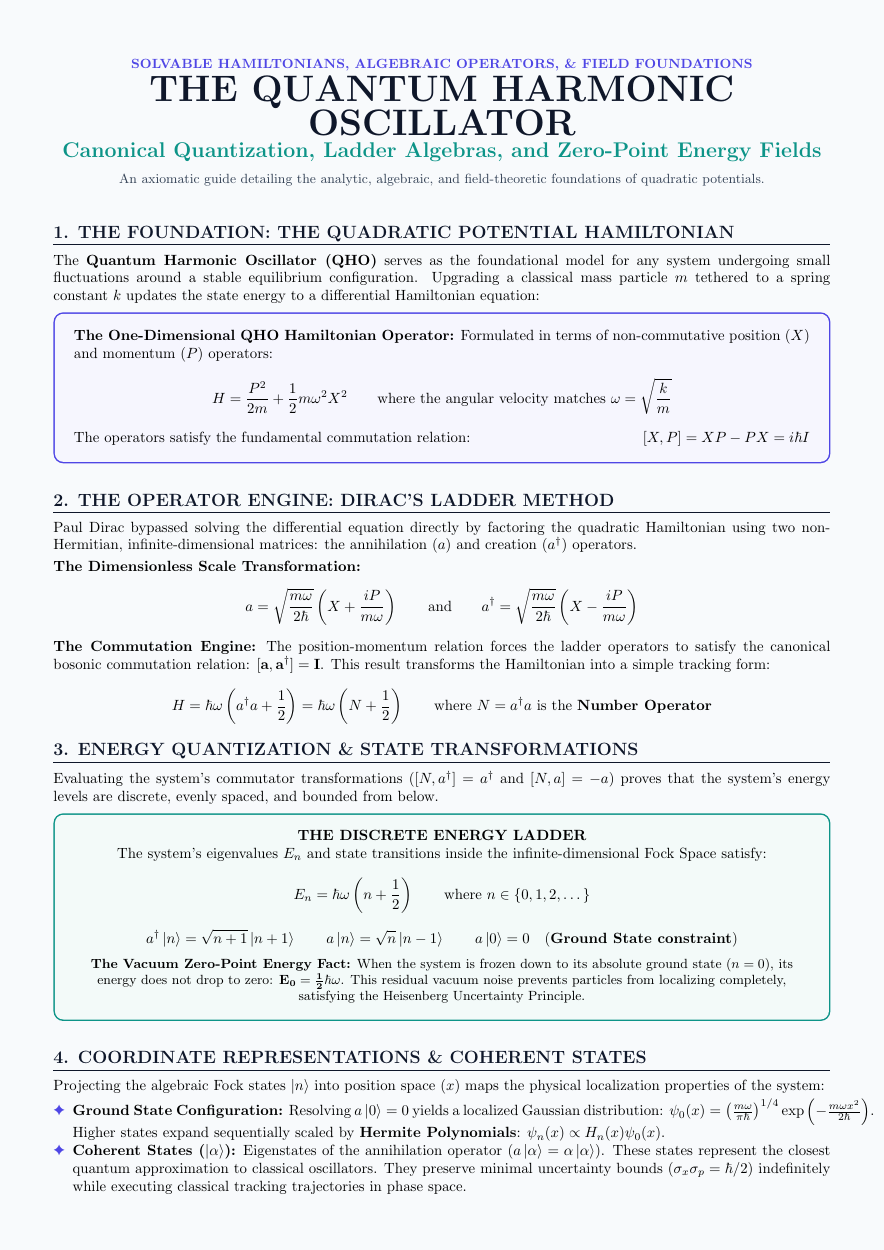
1. THE FOUNDATION: THE QUADRATIC POTENTIAL HAMILTONIAN
The Quantum Harmonic Oscillator (QHO) serves as the foundational model for any system undergoing small
fluctuations around a stable equilibrium configuration. Upgrading a classical mass particle m tethered to a spring
constant k updates the state energy to a differential Hamiltonian equation:
The One-Dimensional QHO Hamiltonian Operator: Formulated in terms of non-commutative position (X)
and momentum (P) operators:
P 2 1 r k
H = + where the angular velocity matches ω = 2m 2mω2X2 m
The operators satisfy the fundamental commutation relation: [X, P] = XP −PX = iℏI
Extract · PDF page 1
2. THE OPERATOR ENGINE: DIRAC’S LADDER METHOD
Paul Dirac bypassed solving the differential equation directly by factoring the quadratic Hamiltonian using two non-
Hermitian, infinite-dimensional matrices: the annihilation (a) and creation (a†) operators.
The Dimensionless Scale Transformation:
iP rmω rmω
X + and a† = X −iP a =
2ℏ mω 2ℏ mω
The Commutation Engine: The position-momentum relation forces the ladder operators to satisfy the canonical
bosonic commutation relation: [a, a†] = I. This result transforms the Hamiltonian into a simple tracking form:
1 1
H = ℏω a†a + = ℏω N + where N = a†a is the Number Operator
2 2
Extract · PDF page 1
3. ENERGY QUANTIZATION & STATE TRANSFORMATIONS
Evaluating the system’s commutator transformations ([N, a†] = a† and [N, a] = −a) proves that the system’s energy
levels are discrete, evenly spaced, and bounded from below.
THE DISCRETE ENERGY LADDER
The system’s eigenvalues En and state transitions inside the infinite-dimensional Fock Space satisfy:
1
En = ℏω n + where n ∈{0, 1, 2, . . . }
2
√ a† |n⟩= n + 1 |n + 1⟩ a |n⟩= √n |n −1⟩ a |0⟩= 0 (Ground State constraint)
The Vacuum Zero-Point Energy Fact: When the system is frozen down to its absolute ground state (n = 0), its
energy does not drop to zero: E0 = 12ℏω. This residual vacuum noise prevents particles from localizing completely,
satisfying the Heisenberg Uncertainty Principle.
Extract · PDF page 1
4. COORDINATE REPRESENTATIONS & COHERENT STATES
Projecting the algebraic Fock states |n⟩into position space (x) maps the physical localization properties of the system:
✦Ground State Configuration: Resolving a |0⟩= 0 yields a localized Gaussian distribution: ψ0(x) = mωπℏ 1/4 exp −mωx22ℏ .
Higher states expand sequentially scaled by Hermite Polynomials: ψn(x) ∝Hn(x)ψ0(x).
✦Coherent States (|α⟩): Eigenstates of the annihilation operator (a |α⟩= α |α⟩). These states represent the closest
quantum approximation to classical oscillators. They preserve minimal uncertainty bounds (σxσp = ℏ/2) indefinitely
while executing classical tracking trajectories in phase space.
Extract · PDF page 2
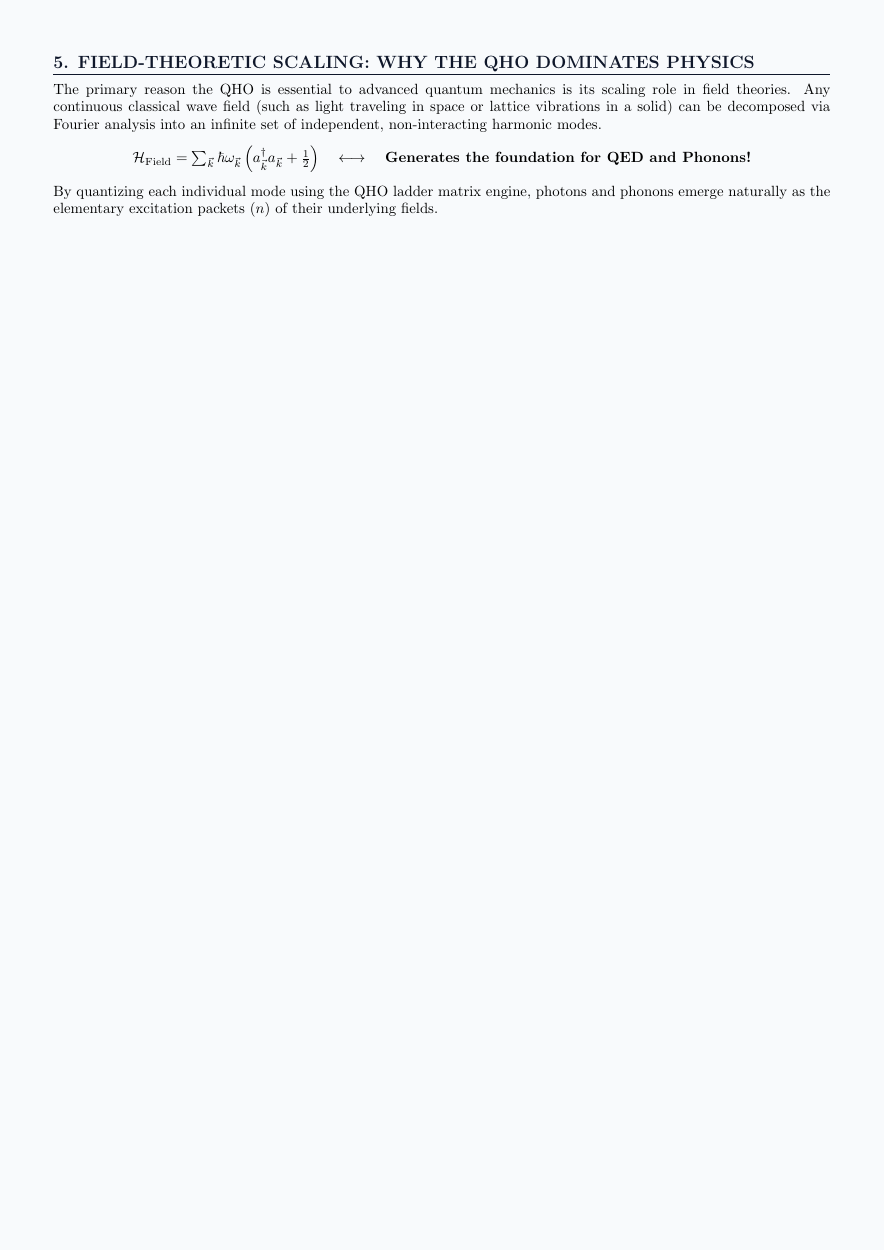
5. FIELD-THEORETIC SCALING: WHY THE QHO DOMINATES PHYSICS
The primary reason the QHO is essential to advanced quantum mechanics is its scaling role in field theories. Any
continuous classical wave field (such as light traveling in space or lattice vibrations in a solid) can be decomposed via
Fourier analysis into an infinite set of independent, non-interacting harmonic modes.
HField = P⃗k ℏω⃗k a†⃗ka⃗k + 21 ←→ Generates the foundation for QED and Phonons!
By quantizing each individual mode using the QHO ladder matrix engine, photons and phonons emerge naturally as the
elementary excitation packets (n) of their underlying fields.