Mathematical fidelity: These page images preserve the exact notation and visual layout of the supplied PDF. The optional text extract below is for searching/copying only and may contain transcription errors.
Original pages — equations and symbols preserved
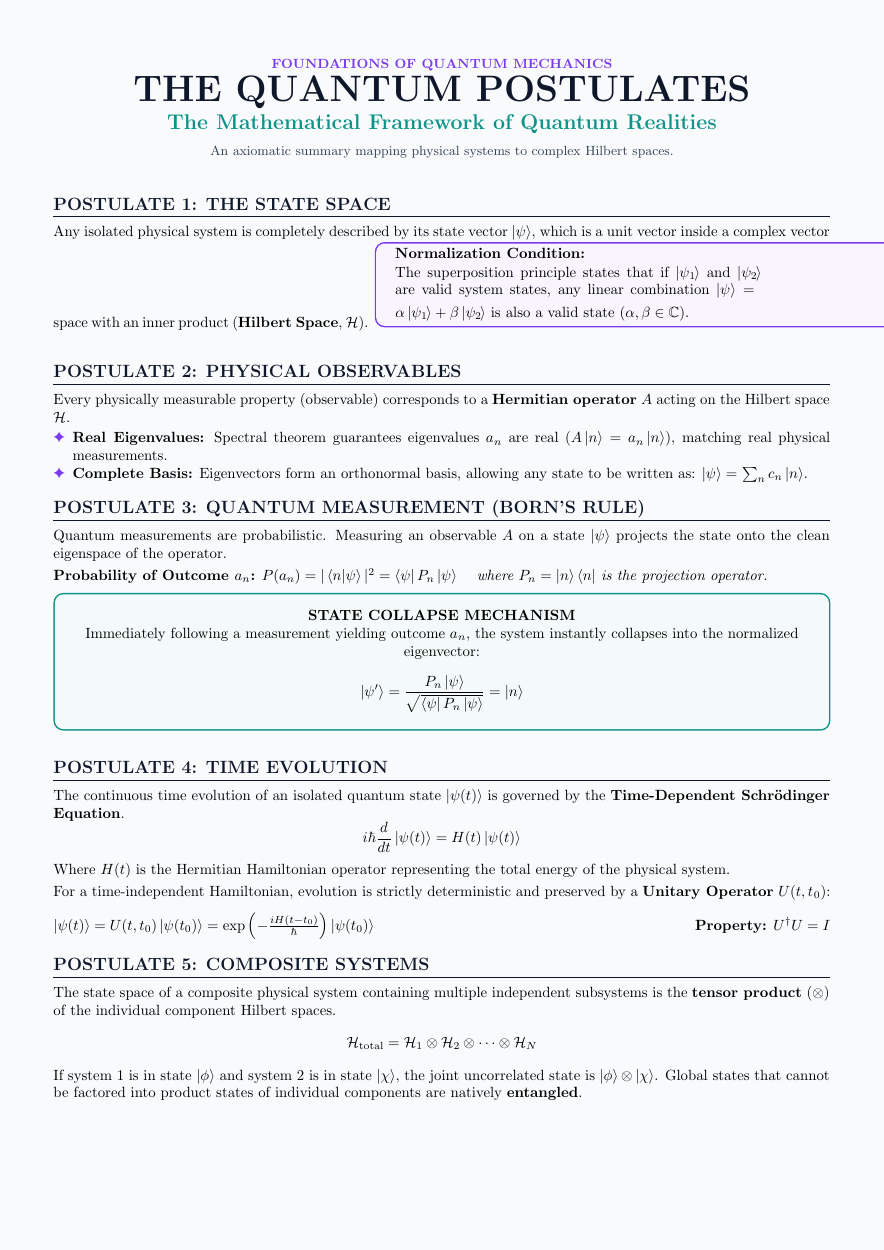
Show extracted text (searchable; equations may be imperfect)
Extract · PDF page 1
FOUNDATIONS OF QUANTUM MECHANICS
THE QUANTUM POSTULATES
The Mathematical Framework of Quantum Realities
An axiomatic summary mapping physical systems to complex Hilbert spaces.
POSTULATE 1: THE STATE SPACE
Any isolated physical system is completely described by its state vector |ψ⟩, which is a unit vector inside a complex vector
Normalization Condition:
The superposition principle states that if |ψ 1⟩ and |ψ 2⟩
are valid system states, any linear combination |ψ ⟩ =
α |ψ 1⟩ + β |ψ 2⟩ is also a valid state (α, β ∈ C ).
space with an inner product (Hilbert Space, H).
POSTULATE 2: PHYSICAL OBSERVABLES
Every physically measurable property (observable) corresponds to a Hermitian operator A acting on the Hilbert space
H.
✦Real Eigenvalues: Spectral theorem guarantees eigenvalues an are real (A |n⟩= an |n⟩), matching real physical
measurements.
✦Complete Basis: Eigenvectors form an orthonormal basis, allowing any state to be written as: |ψ⟩= Pn cn |n⟩.
POSTULATE 3: QUANTUM MEASUREMENT (BORN’S RULE)
Quantum measurements are probabilistic. Measuring an observable A on a state |ψ⟩projects the state onto the clean
eigenspace of the operator.
Probability of Outcome an: P(an) = | ⟨n|ψ⟩|2 = ⟨ψ| Pn |ψ⟩ where Pn = |n⟩⟨n| is the projection operator.
STATE COLLAPSE MECHANISM
Immediately following a measurement yielding outcome an, the system instantly collapses into the normalized
eigenvector:
Pn |ψ⟩ |ψ′⟩= = |n⟩
p ⟨ψ| Pn |ψ⟩
POSTULATE 4: TIME EVOLUTION
The continuous time evolution of an isolated quantum state |ψ(t)⟩is governed by the Time-Dependent Schr¨odinger
Equation.
iℏd |ψ(t)⟩= H(t) |ψ(t)⟩
dt
Where H(t) is the Hermitian Hamiltonian operator representing the total energy of the physical system.
For a time-independent Hamiltonian, evolution is strictly deterministic and preserved by a Unitary Operator U(t, t0):
|ψ(t)⟩= U(t, t0) |ψ(t0)⟩= exp −iH(t−t0)ℏ |ψ(t0)⟩ Property: U †U = I
POSTULATE 5: COMPOSITE SYSTEMS
The state space of a composite physical system containing multiple independent subsystems is the tensor product (⊗)
of the individual component Hilbert spaces.
Htotal = H1 ⊗H2 ⊗· · · ⊗HN
If system 1 is in state |ϕ⟩and system 2 is in state |χ⟩, the joint uncorrelated state is |ϕ⟩⊗|χ⟩. Global states that cannot
be factored into product states of individual components are natively entangled.