Mathematical fidelity: These page images preserve the exact notation and visual layout of the supplied PDF. The optional text extract below is for searching/copying only and may contain transcription errors.
Original pages — equations and symbols preserved
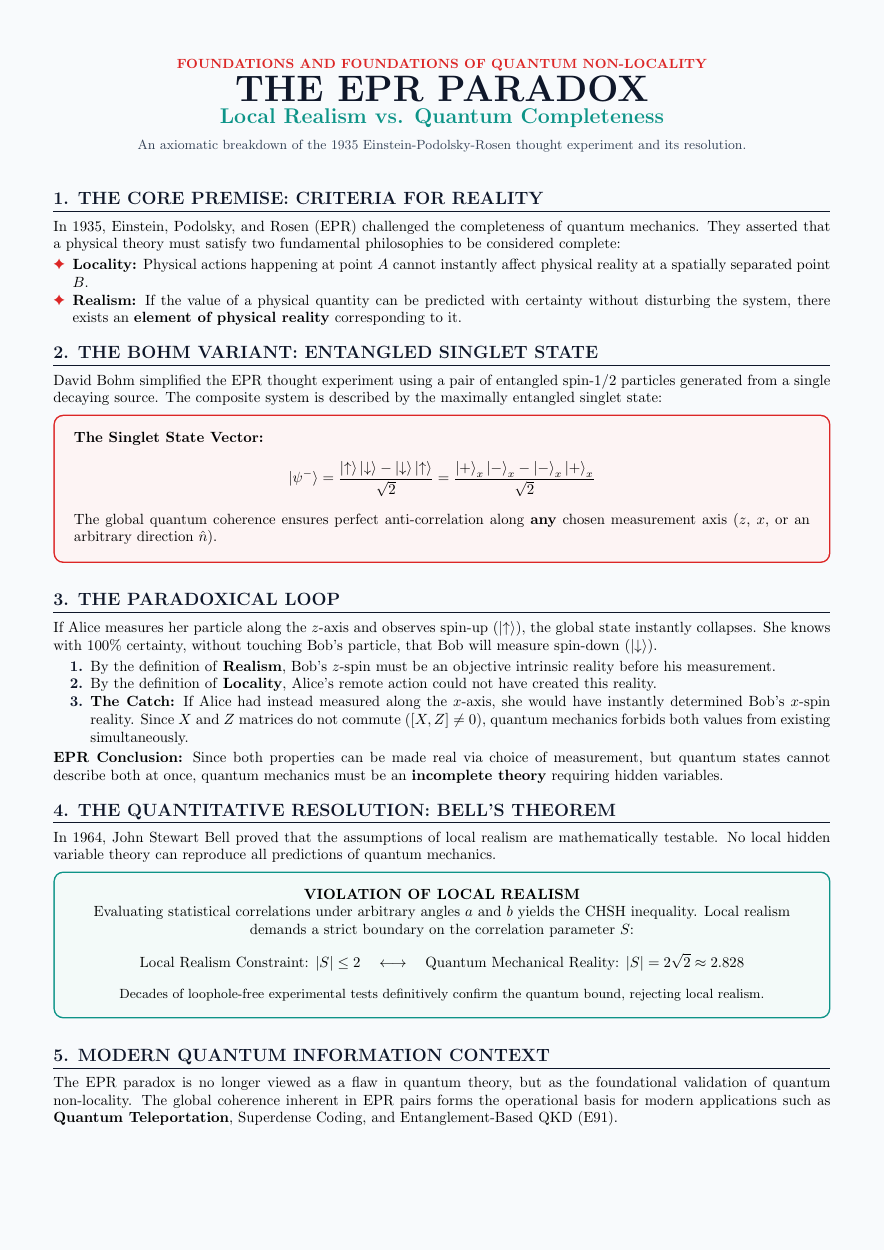
Show extracted text (searchable; equations may be imperfect)
Extract · PDF page 1
FOUNDATIONS AND FOUNDATIONS OF QUANTUM NON-LOCALITY
THE EPR PARADOX
Local Realism vs. Quantum Completeness
An axiomatic breakdown of the 1935 Einstein-Podolsky-Rosen thought experiment and its resolution.
Extract · PDF page 1
1. THE CORE PREMISE: CRITERIA FOR REALITY
In 1935, Einstein, Podolsky, and Rosen (EPR) challenged the completeness of quantum mechanics. They asserted that
a physical theory must satisfy two fundamental philosophies to be considered complete:
✦Locality: Physical actions happening at point A cannot instantly affect physical reality at a spatially separated point
B.
✦Realism: If the value of a physical quantity can be predicted with certainty without disturbing the system, there
exists an element of physical reality corresponding to it.
Extract · PDF page 1
2. THE BOHM VARIANT: ENTANGLED SINGLET STATE
David Bohm simplified the EPR thought experiment using a pair of entangled spin-1/2 particles generated from a single
decaying source. The composite system is described by the maximally entangled singlet state:
The Singlet State Vector:
|↑⟩|↓⟩−|↓⟩|↑⟩ |+⟩x |−⟩x −|−⟩x |+⟩x |ψ−⟩= √ = √
2 2
The global quantum coherence ensures perfect anti-correlation along any chosen measurement axis (z, x, or an
arbitrary direction ˆn).
Extract · PDF page 1
3. THE PARADOXICAL LOOP
If Alice measures her particle along the z-axis and observes spin-up (|↑⟩), the global state instantly collapses. She knows
with 100% certainty, without touching Bob’s particle, that Bob will measure spin-down (|↓⟩).
1. By the definition of Realism, Bob’s z-spin must be an objective intrinsic reality before his measurement.
Extract · PDF page 1
2. By the definition of Locality, Alice’s remote action could not have created this reality.
3. The Catch: If Alice had instead measured along the x-axis, she would have instantly determined Bob’s x-spin
reality. Since X and Z matrices do not commute ([X, Z] ̸= 0), quantum mechanics forbids both values from existing
simultaneously.
EPR Conclusion: Since both properties can be made real via choice of measurement, but quantum states cannot
describe both at once, quantum mechanics must be an incomplete theory requiring hidden variables.
Extract · PDF page 1
4. THE QUANTITATIVE RESOLUTION: BELL’S THEOREM
In 1964, John Stewart Bell proved that the assumptions of local realism are mathematically testable. No local hidden
variable theory can reproduce all predictions of quantum mechanics.
VIOLATION OF LOCAL REALISM
Evaluating statistical correlations under arbitrary angles a and b yields the CHSH inequality. Local realism
demands a strict boundary on the correlation parameter S:
√
Local Realism Constraint: |S| ≤2 ←→ Quantum Mechanical Reality: |S| = 2 2 ≈2.828
Decades of loophole-free experimental tests definitively confirm the quantum bound, rejecting local realism.
Extract · PDF page 1
5. MODERN QUANTUM INFORMATION CONTEXT
The EPR paradox is no longer viewed as a flaw in quantum theory, but as the foundational validation of quantum
non-locality. The global coherence inherent in EPR pairs forms the operational basis for modern applications such as
Quantum Teleportation, Superdense Coding, and Entanglement-Based QKD (E91).