Mathematical fidelity: These page images preserve the exact notation and visual layout of the supplied PDF. The optional text extract below is for searching/copying only and may contain transcription errors.
Original pages — equations and symbols preserved
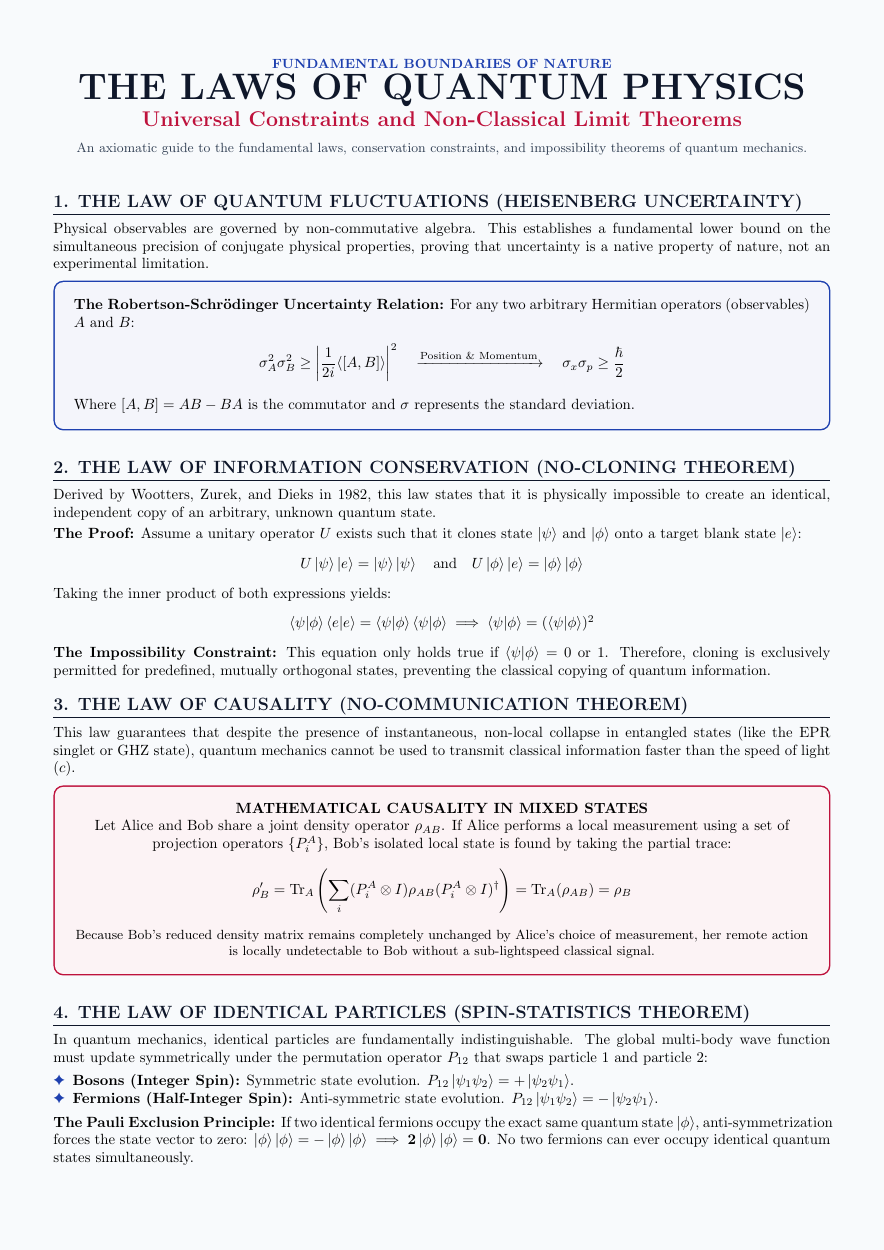
Show extracted text (searchable; equations may be imperfect)
Extract · PDF page 1
FUNDAMENTAL BOUNDARIES OF NATURE
THE LAWS OF QUANTUM PHYSICS
Universal Constraints and Non-Classical Limit Theorems
An axiomatic guide to the fundamental laws, conservation constraints, and impossibility theorems of quantum mechanics.
Extract · PDF page 1
1. THE LAW OF QUANTUM FLUCTUATIONS (HEISENBERG UNCERTAINTY)
Physical observables are governed by non-commutative algebra. This establishes a fundamental lower bound on the
simultaneous precision of conjugate physical properties, proving that uncertainty is a native property of nature, not an
experimental limitation.
The Robertson-Schr¨odinger Uncertainty Relation: For any two arbitrary Hermitian operators (observables)
A and B:
1 2 Position & Momentum σ2Aσ2B ≥ B]⟩ −−−−−−−−−−−−−−→ σxσp ≥ℏ 2i⟨[A, 2
Where [A, B] = AB −BA is the commutator and σ represents the standard deviation.
Extract · PDF page 1
2. THE LAW OF INFORMATION CONSERVATION (NO-CLONING THEOREM)
Derived by Wootters, Zurek, and Dieks in 1982, this law states that it is physically impossible to create an identical,
independent copy of an arbitrary, unknown quantum state.
The Proof: Assume a unitary operator U exists such that it clones state |ψ⟩and |ϕ⟩onto a target blank state |e⟩:
U |ψ⟩|e⟩= |ψ⟩|ψ⟩ and U |ϕ⟩|e⟩= |ϕ⟩|ϕ⟩
Taking the inner product of both expressions yields:
⟨ψ|ϕ⟩⟨e|e⟩= ⟨ψ|ϕ⟩⟨ψ|ϕ⟩=⇒⟨ψ|ϕ⟩= (⟨ψ|ϕ⟩)2
The Impossibility Constraint: This equation only holds true if ⟨ψ|ϕ⟩= 0 or 1. Therefore, cloning is exclusively
permitted for predefined, mutually orthogonal states, preventing the classical copying of quantum information.
Extract · PDF page 1
3. THE LAW OF CAUSALITY (NO-COMMUNICATION THEOREM)
This law guarantees that despite the presence of instantaneous, non-local collapse in entangled states (like the EPR
singlet or GHZ state), quantum mechanics cannot be used to transmit classical information faster than the speed of light
(c).
MATHEMATICAL CAUSALITY IN MIXED STATES
Let Alice and Bob share a joint density operator ρAB. If Alice performs a local measurement using a set of
projection operators {PiA }, Bob’s isolated local state is found by taking the partial trace:
!
ρ′B = TrA X(PiA ⊗I)ρAB(PiA ⊗I)† = TrA(ρAB) = ρB
i
Because Bob’s reduced density matrix remains completely unchanged by Alice’s choice of measurement, her remote action
is locally undetectable to Bob without a sub-lightspeed classical signal.
Extract · PDF page 1
4. THE LAW OF IDENTICAL PARTICLES (SPIN-STATISTICS THEOREM)
In quantum mechanics, identical particles are fundamentally indistinguishable. The global multi-body wave function
must update symmetrically under the permutation operator P12 that swaps particle 1 and particle 2:
✦Bosons (Integer Spin): Symmetric state evolution. P12 |ψ1ψ2⟩= + |ψ2ψ1⟩.
✦Fermions (Half-Integer Spin): Anti-symmetric state evolution. P12 |ψ1ψ2⟩= −|ψ2ψ1⟩.
The Pauli Exclusion Principle: If two identical fermions occupy the exact same quantum state |ϕ⟩, anti-symmetrization
forces the state vector to zero: |ϕ⟩|ϕ⟩= −|ϕ⟩|ϕ⟩=⇒2 |ϕ⟩|ϕ⟩= 0. No two fermions can ever occupy identical quantum
states simultaneously.